Rebar tying, prefabricated cage welding, embed-plate stitching, and on-site splicing are the four concrete-side arc-welding tasks buyers actually procure for, and each is gated by a different combination of process, current, duty cycle, and supply architecture [S1][S5]. Chinese B2B catalogs published in July 2026 show entry-level 100 A inverter MMA units at US$34 per piece at 100-piece MOQ, mid-range industrial sets at US$425–7,000 per piece, and automated inverter welding systems with integrated wire feed and CNC interfaces at US$14,800–296,300 per set [S4].
Concrete work sits between field carpentry and structural fabrication: the loads are static, the steels are usually lower-carbon rebar (ASTM A615 Grade 60, 420 MPa yield class) plus the occasional embed plate, and the joints are short, repetitive, and almost always in awkward positions. That profile is what makes stick (SMAW) the default, and what makes SAW a niche choice reserved for prefabrication yards, not site work [S1][S6].
Process family: which arc method for which concrete task
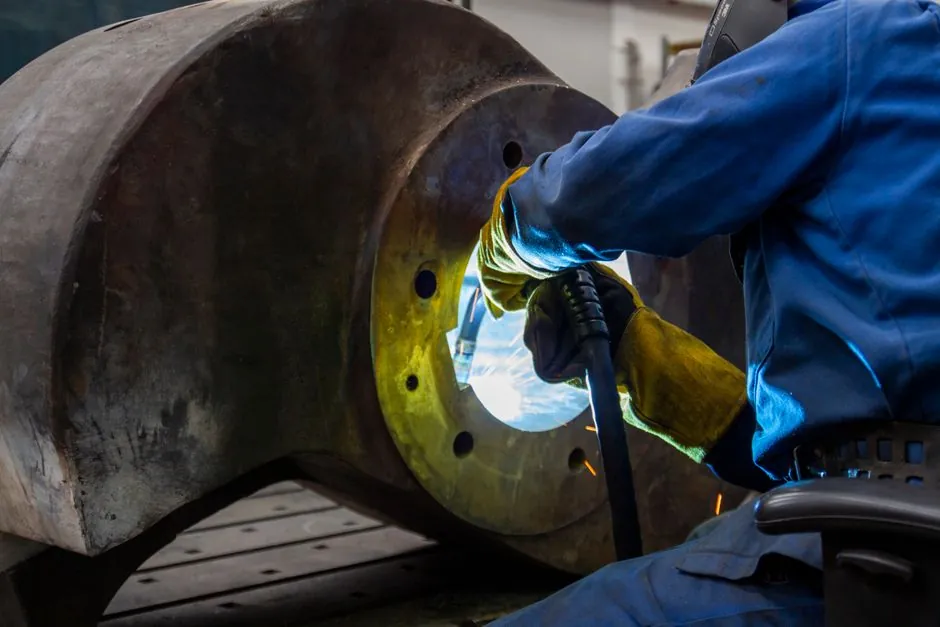
Shielded Metal Arc Welding (SMAW, "stick") dominates portable inverter catalogs on m.ecvv.com because the flux-coated electrode tolerates dirty, rusty rebar and works on a 220 V single-phase site supply [S5]. For on-site rebar splicing and embed-plate fillet welds, a 160–250 A portable inverter stick unit is the typical 2026 specification, and the entry-tier 120–200 A bracket covers 1.6–3.2 mm rutile and basic electrodes on 1.5–6 mm steel with stated duty cycles of 60% at 200 A on the upper end of consumer-grade product listings [S4].
Submerged Arc Welding (SAW) is the correct choice only when the cage or embedment is moved to a fixed jig in a prefabrication yard, where the granular flux bed, dust extraction, and three-phase 380 V supply are actually available, and where long straight seams justify the high deposition rate. A multihead automatic arc welding cell with a 400 x 200 mm X-Y-Z travel on rail gauges between 1420–1472 mm that complies with NF EN 13977 illustrates the floor-level workflow SAW demands [S1]. Gas Metal Arc (GMAW/MIG) and Flux-Cored Arc (FCAW) sit in between, and are increasingly specified for production cage lines where the operator can stay inside a fume-extraction booth; cross-process detail lives in the arc welder encyclopedia entry.
Output amperage, duty cycle, and electrode diameter
Continuous output current caps both plate thickness and rod diameter in one number, and 2026 wholesale bands cluster portable inverters at 120–250 A for MMA work, mid-range industrial sets at 250–350 A, and heavy fabrication AC transformer sets at 400–500 A for thick plate [S4]. For concrete-side work the realistic sweet spot is the 200–350 A bracket, because rebar diameters from 10 mm (No. 3) to 25 mm (No. 8) cross the common embed-plate range of 6–15 mm that a 250–350 A inverter handles with 2.5–5.0 mm electrodes at 60% duty cycle or better [S4].
Duty cycle must be stated as a percentage at a stated current and ambient (typically 40°C), because the thermal limit is what actually limits productivity on long cage seams. A 60% duty cycle at 250 A is not the same machine as a 60% duty cycle at 400 A, and a bare "200 A welder" without a duty rating is a red flag when cages run two-shift production [S4][S5]. A 50.0 kg per piece WSE-series inverter DC argon-arc unit, for example, is floor-standing rather than site-portable because it carries a higher continuous-current rating, and that weight differential is a proxy for duty cycle headroom [S5].
Input supply, phase, and grid compatibility
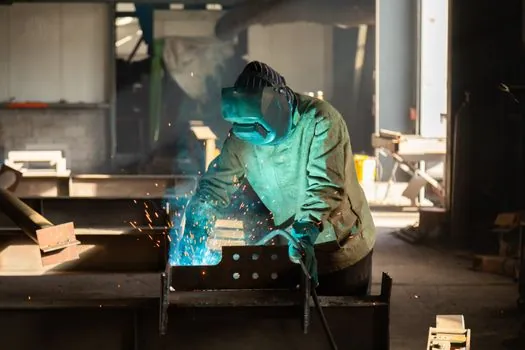
Input phase is a hard gate. Chinese portable-inverter SKUs are predominantly 220 V single-phase 50/60 Hz to suit site generators and small-shop distribution, while multihead automatic arc welding cells and submerged-arc installations are three-phase 380 V industrial supplies, and mating the two architectures is a wiring fault, not a preference [S5]. Mating a three-phase SAW head to a single-phase socket will not run; mating a single-phase stick inverter to a site with no neutral will trip the input rectifier [S5].
For plants standardising on 380 V three-phase, a WSE-class inverter DC argon-arc or a multihead robotic system on the same bus simplifies spares, breakers, and EMC filtering. For rebar tying, embed-plate work, and any cast-in-place site, the 220 V portable inverter remains the only realistic option, and the 1-piece MOQ model on m.ecvv.com is a typical sourcing format for contractors buying 10 to 50 units per year [S5]. Buyers weighing this gate against adjacent equipment, such as a portable welding cutting tool for rebar trimming before fit-up, will find the same 220 V single-phase rule applies.
AC transformer vs DC inverter: a criteria comparison for concrete work
AC transformer arc welding machines listed on Made-in-China cluster at US$425–7,000 per piece at 1-piece MOQ, weigh 80–150 kg for a 300 A class unit, tolerate generator input and harsh site conditions, but consume roughly 1.5× the input kVA per amp of weld output versus an inverter, and do not support DC-only processes such as cellulose 6010 pipe welding at high quality [S4]. Inverter DC sets weigh 5–25 kg across the 120–250 A portable class, hit 80–85% electrical efficiency versus 50–60% for transformer sets, and support a wider electrode mix (6010, 7018, 308L, low-hydrogen) at cleaner arc stability [S4].
The decision rule for concrete work is straightforward. Pick AC transformer for prefabrication yards running 400–500 A above 15 mm plate where the floor weight is not the limiter, and pick inverter for portable, low-spatter, and DC-only rebar splicing below 350 A, which is essentially every cast-in-place site in the catalogue [S4][S5]. For embed-plate fillets against concrete forms, a 200–250 A inverter with a Hot Start and Arc Force control is the workhorse spec, because the start-and-stop frequency on stitch welds is what punishes a thermally limited machine.
Standards, conformity, and the spec line a buyer should demand
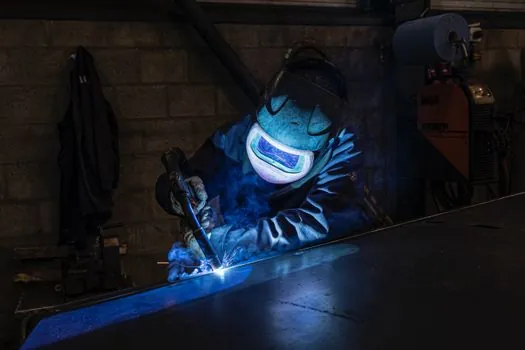
The standards that govern arc welding equipment selection in 2026 are mostly process and quality rather than product safety: EN ISO 3834 sets fusion-welding quality requirements for fabricators, EN ISO 25980 covers transparent welding curtains for arc-radiation protection, and NF EN 13977 governs rail-welding machinery safety, which is the same conformity line a concrete-side rebar cage welder should look for when buying automated cells [S1]. For site work, the aerial work platform used to reach rebar mats at height is governed by a different conformity chain, but the arc source feeding the operator follows the same EN ISO 3834 quality line.
A 2026 spec line worth demanding on a portable inverter datasheet reads: "200 A DC MMA/GTAW, 220 V single-phase 50/60 Hz, 60% duty cycle at 200 A and 40°C ambient, electrode diameter 1.6–4.0 mm, weight under 12 kg, EN ISO 3834 fabrication conformity, OCV below 24 V (VRD) for site safety". An entry-tier Chinese portable inverter in the 120–200 A bracket with that datasheet pattern sits under US$200 per piece at 100-piece MOQ, and that is the price point the concrete rebar market actually pays for site tying work [S4].
Use cases, failure modes, and what to skip
The concrete-side buyer should skip three things: any "200 A welder" without a stated duty cycle and ambient, any three-phase SAW head quoted for a single-phase site, and any inverter without a VRD (voltage reduction device) for operator safety in damp rebar-mat environments. Hot Start, Arc Force, and anti-stick are the three controls that materially affect rebar splicing productivity, and remote-control compatibility matters once the welder sits next to an aerial work truck on a slab pour [S2][S4].
The four concrete use cases map cleanly to four machine archetypes. Site rebar tying and embed-plate fillets: 200–250 A portable inverter stick, 220 V single-phase. Prefabrication cage production: 350–500 A inverter or transformer stick, three-phase 380 V, 60% duty or better. Long straight seam cages in a yard: SAW gantry with flux recovery, three-phase, dust extraction. Robotic cage cells in tier-1 precast plants: multihead automatic arc welding system, three-phase, CNC interface, with 1-piece MOQ inverter welders at US$14,800–296,300 per set at the top of the Made-in-China band [S4][S5].
For buyers tracking this space, the verifiable next nodes are the 2026 Q3 EN ISO 3834 conformity audit cycle for fabrication shops and the ongoing shift of portable inverter SKUs from 1-piece to 100-piece MOQ on Chinese B2B portals, which is a price-pressure signal on entry-tier 120–200 A units. Field signal to watch: whether the 1-piece MOQ inverter SKU on m.ecvv.com drops below the US$34 floor in the next catalogue refresh, which would reset the entry price for site rebar welders across the contractor market [S4][S5].
Related analysis: Sand Blasting Machine Picks for Lighting Fixtures: 2026 Spec Map.