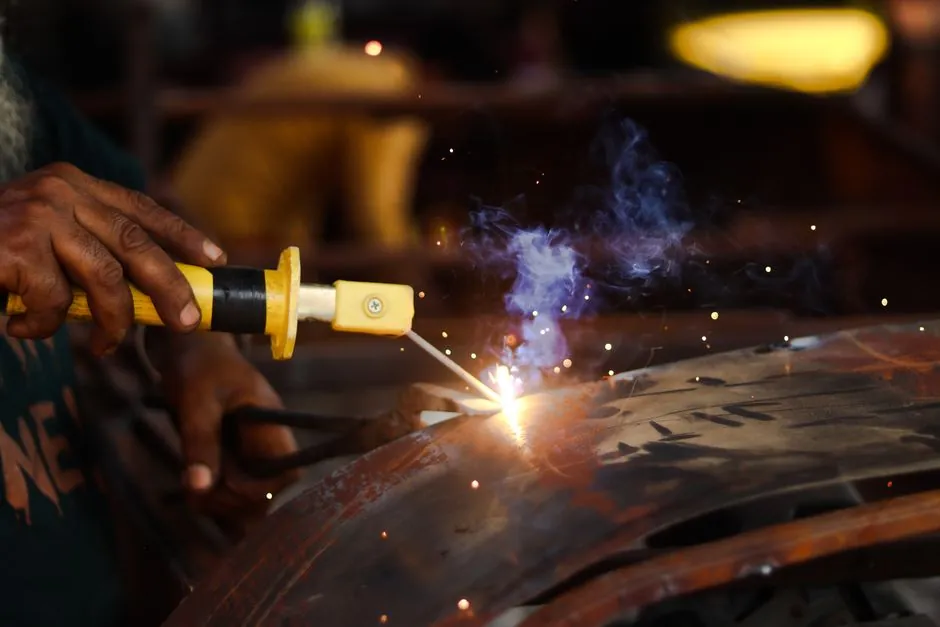
Road maintenance welding is overwhelmingly a field SMAW job, and 2026 OEM catalogs in the 200–400 A single-phase inverter bracket dominate procurement for pothole-patch rigs, crash-barrier repair, and sign-gantry fabrication [S2][S4].
Buyers should anchor the decision on four hard gates, process family, output current, duty cycle at rated output, and input phase, before brand, weight, or inverter-versus-transformer topology is even considered [S2][S7].
Why 220 V single-phase inverter MMA wins on the maintenance truck
Chinese portable-inverter SKUs in mid-2026 are predominantly 220 V single-phase 50/60 Hz to suit site generators and small-shop distribution, while multihead automatic arc welding cells and submerged-arc installations are three-phase 380 V industrial supplies; mating a three-phase SAW head to a single-phase socket will not run [S2]. A road maintenance crew rolling up to a wet patch on a county road needs a welder that will start off a 5 kVA portable genset, lift cellulosic 6010 or low-hydrogen 7018 rods, and weigh under 30 kg so a single tech can carry it down an embankment.
Inverter DC sets in the 120–250 A portable class weigh 5–25 kg, hit 80–85% electrical efficiency versus 50–60% for transformer sets, and support a wider electrode mix (6010, 7018, 308L, low-hydrogen) at cleaner arc stability, which is why road, rail, and field-service fleets have shifted away from transformer AC sets below the 300 A mark [S4]. For deeper background on the underlying arc physics, the arc welder encyclopedia entry covers the process family in detail.
Current and duty cycle: size the joint, not the headline number
Continuous output current is the single most useful filter when sizing a stick welder, because it caps both plate thickness and rod diameter in one number; entry-level 120–200 A digital inverter ARC welders cover 1.6–3.2 mm rutile and basic electrodes on 1.5–6 mm steel, mid-range 250–350 A sets handle 2.5–5.0 mm electrodes and 6–15 mm plate at 60% duty cycle or better, and 400–500 A AC transformer sets support 4.0–6.0 mm electrodes and continuous plate work above 15 mm [S4].
Look for duty cycle stated as a percentage at a stated current, e.g. 60% at 250 A at 40 °C ambient, because the thermal limit is what actually limits real productivity on long seams, and a bare "200 A welder" without a duty rating is a red flag [S4][S5]. For typical road work, welding a 6 mm crash-barrier post saddle, a 10 mm sign-gantry base plate, or a 4 mm guard-rail splice, a 250 A inverter at 60% duty covers the bulk of the workload and leaves headroom for the occasional 5.0 mm 7018 repair on a snowplow blade. For higher-cycle work like continuous guard-rail seam runs, the duty cycle at the operating current is the binding spec, and an engine-driven unit rated 60% at 300 A continuous will outrun a 200 A inverter that drops to 20% at the same amperage.
Inverter DC vs engine-driven vs AC transformer: a side-by-side decision
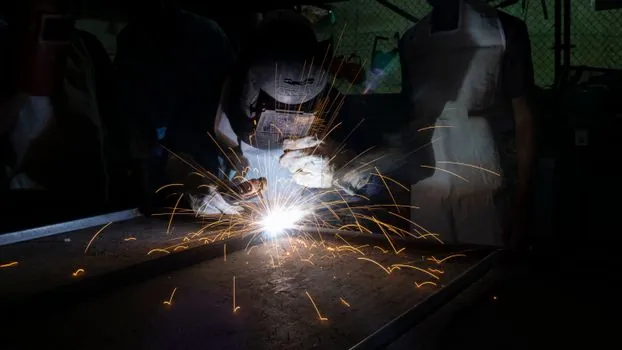
The three realistic power-source topologies for road maintenance trade off weight, grid dependency, and electrode compatibility in a way that maps directly to the job site. Inverter DC sets weigh 5–25 kg across the 120–250 A portable class, run on 220 V single-phase, support DC-only processes such as cellulose 6010 pipe welding at high quality, and are the lowest-cost entry point, with 2026 wholesale bands running from US$34 per piece for entry 100 A inverter MMA units to US$425–7,000 per piece for AC transformer sets at 1-piece MOQ from Diamond-Member audited Chinese suppliers [S4].
Engine-driven welder-generators are the only option when no grid or site generator is available, and most field engine-driven welders spend roughly 50% of their time acting as a generator for tools, lights, and plasma cutters; the 10 kW class is a typical match for a 9-inch grinder or a plasma cutter with high inrush current, while Total Harmonic Distortion (THD) of the auxiliary output matters for any sensitive electronics on the truck [S8]. AC transformer arc welding machines weigh 80–150 kg for a 300 A class unit, consume roughly 1.5× the input kVA per amp of weld output compared with an inverter, and do not support DC-only processes such as cellulose 6010 pipe welding at high quality, which is why they have been pushed out of the maintenance-truck segment but remain the default for shipyard and structural fabrication above 300 A [S4]. Decision rule for a road crew: pick the 220 V inverter MMA for grid-connected depots and trailer-mounted service, the engine-driven welder-generator for remote cut-sites and night emergency callouts, and the AC transformer only for the stationary structural shop.
Matching the welder to the actual road work: pothole rigs, barriers, gantries
Road maintenance work breaks into three load profiles, and each one biases the spec in a different direction. Light patch-and-repair work, sign post replacement, manhole frame re-welding, small guide-rail splices, sits inside the 140–200 A portable inverter band and uses 2.5–3.2 mm 6013 or 7018 rods at 60% duty or better [S1][S4]. Mid-range structural repair, W-beam guard-rail splices, sign-gantry base plates, drainage grate frames, lives in the 250–350 A inverter band with 4.0 mm low-hydrogen rods and demands 60% duty at rated output for continuous seam work [S4]. Heavy repair, snowplow blade rebuilds, truck-body panel replacement, bridge-expansion-joint repairs, pushes into the 400 A and above bracket where engine-driven or three-phase industrial sets take over [S3][S8].
For a 2026 mid-sized municipal road crew running 2–4 trucks, the typical fleet is two 250 A inverter MMA units, one 400 A engine-driven welder-generator on the heavy truck, and a small 200 A inverter dedicated to the sign-shop bench, which mirrors the 200/250/300/400/500/600 A catalogue bands that Indian OEM Digital Weld uses to size its own arc welding line for "light-to-medium fabrication, heavy maintenance, construction, heavy pipe welding, and shipbuilding" respectively [S3]. Process fit is the second filter: the same physical unit can be MMA-only, MIG-only, or multi-process, and the price band shifts sharply with each added process, so a road crew that never runs MIG wire should not pay for a multi-process inverter when a dedicated MMA stick unit will do the same work at lower cost and simpler training [S4].
Standards, safety, and the 2026 sourcing picture
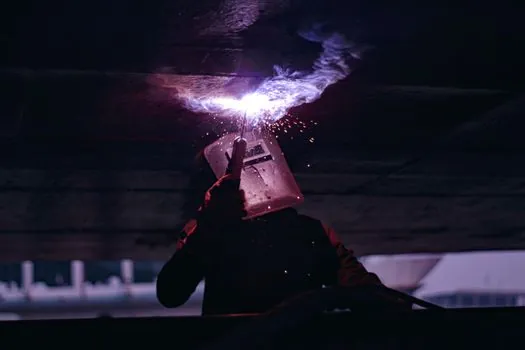
Stick welding remains the most common low-cost process and dominates portable inverter catalogs because it tolerates rusted, painted, or dirty base metal, works outdoors and in windy conditions where shielding gases would be ineffective, and is the safest practical option for crews that cannot control the work environment [S1][S3]. For a procurement spec targeting 2026 deliveries, anchor the datasheet on three numbers: output current range stated with a duty cycle at a stated ambient (typically 40 °C), input phase and voltage, and electrode diameter capability, then check the IP rating and overheat/overload protection for outdoor truck-mount service [S3][S4][S5].
The 2026 sourcing map for road-maintenance arc welders is heavily skewed to Chinese OEM and Indian OEM channels: Made-in-China wholesale bands for industrial 250–400 A units land in the US$425–7,000 FOB range, automated inverter welding systems with wire feed and CNC interfaces run US$14,800–296,300 per set, and entry-level 100 A inverters ship from US$34 per piece at 100-piece MOQ, with Indian brands like Digital Weld, APS, and Ador covering the 200–600 A bracket on the domestic market [S1][S3][S4]. When the spec is locked, the next move is to confirm the duty cycle at the actual operating current (not the headline maximum), validate the input phase against the truck's genset or depot supply, and pull a sample weld on the thinnest and thickest plate the crew will actually run before signing the PO.
Spec-level background on the components involved: road roller, and welding cutting tool.
Background reading: Rough terrain forklift selection for pipeline construction: 2026 spec path.