
Sandblasting machines for data center construction and equipment manufacturing span 0.5–50 MPa operating pressure, 6–30 kW total power, and 200–4600 mm working envelope widths, with conveyor, batch cabinet, double-sided sheet, and ultra-high-pressure water-driven variants each fitting a distinct fabrication step [S3][S4][S5][S7][S9].
The "best" machine is application-defined: structural steel cleaning before coating favors large blast rooms or conveyor systems; stainless steel sheet finishing for cabinets and panels favors double-sided inline machines; precision component work favors wet/dustless portable pots. Five engineering inputs drive selection: compressed-air volume, daily duty cycle, abrasive type, mesh size, and budget, per established cabinet-selection guidance [S1].
Where Sandblasting Actually Fits in a Data Center
Data center construction creates four distinct surface-prep workloads where abrasive blasting is specified: (1) structural steel members and equipment skids requiring SA 2.5 cleanliness before anti-corrosion coating; (2) stainless steel sheet panels for switchgear cabinets and distribution boxes, where blasting delivers anti-fingerprint, insulation, and anti-corrosion surface properties [S7]; (3) server rack frames and chassis requiring uniform matte finish; (4) on-site maintenance of generator housings, transformer tanks, and cable tray supports where portable dustless pots replace open-air blasting [S2].
For new-build work, automated conveyor and double-sided inline machines dominate because flat sheet and long-profile components are the highest-volume parts; for site retrofit and maintenance, portable dustless blasting pots on wheeled frames are the practical choice because they suppress visible dust plumes that would otherwise trigger local shutdowns in occupied buildings [S2]. A typical conveyor-type batch unit delivers 200 kg payload capacity, 6.8 m³/min air consumption at 5–8 bar working pressure, and 8.8 kW total connected power for a 1500 × 1900 × 1000 mm working chamber [S5].
Conveyor and Double-Sided Sheet Machines: the Workhorse Tier
Conveyor sandblasting machines configured with 10–16 boron carbide nozzles, PLC + touchscreen control, and stepless inverter belt-speed regulation are the standard answer for stainless steel sheet panels going into switchgear, distribution boxes, and precision electronic enclosures [S5][S7]. A 16-gun pass-through conveyor at model KF-4215-16A runs 4600 × 1900 × 2140 mm overall with a 1500 × 1900 × 1000 mm working space, 7.5 kW dust fan, and 6-filter dust collector rated for sustained shift work [S5].
Double-sided inline machines target sheet metal that cannot tolerate part-on-part contact, blasting both faces in a single pass to deliver consistent surface roughness for downstream powder coating or anti-fingerprint treatment; common processing widths are 600, 800, 1000, and 1300 mm, matching standard data center cabinet panel cut sizes [S7]. A 30 kW compressed-air double-sided unit runs at 0.5–0.8 MPa working pressure, 220/380 V 50/60 Hz supply, with 45–60 day lead time and 40 sets/year supply capability [S9][S10]. For higher automation, intelligent conveyor units add remote control, electrical explosion-proofing, and patented digital-control gun arrays for clean-room-adjacent finishing halls [S6].
Portable Dustless Pots and High-Pressure Water-Driven Units
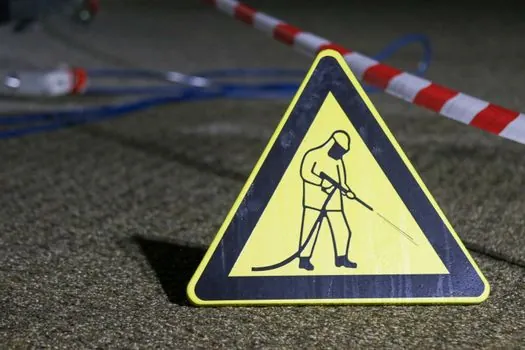
Portable dustless sandblasting machines are the right tool for on-site data center work, generator skid refurbishment, and any application where a visible dust plume would compromise adjacent IT spaces; these standalone wheeled pots support both wet and dry modes, accepting crushed glass, glass beads, sodium bicarbonate, steel grit, garnet, walnut shells, and corn cob, but operators should avoid silica sand because of respirable crystalline silica hazards [S2].
Ultra-high-pressure water-driven sandblasting machines operate at 50 MPa (7250 psi) with abrasive velocity up to 300 m/s, cutting blasting time 40–60% versus 15 MPa machines and stripping 10+ mm rust or industrial epoxy coatings that standard pots cannot touch; the safety stack includes emergency stop at panel and gun, hopper-lid door interlock that shuts down the pump, manual pressure-relief override, and a 15–22 kW cyclone + HEPA dust collector that separates 90% of dust centrifugally and captures 99.97% of 0.3 µm particles on the HEPA stage [S3]. These units are oversized for typical data center steelwork but earn their place on thick-coating removal, oil-stained transformer tanks, and offshore-grade structural members used in coastal hyperscale sites [S3].
Selection Criteria: Pressure, Air, Abrasive, Duty Cycle, Footprint
Five quantified inputs decide the machine, per the cabinet-selection factors used across the industry: (1) compressed-air supply in CFM at the working pressure (a 16-gun conveyor needs roughly 6.8 m³/min at 5–8 bar [S5]); (2) daily duty cycle in hours, which sizes the dust collector blower, filter area, and separator reclaimer; (3) abrasive type, where glass beads are the common default but soda, plastic media, and steel shot require cabinet features tuned to that media [S1]; (4) mesh size for the target finish roughness; (5) budget envelope, which is the most common selection driver but is the wrong place to start because an undersized pot creates more lost labor than the savings [S1].
Decision matrix for data center use cases: portable dustless pot (0.7–1.2 MPa, 50–250 kg dry weight class) for on-site retrofit and maintenance, fits tight mechanical rooms, low CAPEX; conveyor batch machine (5–8 bar, 6.8 m³/min, 8.8 kW, 200 kg payload) for stainless panel finishing in 600–1500 mm width range, mid CAPEX; double-sided inline machine (0.5–0.8 MPa, 30 kW, 350–450 mm drum diameter) for high-volume sheet and chassis work, highest throughput per operator; blast room (7 × 4 × 3 m internal volume class) for oversized structural steel, generator housings, and welded frames that will not fit a cabinet [S5][S7][S8][S9]. High-pressure water-driven units (50 MPa) are reserved for extreme coating removal and should not be specified for routine data center structural work [S3].
Dust Control, Safety, and Standards Constraints

Dust containment is the make-or-break specification for any blasting operation inside or adjacent to an occupied data center, because traditional dry blasting produces visible plumes that local regulators shut down on sight, while wet/dustless systems encapsulate abrasive and coating debris in water so it falls directly to the ground for easier containment [S2]. A 50 MPa ultra-high-pressure system pairs a cyclone separator (90% centrifugal removal) with HEPA filtration (99.97% at 0.3 µm) to capture 95%+ of airborne particulate and align with OSHA and EU REACH requirements for industrial surface treatment [S3].
Safety interlocks on high-pressure units are non-negotiable: emergency stop buttons at both the operator panel and the gun, a door interlock that depressurizes the pump if the hopper lid opens, and a manual pressure-relief override for maintenance lockout must all be present on any machine specified above 15 MPa [S3]. Electrical explosion-proofing is a separate spec line on intelligent conveyor units intended for clean-room-adjacent finishing halls, and CE marking plus PLC-based control with touchscreen HMI is now standard on production-grade conveyor and double-sided machines from major Chinese OEMs [S6][S10]. For data center structural steel destined for humid or coastal sites, post-blast surface preparation should target the coating vendor's specified cleanliness grade (typically near-white metal) within the holding-time window before primer application.
Trade-offs and Common Mistakes
The most common specification mistake is buying on pressure alone: a 50 MPa ultra-high-pressure unit delivers 5–10× the cleaning power of a 0.8 MPa cabinet but at the cost of abrasive consumption, noise, operator-skill demand, and CAPEX that does not translate to better finishes on thin stainless panels [S3]. For sheet metal under 3 mm, ultra-high-pressure water-driven blasting risks warping and base-material damage; standard compressed-air conveyor or double-sided units at 0.5–0.8 MPa are the correct specification [S7][S9].
The second mistake is ignoring daily duty cycle, which determines dust collector blower CFM, filter surface area, separator reclaimer capacity, and time-between-cleanings; an undersized dust collector on a 16-gun conveyor becomes the production bottleneck within one shift [S1]. The third mistake is specifying silica sand as the abrasive for indoor or site-adjacent work: respirable crystalline silica exposure is a documented health hazard, and crushed glass, garnet, or sodium bicarbonate deliver equivalent or better finishes without the regulatory exposure [S2]. A fourth trap is treating the budget line as the starting point rather than the constraint, which leads to slow machines, missed finish specs, and excessive dust that triggers site shutdowns [S1].
How Leading OEMs Position Their Lines

Media Blast segments its catalog into 10 machine categories and 60 cabinet models covering every abrasive delivery method (siphon, gravity, direct pressure, micro) and every duty cycle, with selection driven by the five-factor framework above [S1]. Kafan offers 13 sandblasting equipment sub-categories from automatic inline and conveyor systems through wet blasting cabinets, pressure pots, and custom-engineered systems for non-standard parts [S4]. PTING Technology positions its PTSF-series intelligent conveyor units as patented digital-control platforms with remote control, electrical explosion-proofing, and integrated dust removal aimed at clean-room-adjacent finishing halls [S6]. Chong Jen Machinery and MIZHI focus respectively on double-sided stainless steel sheet machines and ultra-high-pressure 50 MPa water-driven units for heavy-industry surface prep [S3][S7].
Lead times for compressed-air double-sided and conveyor units are typically 45–60 days with 40 sets/year per line supply capability, so data center build schedules should plan a 60–90 day procurement buffer for production-grade blasting equipment [S9][S10]. For facility teams weighing the broader question of how cabinet-level surface prep fits inside a server-room buildout, the related aluminum veneer panel selection for cleanrooms spec map covers the panel-side specification that often follows the steel frame prep. For procurement leads standardizing across multiple industrial equipment categories, the zinc ingot plant capacity planning 2026 spec map provides a comparable spec-first template for greenfield industrial builds.
Trackable signals for the next sourcing window: (1) the next 50 MPa ultra-high-pressure model release with integrated abrasive-recovery loop, which would cut consumable cost on heavy structural work; (2) conveyor unit price points for 12–16 gun configurations, which set the realistic CAPEX for mid-volume data center panel finishing lines; (3) any tightening of respirable-crystalline-silica enforcement on construction sites, which would accelerate the shift from dry silica blasting to dustless wet systems across indoor data center buildouts.
The underlying component specifications are covered under sand blasting machine, shot blasting machine, and data logger.