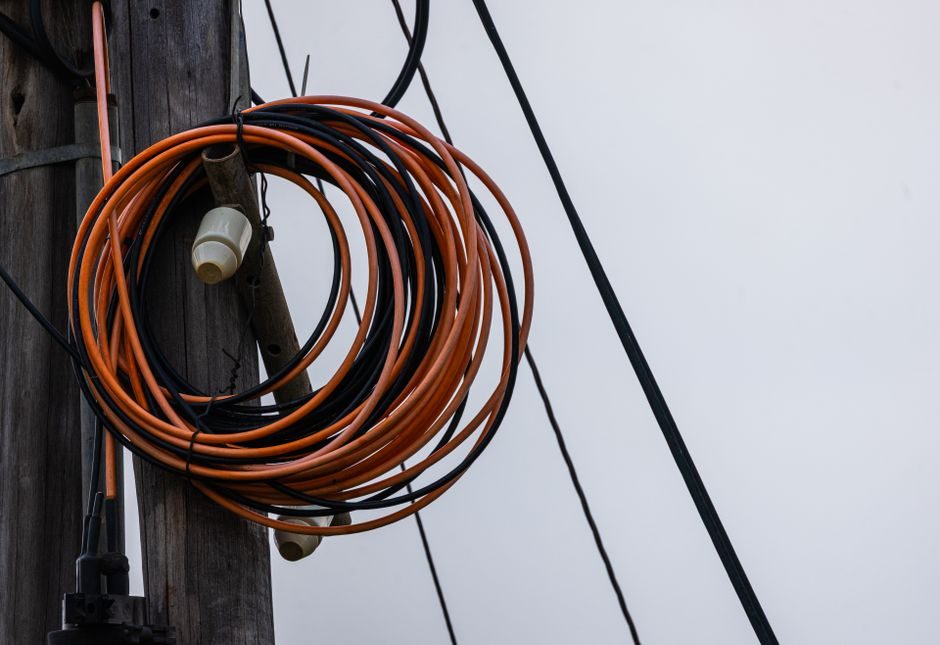
Cable tray and drag chain cable are not substitutes — they belong to two different families of cable-routing hardware that meet at the cabinet gland box. Cable tray is the rigid structural system used to securely support insulated cables along fixed routes in plants, refineries, data centres and street-lighting networks [S7], while a drag chain cable is a continuous-flex cable designed to ride inside an cable drag chain on a machine that reciprocates or travels.
The split matters because a flex cable dropped into a tray will fail in months from copper fatigue, and a tray-grade cable dragged through a chain will crack its jacket within days. The selection map below lines tray types against drag chain grades on four decision criteria so a process engineer can size the right family in one pass.
Definition and Scope of Each Family
A cable tray is defined in industry literature as "an assembly of units and associated fittings forming a rigid structural system which can securely support insulated electric cables" used for power, control and signal distribution in buildings, plants and outdoor lighting [S7]. Main sub-types are ladder, perforated (ventilated), solid-bottom trough, and channel — Chongqing Tianbao lists all of these alongside its drag-chain and busbar product lines [S8]. Cable-tray manufacturers in the UAE and Pakistan supply straight sections, elbows, tees, crosses, covers, connectors and post supports as a complete modular system [S1][S4][S5].
A drag chain cable is a multi-conductor control or servo cable whose conductors, stranding, pitch, fillers and outer jacket are all engineered for continuous flexing. Manufacturers on made-in-china.com offer drag chain cable in a price band of US$5.00–10.00 per metre with a 500 metre MOQ from Diamond Member Shanghai RONA Cable [S2]. Hebei Shengtuo markets the matching plastic drag chain and flexible conduit as one product family for machine tools [S9]. Alibaba lists CNC-specific cable drag chains as a separate SKU from the cables themselves, with the chain carrying the cable rather than the cable being a structural element [S3].
Selection Criteria Mapped 1:1
Four criteria separate the two families cleanly:
1. Motion. Tray assumes static routing; drag chain is rated for reciprocating travel. CNC cable carriers sold on alibaba.com are explicitly built for repeated axis strokes rather than fixed runs [S3].
2. Flex life. Drag chain cables are typically rated in millions of bending cycles (≥1×10⁶ for entry-level PUR/PVC, ≥5×10⁶ for high-flex TPE constructions); tray-grade cables such as XLPE/PVC are not flex-rated and fail by copper work-hardening when repeatedly moved. The made-in-china.com Wuxi/Jiangsu supplier list separates "flexible flat cable" and "drag chain cable" into distinct sub-categories, confirming the market treats them as different SKUs [S2].
3. Mechanical load. A cable tray is a load-bearing structure — Tianjin Leading's 10-article series ships straight ladder, tee, cross, cover, connector and post as a kit that takes cable weight plus its own dead load across spans [S1]. A drag chain is a guide, not a beam: its job is to keep the cable on a defined radius, not to carry tray-level loads.
4. Span and environment. Tray handles long static spans with support posts every 1.5–3 m typical; drag chain runs the short axis distance of a machine — usually 1–10 m of travel — inside an enclosed or openable plastic chain.
Who Each Option Is For (and Who It Is Not For)

Cable tray fits fixed plant distribution: substation to MCC feeders, MCC to field marshalling boxes, refinery cable racks, data-centre overhead busways, and outdoor street-lighting feeds where Al-Fazal Engineering supplies galvanised tray and pole systems across Pakistan [S5]. It is wrong for any application where the cable itself moves on each cycle.
Drag chain cable fits machine tools, gantries, robot dress packs, CNC axes, automated storage and retrieval carriages, and packaging lines — exactly the retrofit case covered in the related guide on drag chain cable selection for packaging line retrofit. It is wrong for buried runs, vertical risers unsupported by a carrier, or long outdoor spans where UV, water pooling and mechanical impact dominate the failure mode.
Cross-over cases exist: a short flexible pigtail between a vibrating machine and a tray-fixed run is normally drag-chain cable on the moving side and tray cable on the fixed side, with a gland or strain-relief at the boundary. Conveyor chain drives are similar in concept — a moving chain on one side, a static guard or tray on the other — and the chain conveyor system is the wrong choice if the load is static.
Comparison: Tray Type vs Drag Chain Grade on Four Decision Criteria
Reading the market as of August 2026, the four decision criteria line up as follows.
Cost per metre. Perforated and ladder tray from Asian mills such as Tianjin Leading ships at the lowest cost per metre of supported cable; Chongqing Tianbao's combined catalogue of ladder, trunking, drag chain and busbar shows tray and trunking priced at the commodity end [S1][S8]. Drag chain cable starts at US$5/m MOQ 500 m on made-in-china.com and rises sharply for shielded servo, TPE-jacketed and ≥5×10⁶-cycle grades [S2].
Installation effort. Tray is a mechanical fit — straight, tee, cross, cover, connector, post — with no cable prep beyond cutting and dressing [S1][S7]. Drag chain cable requires chain assembly, segmented clamping to flatten the cable inside the chain, drain loops at each end, and a strain-relief boot to the cabinet — far more touch-time per metre.
Lifetime in service. Tray hardware has a multi-decade design life in dry indoor or coated outdoor service; only the cover and connector screws are maintenance items. Drag chain cable lifetime is cycle-counted rather than year-counted, so the same cable may last 10 years on a slow packaging line or 18 months on a high-cycle CNC axis.
Integration with adjacent systems. Tray is straightforward to combine with roller chain drives in a conveyor line, with busbar trunking for high-current feeders, and with overhead lighting circuits on the same rack [S8]. Drag chain integrates with servo drives, encoder feedback and pneumatic/hydraulic dress packs, not with lighting or power distribution.
Real Use Cases, Limits and Failure Modes

Plant-side use case. A 2 km refinery cable rack on a 1.5 m support pitch, 600 mm wide ladder, hot-dip galvanised, with FR-XLPE/PVC tray cable — this is the textbook fixed-distribution case that [S1] and [S7] describe, and the same pattern scaled to city street-lighting runs by Al-Fazal Engineering in Pakistan [S5]. The dominant failure mode here is corrosion at the support interface or cover, not cable fatigue.
Machine-side use case. A CNC machining centre with X/Y/Z travels of 0.8/0.6/0.5 m at 60 m/min and a 7×24 duty cycle needs drag chain cable in the servo power, encoder feedback and brake lines, fed from a chain on each axis — the configuration behind Alibaba's CNC cable drag chain category [S3]. The dominant failure modes are jacket abrasion at chain cross-overs, copper breakage at the gland when the drain loop is wrong, and EMC degradation if the shield is not terminated 360° at both ends.
Hybrid use case. A bottling line retrofit pairs a new drag chain on the filler carousel with an existing overhead tray feeding the panel — the drag chain cable selection criteria for packaging line retrofit reference covers the boundary design in detail. A poorly drawn boundary (drag chain cable terminated directly into a tray gland without strain relief) is the single most common field failure.
Sourcing, Standards and What to Verify at Quote
Asian supply for both families is concentrated. Tianjin Leading and Chongqing Tianbao cover the rigid side — ladder, perforated, trough, channel, cover, tee, cross, connector, post [S1][S8]. Hebei Shengtuo and the made-in-china.com Jiangsu/Wuxi cluster cover the moving side — plastic drag chain, flexible conduit and drag chain cable [S2][S9]. Al-Fazal and the UAE cabletrayuae.com portal cover regional assembly and export of tray and street-lighting poles [S4][S5].
At quote stage, verify four numbers: (1) tray material and coating — pre-galvanised, hot-dip galvanised to ISO 1461, or stainless 304/316; (2) tray support span vs the manufacturer's published load curve (the longer the span, the less load the tray can carry, as the bilingual entry on 电缆槽 spells out [S6]); (3) drag chain cable cycle rating — ask for the test method, not the marketing number; (4) chain pitch and inner cross-section versus cable outer diameter, with fill ratio kept around 40–60% to avoid jacket pinch.
Trackable signals: monitor made-in-china.com drag chain cable listings for sub-US$4/m PVC entry grades, and watch Hebei Shengtuo and similar machine-accessories suppliers for chain pitches above 80 mm, which signal a shift toward higher cable diameters and heavier servo loads. For tray, the next signal is the appearance of IEC 61537-compliant stainless 304/316 SKUs from the UAE/Pakistan assembly base, which would indicate uptake in offshore and food-grade projects.