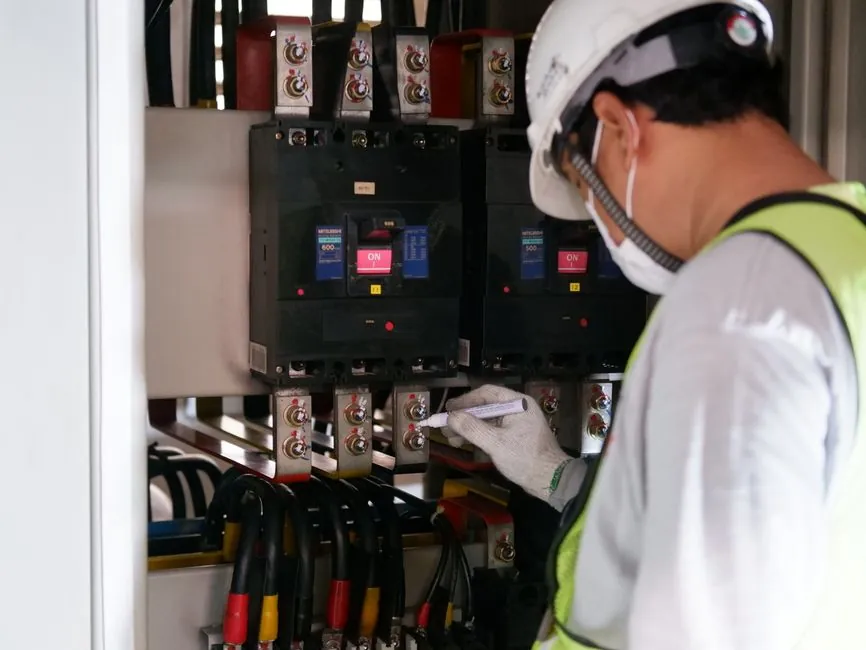
Semiconductor circuit breakers, also called solid-state circuit breakers (SSCBs), clear DC short circuits in the microsecond range, up to 1,000 times faster than conventional electro-mechanical devices, which is the spec that matters for AI data center and 800V HVDC power distribution [S1].
For semiconductor fabs and AI server halls, the relevant design envelope in 2026 is 240–1000 VDC bus architectures, SiC and IGBT power stages, and protection coordinated with upstream DC switchgear, contactors and fuses, not standalone AC molded-case replacements [S3]. Eaton, ABB, Siemens, Schneider Electric, Fuji Electric, Infineon, LS Electric, Atom Power, Blixt Tech and HIITIO are the ten manufacturers most cited in SSCB procurement in 2026 [S3].
Why mechanical breakers lose to SSCBs in DC microsecond fault clearing
A conventional molded-case circuit breaker clears a fault in roughly 30–100 ms because a bimetallic or magnetic trip element has to move a latch, then an arc chute has to stretch and extinguish the arc. Solid-state designs replace that latch-and-arc chain with SiC MOSFET or IGBT switches, so fault interruption drops into the low microsecond band, which is mandatory for HVDC distribution where an 800V DC bus can push 50 kA of prospective fault current before the upstream converter even sees the event [S1].
For semiconductor process tools, the practical consequence is that the DC bus feeding ion implanters, plasma etch RF generators, and stepper reticle stages stays isolated to the faulted feeder instead of sagging the whole tool cluster. A 1,000x faster clearing time also cuts let-through energy (I²t) by orders of magnitude, which is what protects the downstream SiC power module itself from being the very thing that blows up [S1].
2026 SSCB supplier map: ten names procurement actually sees
HIITIO leads the 2026 SSCB vendor ranking on the strength of its HSB1 series, rated 240–1000 VDC, built around SiC/IGBT modules and made in an IATF16949-certified 30,000 m² facility in Wenzhou, with HVDC contactors, semiconductor fuses, DC MCBs and full solid-state transformer (SST) systems sold as one architecture [S3].
The other nine suppliers, with their flagship DC protection positioning: Eaton (1911, Dublin) for commercial and industrial solid-state distribution; ABB (Zurich) with the SACE Infinitus RB-IGCT DC breaker; Siemens (Munich) with the SENTRON 3QD2 and the wider SENTRON solid-state protection line for low-voltage DC; Schneider Electric (Rueil-Malmaison) on SiC-based building and industrial DC networks; Fuji Electric (Tokyo) on industrial semiconductor-based breakers; Infineon (Neubiberg) supplying the SiC/GaN power devices that third-party SSCB integrators build around; LS Electric (Anyang) on DC power devices for data center and renewable applications; Atom Power (Huntersville, NC) with the UL-listed Atom Switch digital solid-state breaker; and Blixt Tech (Stockholm) with the IEC-certified Blixt Zero residential SSCB [S3].
High-voltage side, the parallel 2026 leaderboard for HV breakers is Hitachi Energy, Siemens Energy, ABB and Schneider, with the global HV breaker market projected at USD 10.20 billion in 2026 rising to USD 20.13 billion by 2035 at a 9.55% CAGR, and Asia-Pacific accounting for about 41% of that demand on the back of China, India, Japan and Southeast Asia transmission build-out [S5].
Decision criteria: voltage class, response time, certification, and switching device
Four criteria separate credible SSCB suppliers from rebranded contactor stacks. The first is voltage class: 240–500 VDC covers server rack and telecom backup, 800 VDC covers the AI data center HVDC bus, and 1000–1500 VDC covers utility-tied battery storage and large PV; the HSB1, Atom Switch, LS DC MCCB range and SENTRON 3QD2 all hit the 1000 VDC band, while LS Electric also markets an 1800V DC breaker for high-altitude applications where standard 1500V class is insufficient [S3][S4].
The second criterion is fault-clearing time and let-through energy. The Siemens SENTRON 3QD2 is documented at microsecond-range interruption, up to 1,000x faster than conventional systems, which is the published benchmark to compare against; Eaton, ABB and HIITIO publish comparable microsecond-class numbers in their SSCB datasheets, while conventional molded-case breakers sit in the 30–100 ms band [S1][S3].
The third criterion is certification: UL 489 / UL 1066 for North American panel builders, IEC 60947-2 for global LV switchgear, IEC 62271 for HV, plus project-specific semiconductor-fab requirements such as NETA MTS commissioning tests and 7-day current monitoring before and after any breaker adjustment [S2][S3]. The fourth is the underlying switching device: SiC MOSFET gives the lowest conduction loss and the fastest turn-off, IGBT is more rugged at very high DC currents, and hybrid mechanical-plus-SSCB designs keep cost down on lower-current feeders.
Comparison: HIITIO HSB1 vs Siemens SENTRON 3QD2 vs Atom Power Atom Switch
On the 800V HVDC data center bus, the three most commonly short-listed SSCBs line up as follows. The HIITIO HSB1 covers 240–1000 VDC, is built around SiC/IGBT power modules from a single IATF16949 line in Wenzhou, and is sold as part of a full DC architecture (HVDC contactors, fuses, DC MCBs, SST), which is helpful for fab electrical engineers who need one bill of materials [S3].
The Siemens SENTRON 3QD2 targets low-voltage DC, integrates protection, switching, monitoring and energy management in one parametrizable unit with no mechanical wear parts, and is sold integrated into SIVACON S8 switchboards and SIVACON 8PS busway; the SIRIUS 3RF5 solid-state switching device is positioned as the high-frequency DC switching companion [S1]. The Atom Power Atom Switch is the UL-listed digital solid-state breaker choice for North American panel builders who need UL 489 documentation rather than just IEC 60947-2 [S3].
For a 1500V DC battery storage or PV plant, the relevant Siemens Energy HV breaker portfolio and the Hitachi Energy EconiQ SF₆-free HV breaker (launched January 2026) sit above the SSCB band and handle the substation side of the same fault [S5].
Use cases in semiconductor manufacturing and AI factory power
Three use cases dominate 2026 SSCB orders from fab and AI data center buyers. The first is HVDC distribution inside AI factories: 800V DC busbars feeding GPU racks, where an SSCB on every feeder prevents a short on one rack from collapsing the bus voltage across the whole cluster; this is the application SENTRON 3QD2, SENTRON solid-state protection, and the HSB1 series are all pitched at [S1][S3].
The second is process tool DC protection: ion implanters, plasma etch RF generators, and stepper power supplies all run on internal DC bus rails that historically have been protected by fuses; fuses are single-use, and an SSCB with sub-cycle clearing plus a reclose command is now being retrofitted on critical tools where unscheduled tool-down events cost USD 9,000+ per minute [S2][S3]. The third is grid-tied battery energy storage and PV: 1000–1500 VDC battery strings paired with an 1800V DC SSCB at high-altitude sites, coordinated with HV substation breakers from the Hitachi/Siemens Energy/ABB tier [S4][S5].
What SSCBs do not replace, and where they fail
An SSCB is not a drop-in for every molded-case breaker. Solid-state devices leak microamps to amps of off-state current through their SiC/IGBT channels, so for applications requiring a true galvanic isolation for lockout/tagout you still need a mechanical disconnector in series, which is why suppliers pair an SSCB with a DC switch-disconnector or a contactor [S3].
SSCBs also dissipate more heat under steady load than a mechanical breaker of the same current rating, so thermal management (heat sinks, forced air, or cold plate) must be designed in, and the panel builder must derate accordingly. Finally, semiconductor switches have a finite short-circuit withstand, and a sustained bolted fault upstream can still destroy the SiC module, which is why every credible SSCB architecture still has a fast-acting semiconductor fuse or DC MCB on the line side as the second line of defense [S3].
Testing, commissioning, and NETA discipline for fab-grade SSCBs
A solid-state breaker is only as good as its commissioning test record. The 2026 industry workflow on a semiconductor-fab or data-hall retrofit starts with a short-circuit study to determine the maximum fault current at each panel, then a single-line diagram review, then a 3-to-7 day load study to identify overcurrent and harmonic risk, and only then is the SSCB selected with a kA interrupting rating comfortably above the calculated available fault current (for example, 14 kAIC and up on a 480V-derived panel) [S2].
Testing is performed during commissioning, after any unexpected trip, after a power system study, and at regular intervals in high-stress environments; hospitals and fabs are typically required to run 7-day current monitoring before and after any breaker adjustment, and Bay Engineers' published method aligns with NETA MTS for the on-site acceptance test [S2]. Note that an underrated breaker that fails to clear a fault can damage panels and trip main switchgear, shutting down entire data centers or fabs, which is the entire reason the SSCB category exists in the first place [S2].
Trackable signals to watch over the next two quarters
Two signals will tell the market whether SSCBs have crossed from premium to default in fab and AI factory design. The first is UL 489 listings on second-tier SSCB products beyond the Atom Switch, because UL-listed solid-state breakers are what panel shops in North America can actually install without a field-evaluation label; the second is the first published 800V HVDC reference design that integrates an HSB1, SENTRON 3QD2 or Schneider SiC SSCB with the upstream SST and downstream DC/DC converters as a single bill of materials, rather than three separate vendor packages [S1][S3]. A third, longer-cycle signal is the rollout of SF₆-free HV breakers from Hitachi Energy's EconiQ line at transmission voltages adjacent to fab substations, where the January 2026 product launch sets the template for grid-edge retrofits through 2027 [S5].
Spec-level background on the components involved: pressure transmitter, and flow meter.
Related analysis: Nitrile Rubber (NBR) Selection for Medical Devices: Spec Bands, Biocompatibility, and.