
Three pricing tiers define CNC controller procurement in mid-2026: PC-based motion-control kits in the low-hundreds USD bracket, Asian-manufactured turning controllers listed at US$220-450 per set on wholesale platforms, and proprietary industrial controllers whose BOM cost is rarely disclosed publicly [S1][S3].
Lead-time risk concentrates in three components: the PCI/PCIe pulse-generator card, the stepper/servo drive interface, and the firmware-locked software licence — with WinCNC's hardware consisting of a 64-bit PCI/PCIe card plus daughter board carrying a high-speed microprocessor for pulse buffering [S1]. Supply chain analyst roles supporting these lines commanded a median total pay of US$107,000 per year in the United States as of 2025, per Glassdoor data cited in the Coursera 2026 guide [S2].
PC-Based Controller Architecture and the 100 kHz Pulse Ceiling
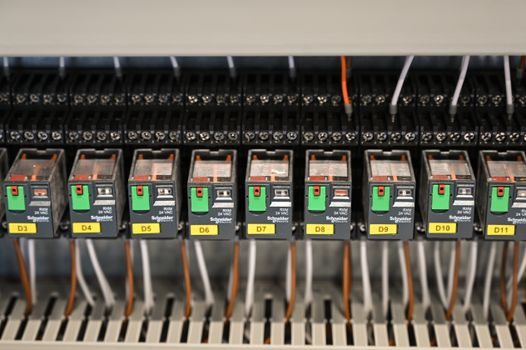
WinCNC specifies a 6-axis simultaneous output ceiling of 100 kHz without step loss, with TTL step-and-direction signalling to motor drives and a 37-pin (standard) or 25-pin (optional) rear connector for limit switches and output relays [S1]. The controller outputs additional TTL I/O pins for auxiliary functions, and a screw-terminal IO interface board option provides on-board 5 VDC power, output relays, and input isolation to remove soldering from field wiring [S1].
Compatibility is bounded to Windows 7, 8, 10 and 11 in 32- and 64-bit builds, requiring one enabled USB port plus an available PCI or PCIe slot; legacy support reached back to Windows 95/98/ME/2000/XP [S1]. WinCNC 3 uses a different daughter board than WinCNC 2, which is a documented forward-incompatibility: existing v2 users must upgrade software and purchase a new daughter board to migrate [S1]. The look-ahead buffer reads thousands of G-code lines ahead, enabling smoother arc and line-segment transitions than point-to-point interpreters — a real motion-quality differentiator, not a marketing claim, given the proprietary real-time vector-matching routines described in vendor documentation [S1].
Asian OEM Turning Controllers: Price Band and MOQ Structure
Wholesale listings on Made-in-China.com (snapshot 2026-05-13) show 4-axis CNC turning controllers with tool-centre-point control from Chongqing SiyueEr Technology at US$220-290 per piece MOQ-1, while Shenzhen Guanhong Automation lists higher-spec turning-controller sets at US$450-458 MOQ-1 [S3]. Both suppliers carry Diamond Member and Audited Supplier badges on the platform, and the listings are positioned for rotary-table boring-tool and tool-holder integration [S3].
The US$220-458 band represents the entry-tier turning-controller market, with MOQ held at a single piece/set on listed SKUs — a sourcing advantage for low-volume retrofitters and training shops [S3]. Spec sheets on these listings emphasise 4-axis kinematics and tool-centre-point (TCP) control, but do not disclose the underlying pulse generator architecture, firmware revision policy, or field-service network; buyers should treat the price as a hardware-only figure and budget separately for integration labour and post-warranty support.
Selection Criteria: Axis Count, Signal Type, and Integration Labour

Three gates separate the tiers: (1) simultaneous axis count — 6 axes at 100 kHz is the documented PC-based ceiling for WinCNC versus 4 axes typical on the Asian OEM turning-controller SKUs sampled [S1][S3]; (2) signalling — TTL step-and-direction output to stepper/servo drives is universal on the PC-based tier, while industrial proprietary lines often use EtherCAT or proprietary fieldbus that an integrator must match; (3) operating environment — screw-terminal IO boards with 5 VDC on-board power and input isolation suit shop-floor retrofit wiring without soldering [S1].
For a buyer, the decision matrix collapses to: choose PC-based (WinCNC-class) for ≤6 axes, retrofit flexibility, G-code look-ahead smoothness, and budget under US$1,000 in controller hardware; choose Asian OEM turning controllers for ≤4-axis lathe-class work where US$220-450 MOQ-1 pricing and Diamond-Member supplier audit status matter more than open pulse-generator documentation [S1][S3]. The PC-based path runs alongside other Windows applications without losing steps only because of the on-card high-speed pulse buffer, a fact directly relevant to shops that want a single PC for both CAM office work and shop-floor control [S1].
Who This Supply Chain Fits — and Where It Breaks
PC-based kits suit job shops, training facilities, plasma cutters, and small milling/retrofit operations that already standardise on Windows and want G-code look-ahead plus touch-screen UI scaling (button and toolbar sizes enlarge for touch use) [S1]. Asian OEM turning-controller listings fit lathe builders, 4-axis job shops, and cost-driven OEMs that need MOQ-1 procurement and audited-supplier status on a recognised B2B platform [S3].
The tier breaks where (a) high-axis-count machining centres (≥5 simultaneous axes on production parts) demand EtherCAT-class deterministic fieldbus that PC-based TTL output cannot match; (b) safety-certified environments (functional safety, SIL-rated E-stop) require certified industrial controllers rather than a Windows-hosted motion package; (c) long-lifecycle OEM production lines (10-15 year support windows) expose the fragility of vendor-locked firmware such as the WinCNC v2-to-v3 daughter-board migration that forces a hardware swap on upgrade [S1]. Buyers building a ball screw supply chain alongside the controller should also evaluate whether the pulse generator can drive the precision-grade screws demanded by their tolerance class, since the two subsystems are co-designed in any retrofit.
Limitations, Failure Modes, and Sourcing Levers
The most common failure mode in PC-based CNC control is step loss when the host OS pre-empts pulse generation; WinCNC's architecture mitigates this with a dedicated on-card high-speed microprocessor for pulse buffering, allowing 100% pulse accuracy at maximum frequency even with other Windows processes active [S1]. A second failure point is the firmware/hardware lock-in: WinCNC 3 requires a different daughter board than WinCNC 2, so version upgrades are not drop-in [S1].
On the OEM side, undisclosed firmware revision policy, sparse English documentation, and reliance on the wholesale platform's audited-supplier badge (rather than an independent functional-safety certificate) are the dominant risks in the US$220-458 price band [S3]. A practical sourcing lever is to split the procurement: buy the controller hardware from an audited Asian supplier for cost advantage [S3], and budget separately for a Western integrator to validate G-code interpreter behaviour, axis-tuning constants, and E-stop chain compliance — mirroring the segmentation logic used in OEM vs ODM server hardware sourcing where BOM cost and integration labour are deliberately unbundled.
Sourcing Standards, Analyst Support, and Trackable Signals
No single IEC or ISO standard governs CNC controller interoperability at the pulse-generator level; instead, buyers reference IEC 61131-3 for PLC programming concepts, ISO 6983 (G-code) for part-programming language, and ISO 23247 for digital-twin frameworks in machining [S2]. Supply chain analyst support for CNC controller lines in 2026 commands a US$107,000 median total pay in the United States, with manufacturing and wholesale-trade services paying above the cross-industry median, per Glassdoor figures cited in October 2025 [S2].
Trackable signals for the next sourcing cycle: (1) disclosure of EtherCAT-class support on the next WinCNC daughter-board revision, which would break the 100 kHz TTL ceiling and reposition the PC-based tier against industrial controllers; (2) movement in the US$220-458 turning-controller price band on Made-in-China.com listings, since MOQ-1 pricing on Diamond-Member SKUs is the cleanest read on Asian OEM controller inflation or compression [S3]; (3) demand-side pressure from the related ball screw suppliers chain, where precision-grade screws require controller pulse fidelity that the 100 kHz / 6-axis class either meets or constrains, depending on axis count and servo loop tuning.
The underlying component specifications are covered under dc power supply, switching power supply, and industrial ups.