A correctly specified sorting conveyor for cold chain runs at ambient ranges from roughly -25°C in dock buffer zones up to +8°C in pack-and-sort halls, with the frame, belt, drive and electrical package each rated independently for that band [S1][S2].
For 2026 builds, target throughput of 2,000 to 4,000 parcels per hour per lane, parcel weight 0.2 to 30 kg, and a sorting system footprint under 120 m including the induct and the take-away spurs. Stainless 304 is the default frame material; 316L is required only where chlorine-bearing sanitizers (NaClO, quaternary ammonium) are used daily.
Frame, belt, and chain selection in sub-zero zones
304 stainless with 2B or bead-blasted finish handles the temperature swing without visible frost-condensation pitting when paired with closed-cell foam underbelt insulation at the induct curve [S1]. Open-style chain conveyor structures freeze up below -18°C because ice bridges between link plates; the workaround is either a conveyor chain executed in engineering plastic (POM, PA66 with MoS2) or a flat PU belt with zero-splice thermo-weld.
Belt choices split on SKU: PU (TPU) food-grade monolithic belt, 2 to 3 mm thick, 85 to 95 Shore A, for cartons and totes; modular PP or POM belt with 12.7 to 25.4 mm pitch for crates and rigid trays. PU is more hygienic (no pin openings) but cold-stiffens below -20°C, so PU should be re-rated for a minimum bend radius of 3 to 4x belt thickness in freezer tunnels.
Roller diameters follow a cold-rule: minimum 50 mm for 89 mm face under 30 kg parcel load at -25°C, otherwise the rubber lagging on the drive pulley glass-transitions and the belt slips. [S2] catalogues galvanized and 304 stainless rollers from 38 to 219 mm OD, with the 50 to 89 mm range covering 90% of cold-chain parcel applications.
Drive, controls, and IP rating against condensation
Drives for freezer zones must be rated -20°C continuous (oil-sealed gearmotor with synthetic PAO oil, IP65), not the usual +40°C catalog rating, otherwise the seal lip hardens and grease purges within 200 to 400 hours. VFDs go outside the cold envelope in a heated MCC room, with cables running through conduit sealed with IP68 Roxtec-type glands at every cold-side penetration. [S3]
Controls philosophy: decentralized IO-Link or AS-i over PROFINET at the sortation stations, with inductive and photoelectric sensors (IP67 / IP69K) at every divert point. Capacitive proximity fails on frosted cardboard, so specify diffuse-reflective infrared with heater, or polarized retroreflective for clear-wrapped trays. Camera-based barcode readers (Cognex DataMan, Keyence SR-X) are typically mounted in a heated enclosure at +5°C, not on the cold frame.
Electrical enclosure heaters sized for 30 to 50 W per 100 L cabinet volume keep internal dew point above ambient, preventing the internal condensation that kills contactors before the conveyor itself fails. This is a common spec miss on cold-chain retrofits.
Throughput, accuracy, and the sortation technology choice
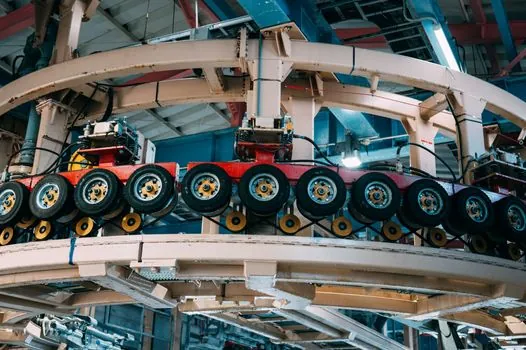
Throughput target: 2,000 to 4,000 parcels/hour per lane; system-level 8,000 to 15,000 parcels/hour across a 3 to 4 lane sortation. Each parcel must be inducted with 95 to 98% first-pass read rate, and the cross-belt or sliding-shoe sorter must commit in under 300 ms at the chute.
Sortation technology comparison for cold chain:
Cross-belt sorter: high throughput (8,000+ pph), 50 mm minimum parcel length, 60 g to 50 kg range, divert accuracy ±25 mm; higher capex (~30 to 40% over belt) and most moving parts to seal.
Sliding-shoe sorter: medium throughput (4,000 to 6,000 pph), 150 mm minimum length, gentler on soft packs, moderate cold performance with PTFE-coated shoes.
Steerable wheel / angled roller sorter: 2,000 to 3,500 pph, best for flat parcels, lowest mechanical complexity in cold, easiest washdown, lower divert accuracy (±50 mm) but cheapest to maintain.
Belt-driven narrow-roller pop-up: 1,500 to 2,500 pph, suited to end-of-line outbound in cold storage; 304 stainless rollers from 50 to 76 mm OD cover the parcel-weight spectrum [S2].
Inline checkweighing, scanning, and temperature gating
Inline checkweighers must hold ±0.1 kg at 0.5 to 5 kg SKU weight and ±0.2 kg at 5 to 30 kg, with dynamic weighing on a 600 to 1,200 mm long stainless belt section. Calibration drift above 0.05%/°C forces a heated cabinet, otherwise daily re-zero is required in freezer zones.
Temperature gating at induct: integrate a non-contact IR sensor (±0.3°C, 0 to 200°C range) on the in-feed; reject if surface temperature is outside the spec band (typically 0 to 8°C for chilled, -22 to -18°C for frozen), to satisfy HACCP records and the cold-chain audit trail called for after the 2020 SARS-CoV-2 cold-chain contamination events in China [S3].
Barcode and label verification: 2D code (GS1 DataMatrix) readers at the in-feed and at the chute; 4-camera tunnel scanners (Cognex, Zebra) only on the chilled side, never in the freezer, to keep MTBF reasonable.
Sanitation, washdown, and material compliance
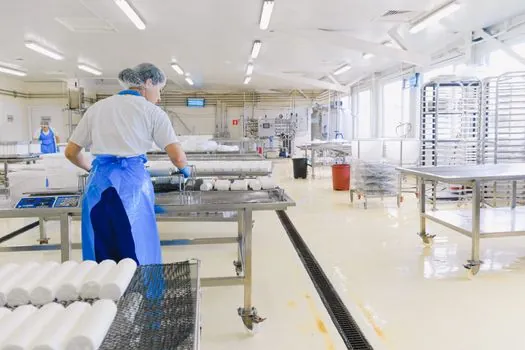
Washdown regime drives material upgrades. For daily foam-and-chlorine wash on a stainless line, specify 316L where chlorine contact exceeds 200 ppm-hour/day; 304 holds up to 50 ppm-hour/day. UHMW and acetal wear strips outperform PA66 in cold, wet, and abrasive conditions; rubber lagging stays EPDM (not natural rubber) to avoid ozone cracking from freezer air.
Food-contact surfaces must meet regional food-grade rules: FDA 21 CFR 110.40 gaskets and belt coatings for U.S. exports, EU 1935/2004 / 10/2011 for European destinations, and GB 4806 for China domestic. Lubricants on bearings, gearmotors, and chain must be food-grade H1 (NSF) if incidental contact is possible; a non-food-grade grease on a freezer belt is a common audit fail.
Integration, footprint, and energy in cold storage
Sortation lives between the inbound dock and the cold storage rack system, typically 60 to 120 m total length with 8 to 20 chutes. Push the in-feed scanner, the main sort conveyor, and the chute diverters into the chilled envelope (+2 to +8°C); keep the drive and VFD cabinets in an adjacent ambient corridor to halve heater power. [S2]
Energy: a 4-lane cross-belt sorter with 6 kW drive train, 0.6 kW controls, and 0.4 kW cabinet heaters draws roughly 7 kW continuous; add 2 to 3 kW per 10 m of belt for frost-heater trace. Specify IE3 or IE4 gearmotors and regenerative VFDs to return 15 to 25% of braking energy to the bus on the descending chutes.
For slab design under the line, steel fiber selection for cold storage warehouse slabs directly impacts the line's vibration envelope and the foundation of the chute support columns, while tapered roller bearing selection for packaging lines covers the head/tail pulley bearing spec most cold-chain builds source through the same vendor.
Final signal: lock the spec on the freezer-belt cold rating (-20°C continuous on drive oil, -25°C on belt material), the washdown material grade (304 vs 316L), and the sortation throughput tier (2,000 vs 4,000 vs 8,000+ pph) before vendor selection. Re-spec any of these three and the line cost moves ±25%.