
A 100 m³/h stationary concrete batching plant such as the PROMAX C100-TWN L is engineered as a containerized "plug-and-play" system that fits inside two 40 ft OT containers or two standard truck trailers, with all equipment installed and electrical work completed at the factory before shipment [S1]. The headline installation win is the 2-container transport envelope and minimal on-site assembly, both of which compress site-mobilization time and lower logistics cost compared with conventional skip-hoist plants [S1].
Across 2026 listings on Made-in-China and ECVV, the bulk of commercial offers sit in two capacity bands: compact/quick-install models at roughly US$12,450–40,000 per set, and mid-range stationary plants such as the HZS35 at FOB US$22,670–28,830 per unit with 1-unit MOQ and L/C or T/T terms [S3][S8]. For admixture, fiber, and vibration accessories that ride alongside the plant, see the concrete admixture, concrete fiber, and concrete vibrator reference entries.
Site Survey and Civil Works Before Delivery
Required inputs are a soil bearing-capacity report (target ≥150 kPa for skid-mounted compact plants, higher for skip-hopper stations), a 400 V three-phase power feed sized to the total installed kW, a water supply rated for at least the mixer's per-cycle demand, and a drainage plan for wash-out and storm runoff [S4].
CONMACH-class manufacturers describe the plant as a facility that doses aggregates (sand, gravel, crushed stone), cement, water, and chemical or mineral additives into a central or twin-shaft mixer, then discharges to transit mixers or trucks, so the layout must keep the truck loop clear of the aggregate stacker and cement-silo auger paths [S4]. On containerized plants, the two 40 ft OT footprint defines the minimum hard-standing pad plus a 6–8 m access apron for the delivery trailers and the mobile crane used to lift the main chassis off the truck [S1].
Foundation, Skid, and Anchor-Bolt Spec
Stationary plants in the 35–120 m³/h band fall into two installation philosophies: a conventional strip/pad foundation with embedded anchor bolts, or a "foundation-free" heavy-skid design that sits on a leveled crushed-stone base [S8]. The PROMAX C100-TWN L plug-and-play line ships pre-assembled on integrated skids and needs only minimal on-site assembly before becoming operational, while Chinese-market 75 m³/h foundation-free models from suppliers such as Henan Hengyuan explicitly market the eliminated civil works as a cost and schedule lever [S1][S8].
For pad-foundation plants, anchor bolts are typically M24–M30 grade 8.8 set to a template tolerance of ±2 mm across the mixer support frame, with grout pockets 100–150 mm deep; the cement silo base ring requires separate anchor sets because silo uplift under wind is the dominant overturning load [S4]. On sites where soil bearing is poor, a reinforced raft 200–300 mm thick with double-mesh A393 rebar is a common OEM recommendation and should be confirmed against the manufacturer's foundation drawing before pour [S4].
Aggregate Bins, Conveyor, and Screw-Auger Alignment
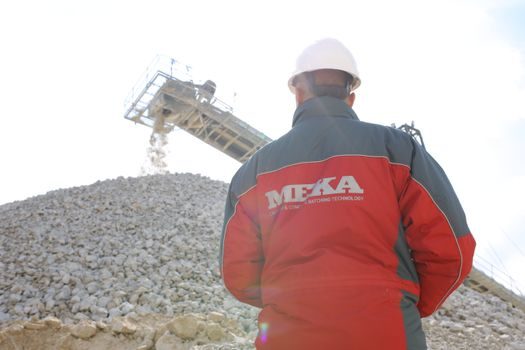
Aggregate bin geometry is dictated by the number of fractions (typically 3–4: fine sand, 0–5 mm, 5–20 mm, 20–40 mm) and the loader reach, with each compartment sized for at least one full production shift of buffer [S4]. Belt conveyors under the bins run at 1.0–1.6 m/s with troughing idlers at 35°–45°, and the head pulley must be aligned to within 1 mm/m to prevent drift that prematurely wears the belt edge [S1].
Cement and fly-ash screw conveyors are the most alignment-sensitive mechanical interface on a batching plant: a 219 mm diameter screw is a standard supply for HZS-class plants, and the trough must be straight within ±1.5 mm over its length to avoid bearing overheat and output loss [S3]. The mixer feed skip, on skip-hoist plants, runs in guide rails that need a plumb check to within 3 mm over the full lift height before the hoist cable is tensioned [S4]. A complete types overview for these configurations is mapped in this stationary/mobile/compact spec breakdown.
Mixer, Water, and Additive Plumbing
Planetary and twin-shaft mixers are both offered across the 35–120 m³/h band, and the choice drives the water and additive plumbing layout because twin-shaft models pressurize the water manifold higher to clear the dual-shaft discharge gate [S3][S4]. Additive dosing lines use PVC or PE chemical hose with dedicated peristaltic or piston pumps; the lines must be flushed at every shift change to prevent polymer build-up that biases the next batch [S4].
Water metering is typically a WPD-style helical turbine or electromagnetic flow meter on a 50–80 mm line sized to charge the mixer in under 15 s at full plant output, with a calibration tolerance of ±1% on the batch ticket [S4]. On plants such as the Henan Dasion HZS35, the mixer is offered in planetary or twin-shaft variants and ships with a separate screw-conveyor sub-supplier line, so plumbing interfaces must be cross-referenced against the project P&ID before piping is fabricated [S3].
Electrical, Control Panel, and Commissioning
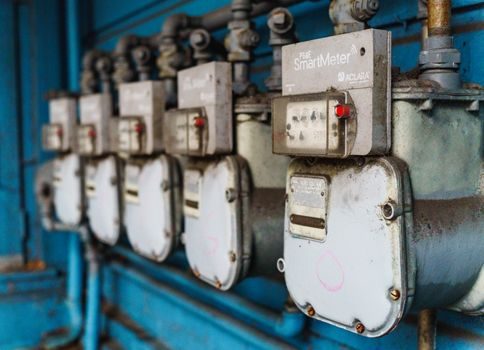
Compact plug-and-play plants arrive with cabinet wiring completed and only the main power feed, grounding electrode (≤4 Ω to earth), and any silo-level signal cables to terminate on site [S1]. The control panel typically uses a PLC with a 10–15 in HMI, recipe storage for 50–200 mixes, and a printer for batch tickets; the analog load-cell signals from the cement and aggregate scales should be verified against test weights to ±0.3% before the first production pour [S4].
For admixture dosing, the peristaltic pump calibration against a graduated cylinder is the single most important step, and a deviation above ±2% should trigger a recalibration before the plant is accepted [S4]. Surge protection on the incoming 400 V feed and a dedicated RCBO per motor starter is a minimum spec for European and Middle East sites, while dust-collection interlocks must be proven before the cement screw runs unloaded [S1][S4].
Acceptance Test, Common Failure Modes, and When to Reject
Acceptance typically follows three staged tests: no-load run for 30 min to check motor rotation and interlocks, load test at 50% then 100% rated output for one full shift, and a calibration cross-check against an independent weighbridge [S4]. A 100 m³/h class plant such as the C100-TWN L should sustain its nameplate output within ±5% over a 4-hour continuous run once the aggregate moisture probe and water-meter trim have been tuned [S1].
Common install-time failure modes and their corrective actions include: aggregate belt drift (realign head pulley, check troughing idler spacing), cement-silo overfill (verify high-level switch and silo-filter vent), mixer discharge gate sticking (clean build-up, re-seat hydraulic line), and admixture pump drift (recalibrate against graduated cylinder) [S4]. Replace, do not repair, any load cell that fails a shunt-cal check or any screw-conveyor trough section that shows visible midline wear greater than 1 mm, because both will bias the mix design and fail the next quality-audit pour [S3][S4]. For a related TCO lens on truck-mounted pumps that often share the same site, see this truck-mounted concrete pump TCO breakdown.