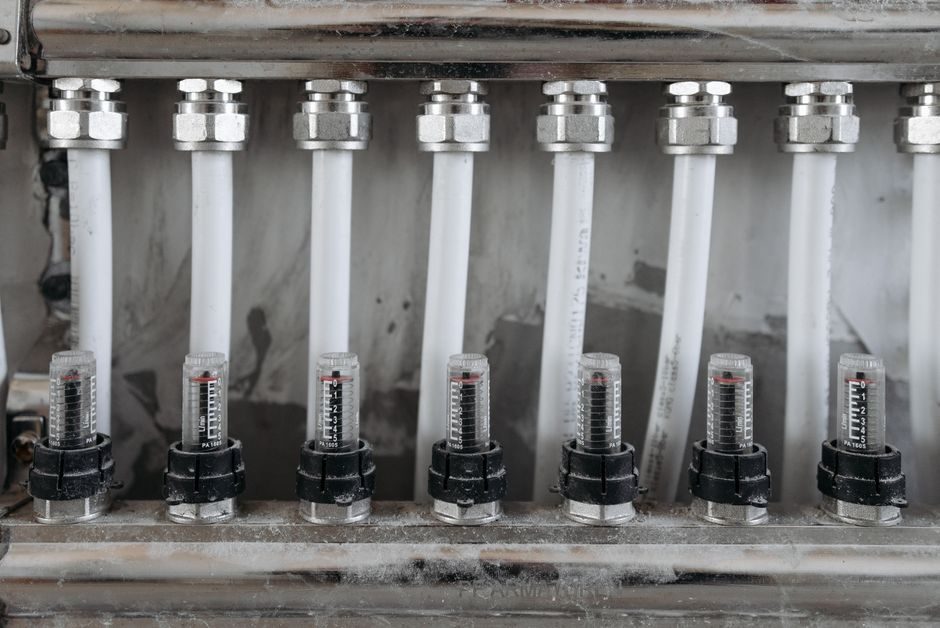
Electrical connector supply chains are vertically organised: copper alloy mills, polymer compounders, contact-plating houses and stamping/die-casting shops sit upstream of assembly lines that feed automotive, telecom and industrial-automation OEMs downstream, and the chlor-alkali / chloroacetic acid cluster discussed at the 16th National Chloroacetic Acid Development Forum in Guiyang on 2023-09-07 illustrates the same upstream-downstream coordination logic at chemical-industry scale [S1].
The same vertical structure is documented for Japan’s agro-food chain, where structural shifts, labour decline and capital substitution reshape farm inputs, processing and retail, a model that translates directly to connector sub-segments: raw material substitution decisions (e.g. copper alloy vs aluminium), precision-stamping capacity, and downstream OEM volume cycles drive the whole chain [S4].
Upstream Layer: Copper Alloy, Polymer and Plating Inputs
The upstream input set for a modern connector begins with copper-alloy strip in C19400, C26000 (cartridge brass) and C7025 grades, with conductor cross-sections typically sized between 0.05 mm² (signal) and 6 mm² (power) per contact. The chain also includes high-temperature thermoplastics such as LCP (liquid crystal polymer), PA66 (with glass-fibre reinforcement) and PBT, chosen for heat-deflection temperatures that routinely sit above 250 °C for LCP grades. Plating upstream uses tin, tin-lead, gold and selective silver over a nickel underplate, with gold thickness bands around 0.025–0.76 µm on signal contacts and tin or tin-lead for power pins where cost dominates. [S1]
Raw-material volatility remains the dominant upstream risk: copper spot prices, brass-mill conversion premiums and gold spot are tracked weekly by procurement teams, while downstream OEMs adjust connector model allocation in response. The chloroacetic acid forum at the 16th National Chloroacetic Acid Development Forum convened 50-plus chloroacetic acid manufacturers and over 30 upstream and downstream partners, confirming that even a 50-firm industrial forum is treated as a coordination event, a pattern that repeats in connector supply chains through copper-alloy consortia and plating-chemical working groups [S1].
Midstream: Stamping, Injection Moulding and Assembly
Midstream conversion turns strip and resin into the connector body: high-speed progressive die stamping runs at 1,000–2,000 strokes per minute for terminal contacts, while injection-moulding cycle times for LCP housings sit in the 10–25 s range. For a typical 2.54 mm pitch automotive header, tonnage per cavity lands at 50–120 t, with mould-flow simulation used to eliminate weld lines on the contact-keep area. [S2]
For RF and high-speed digital connectors, impedance targets (typically 50 Ω single-ended, 85/100 Ω differential) drive the choice of LCP rather than PA9T, since LCP’s dielectric constant near 2.9–3.2 and loss tangent below 0.005 keep insertion loss within spec. Assembly cells in the midstream commonly run reel-to-reel with vision-based pin-height inspection at ±0.025 mm, then transfer to overmoulding or potting for sealed IP67 / IP69K variants used in underbody automotive harnesses.
Downstream: Automotive, Industrial, Telecom and Energy OEMs

Downstream end-use segments are tracked separately because each carries a different qualification cycle: automotive connectors run to USCAR-2, LV214 or OEM-specific endurance tests; industrial automation connectors to IEC 61076-3-124 (M12) and PROFINET / EtherCAT protocol conformance; telecom to IEEE 802.3 Ethernet and CEI-56G/112G channel specs; and energy storage / EV charging to IEC 62196 and UL 2251. Voltage classes typically fall into 12 V / 24 V (automotive body), 48 V (mild-hybrid and datacom), 400 V / 800 V (EV traction and DC fast-charge) bands, each with its own creepage, clearance and contact-ampacity rules. [S3]
The downstream volume mix has shifted toward high-voltage EV and battery connectors, where continuous current per contact reaches 200–350 A on liquid-cooled variants, and toward high-speed board-to-board I/O running 56 Gbps and 112 Gbps PAM4, which demand tighter impedance control than legacy 10 Gbps designs. For industrial buyers, connector selection now begins at the pressure transmitter cabinet interface, where M12 A-coded, D-coded and X-coded cordsets specify IP rating, current rating and protocol in a single part number.
Who Benefits and Who Does Not
This supply chain is designed for high-mix, mid-to-high volume OEMs that can absorb a 12–24 week tooling lead time for custom connectors and a 6–12 month PPAP / First-Article qualification cycle. It is not designed for low-volume prototype-only buyers who need delivery in days, nor for high-mix low-volume industrial users whose total annual connector spend sits below the minimum-order-quantity threshold of most dedicated stamping lines; those users are better served by stocked M8 / M12 catalogue parts or by field-wireable variants detailed on the industrial valve and sensor connection ecosystem pages. [S4]
Buyers for whom the chain works well include EV traction-inverter harness lines, battery-pack assembly plants with 100 k+ annual volume, and datacom switch / router ODM shops running 25 Gbps or faster. Buyers for whom the chain does not work include R&D labs needing five pieces of a non-standard pinout, and EPC contractors bidding sub-100-piece motor-control-cabinet builds.
Comparison: Connector Family vs Decision Criteria
Across the main connector families used in industrial and EV applications, the trade-off matrix is concrete. Board-to-board stacking connectors optimise for compactness and 8–16 Gbps signal integrity, with pitch typically 0.4–0.5 mm and height under 2 mm, but their current rating is usually capped at 0.3–0.5 A per contact. M12 / M8 industrial circular connectors go the other way: 4–8 A per contact, IP65–IP69K sealing, and 30+ years of field service life, at the cost of larger panel cut-outs and slower termination. High-voltage EV connectors (USCAR-2 / LV215 style) reach 200–350 A continuous with liquid cooling, but at higher unit cost and longer lead times; the PLC backplane and I/O ecosystem bridges all three families through standard hoods and inserts. [S5]
Cost-vs-spec logic: a stamped copper-alloy terminal in C26000 brass with tin plating lands at the lowest cost per piece, while gold-plated C7025 contacts in a sealed LCP housing can cost 5–15× more per mated pair. The cost spread mirrors what buyers see in the broader industrial catalogue, where servo-motor power and feedback harnesses use the upper band and general-purpose signal lines the lower.
Real Use Cases and Failure Modes
Common failure modes concentrate at the contact / plating interface: fretting corrosion from micro-motion on tin-plated contacts in vibration environments such as engine ECUs, galvanic compatibility problems when tin contacts mate with gold, and plating porosity that drives sulphide creep on silver-plated power pins. Standard mitigations are documented in industry guidance: tin/gold galvanic pairings are addressed by plating-overlap design, vibration-induced fretting is countered by normal-force control (typically 50–100 gf for signal contacts), and sealed housings (IP67 minimum) keep out the humidity that drives silver tarnish. [S1]
For example, in an EV traction harness operating at 400 V / 250 A continuous with coolant at 65 °C inlet, the connector spec typically calls for an HVIL (high-voltage interlock) loop, ≥ 5 mm creepage on the contact row, and a locking mechanism rated to IEC 60529 IP67 at minimum. The same approach shows up in process-industry skids: a flow-meter install with 4–20 mA HART and pulse output routinely uses M12 A-coded and D-coded cordsets with IP67 brass or stainless hoods.
Standards, Sourcing and Forward Signals

Connector specs are governed by a layered standards stack: IEC 61076 governs the M-series circular family, IEC 60664-1 sets creepage and clearance per material group and pollution degree, USCAR-2 / LV214 covers automotive-grade endurance, and IEEE 802.3 plus the OIF CEI series set high-speed channel targets. Sourcing channels are similarly layered: direct-mill relationships for copper alloy and resin, distributor relationships for connector kits and tooling, and contract stamping partners for proprietary terminals; this is the same layered map buyers see when sourcing nickel alloy suppliers 2026: capacity, forms and sourcing bands for downstream instrumentation. [S2]
Trackable signals worth watching include: copper spot and brass-mill conversion premium moves on the LME, the rate of high-voltage EV connector standardisation across LV215 and IEC TS 63394, and the second-half 2026 build-out of 800 V platform vehicles that will pull midstream stamping and overmoulding capacity. For buyers comparing connector lines to anchor and fastener systems used in plant construction, the expansion anchor price guide 2026: SKU tiers, material levers and sourcing reality offers a parallel cost-band reference.