Copper cathode LME pricing, annealed copper rod drawing capacity, and 24-48 hour distributor cut-to-length turnaround define the 2026 cable-and-wire value chain between mine-mouth and end-user [S2][S3].
The chain runs from copper cathode and aluminium billet (upstream) through wire-rod mill, wire rod drawing, insulation compounding, and stranding (midstream), into control cable, power cable, cable tray and cable gland termination at industrial end-users (downstream), with draw wire sensor integration on the motion-control tail [S2].
Upstream: Copper, Aluminium and Conductive Metal Feedstock
Upstream begins at LME-registered copper cathode (Cu-CATH-1, 99.99% purity) and A7 aluminium ingot (Al 99.7% min), the two feedstocks that drive ~70% of cable conductor mass in low-voltage industrial builds [S2].
Steel and stainless armouring wire — typically AISI 304 or 316 for direct-burial and corrosive atmospheres — feeds the interlocked armour (IA) and wire-armoured (SWA / STA) cable constructions, with galvanised steel (GSW) tape used for cheaper rodent-resistant trays [S2]. Conductor cross-sections in industrial LV/MV cable follow IEC 60228 classes 1 (solid), 2 (stranded) and 5 (flexible), with class 6 fine-stranded reserved for robotic flexing and constant-motion harnesses, a category USA Wire & Cable explicitly lists for robotics and OEM flex applications [S2].
Midstream: Wire-Rod Mill, Insulation Compounding and Cabling
Midstream conversion follows four discrete stages: 8 mm rod → multi-wire drawing to 0.05-2.5 mm final diameter, in-line anneal to soft temper (O) for stranded conductors, extrusion of XLPE / PVC / EPR / TPE / PTFE insulation and jacket compounds, and finally stranding plus armouring [S2][S3]. Jaguar Industries lists PTFE-insulated and heat-shrink-tubing lines on the same 100K sq ft footprint, a co-location pattern that cuts compounding changeover time when fluoropolymers are run on the same line as commodity PVC [S3].
Insulation compound selection is the largest single specification lever downstream of copper price. XLPE (cross-linked polyethylene, rated 90 °C continuous, 250 °C short-circuit) dominates LV power cable, EPR (ethylene propylene rubber, 90 °C, higher flexibility) handles motor lead and welding cable, while PTFE and FEP cover 200 °C+ aerospace and medical builds [S2][S3].
Downstream: End-User Segments and the Termination Stack
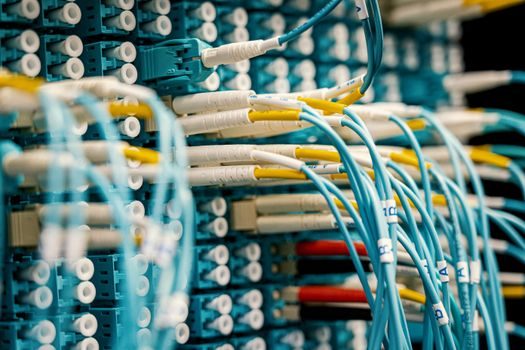
Downstream end-usage splits into five principal demand pools: industrial plant LV/MV power, oil and gas instrumentation, utility distribution, transportation, and data-centre medium-voltage feeder [S2]. USA Wire & Cable's 2026 line card reflects the split: medium-voltage (5-35 kV) and substation control cable sit next to portable power, tray cable, thermocouple, and instrumentation pairs, with single-conductor and armoured constructions covering utility substation and oilfield needs [S2].
The termination stack at the downstream interface — cable gland, cable tray support, and the field-side sensor — is where spec discipline typically breaks. A typical hazardous-area build lands on Ex d (flameproof) or Ex e (increased-safety) cable glands to IEC 60079-x, with IP66/67 sealing and a brass or stainless body matched to the cable tray material [S2]. Draw-wire encoders, the draw wire sensor family, and limit switches terminate the motion-control tail, with 0-2 m, 0-5 m and 0-10 m measurement ranges the common industrial bands [S2].
Sourcing Reality and Distributor Lead Time Bands
Distributor lead time is the single most volatile node in 2026. USA Wire & Cable commits to 24-48 hour cut-to-length on stocked catalog SKUs and ships from a USA master warehouse to all 50 US states and more than 50 countries, with 250+ years of combined internal cable experience as the stated service backbone [S2]. Jaguar Industries quotes the same 24-48 hour turnaround window on thousands of stocked SKUs from a 100K sq ft facility, indicating the cutoff window has compressed from the 2-3 week industry norm of 2020-2022 [S3].
Vendor selection on the upstream side follows a different logic. Copper cathode sourcing is locked to LME-approved refineries and ASARCO / Aurubis / Jiangxi class smelters, with rod-mill drawability typically capped at 1-2% scrap content for ETP class; aluminium uses 4N (99.99%) primary for magnet wire and 3N (99.9%) primary for 1350 overhead conductor [S1][S2]. For deeper supply-chain economics, the Cable and Wire Supply Chain 2026: Lead Times, Pricing Bands and Sourcing Levers piece lays out the same pricing bands in more detail. Insulated-conductor manufacturers, in turn, pull the same wire rod into very different product trees, and the choice of control cable vs power cable is set at the spec stage, not the procurement stage [S2].
Selection Criteria and Common Failure Modes
Specifying cable and wire in 2026 runs through four decision gates. Conductor: solid (class 1) for fixed conduit, stranded (class 2) for tray, fine-stranded (class 5 or 6) for flexing service. Insulation: XLPE for 90 °C LV power, EPR for flexible motor lead, PVC for general-purpose, PTFE/FEP for >150 °C or chemical exposure. Shield: unshielded for power, overall foil + drain for instrumentation, individual + overall for paired signal lines, braid where mechanical abrasion is in play. Armour: GSW for buried tray, SWA (steel wire armoured) for direct burial and impact risk, STA (steel tape armoured) for lighter mechanical demand [S2].
Common failure modes: (1) undersized neutral on harmonic-rich VFD output, where third-harmonic current on the neutral forces 1.73× derating; (2) cable tray fill above 40-50% cross-sectional area, the NEC guidance band, which traps heat and forces ampacity derating; (3) mismatched cable gland vs armour — Ex d glands must match the specific SWA/STA/IA construction; (4) cable gland torque below 80-120% of rated, the band that voids IP and explosion-proof certification; (5) electrolytic corrosion where copper glands land on aluminium cable tray without bi-metal isolation [S2].
Standards, Traceability and What to Verify Before PO
Specifications must reference the underlying standard. IEC 60228 governs conductor class. IEC 60502-1 covers LV power cable construction up to 0.6/1 kV, IEC 60502-2 covers 6-30 kV MV. IEC 60332-1 and IEC 60332-3 cover flame retardance, IEC 60332-3A being the relevant FRLS band for tray bunched cable. Thermocouple extension cable follows IEC 60584-3 colour codes; instrumentation pair shielding and drain follow the manufacturer's datasheet and 0.5-1.5 mm² cross-section guidance [S2].
For the copper upstream question, request mill test certificate with Cu-ETP grade and IACS conductivity; for armour, request the AISI grade and any ASTM/EN reference on the steel tape or wire. Trackable signals for the next 90 days: copper cathode LME band movement around the 8 mm wire-rod mill conversion premium, and 24-48 hour cut-to-length service windows from USA Wire & Cable and Jaguar Industries as the floor for what a stocked industrial distributor is currently committing to in mid-2026 [S2][S3].