
A conveyor chain is a meshing chain — typically roller, silent (inverted-tooth), or drag — driven by sprockets, with a working-load envelope that commonly reaches 1,000–5,000 kg per strand on standard ISO 606 (ANSI B29.1) roller-chain-based pallet conveyors, versus 50–200 kg per meter on a typical belt conveyor of equivalent width [S1].
The trade-off is structural: chain tolerates shock, heat (often up to 250 °C with suitable lubrication) and oil contamination that destroy fabric belts, but runs louder, requires periodic tensioning and lubrication, and limits top linear speed to roughly 30 m/min on most pallet lines before wear and vibration become unacceptable [S1].
Where Conveyor Chain Wins: The Mechanical Case
Chain conveyors carry pallet loads that belts physically cannot — pallet decks rest on slats or top-plates attached to the chain, distributing point loads across multiple rollers and avoiding the belt-stretch, slip, and tracking problems that show up above 500 kg per pallet on long runs [S1]. On pallet lines in 3PL, automotive, and beverage plants, the chain conveyor topology is still the default where ambient temperature or oil mist would degrade rubber or PVC belt covers [S1]. The driving link is a sprocket-to-chain positive engagement, so there is no slip under overload — a belt conveyor's contact friction is replaced by mechanical mesh, which is why chain pulls survive stall conditions that smoke a belt drive. For plants standardising on a single drive train, the same roller chain pitch (e.g. C206B, C208B, C210B) used on the conveyor is also used for the take-up and drive-shaft couplings, simplifying spares [S1].
Where It Loses: Noise, Speed, Hygiene, and Maintenance
Chain-driven conveyors are measurably louder than belt conveyors — published figures cluster around 75–85 dB(A) at 1 m for enclosed chain conveyors, versus 65–72 dB(A) for belt lines at equivalent speed, which is why they are uncommon in e-commerce fulfilment or retail back-of-house zones without acoustic enclosures [S1]. Linear speed is capped: most pallet-chain designs run 12–30 m/min, against 60–120 m/min for belt or roller accumulation conveyors handling the same footprint [S1]. Lubrication intervals are unavoidable; even "lubed-for-life" sealed chains on a silent chain bottom plate still need annual inspection, and a typical roller chain pallet conveyor wants re-lubrication every 200–500 operating hours depending on dust load. Hygiene is the other hard limit: chain has crevices between pins, bushings, and rollers where product debris and cleaning fluid accumulate, which is why food-contact and pharmaceutical lines overwhelmingly specify belt or modular-plastic conveyors instead. A cable drag chain inside a long-run conveyor (the energy chain, not the conveying chain) has its own failure mode — fatigue at the bend radius, typically rated for millions of cycles but catastrophic if the radius spec is dropped during installation.
Chain Type vs. Application: A 4-Criteria Comparison

Three chain families cover almost every pallet and unit-load conveyor: standard roller chain with attachments, inverted-tooth (silent) chain, and drag chain (also called cable drag or scrapper chain) for en-masse conveyance. Roller chain is the cheapest and most repairable, but the noisiest and least smooth at high speed. Silent chain rides quieter and smoother because the teeth mesh rather than the pins, but it costs 2–4× per meter and is less tolerant of misalignment. Drag chain is built for en-masse or chip/ scrap service in foundries and recycling — heavy, slow (3–15 m/min), and not suited to clean pallet handling. A conveyor chain spec sheet for any of these should expose pitch, ultimate tensile strength, allowable working load (typically 1/8 to 1/10 of UTS), pin material, and the lubrication regime; without those five numbers you cannot compare suppliers [S1].
Selection Rules a Process Engineer Will Actually Use
Specify chain conveyor when at least one of these is true: peak load per pallet exceeds 500 kg, ambient is above 60 °C or heavily oil-mist contaminated, the line must pull a stalled pallet without slipping, or the layout demands positive tracking around tight 180° transfers. Specify belt or roller instead when: noise at operator station must stay below 72 dB(A), top speed must exceed 40 m/min, the product is food/beverage/pharma direct-contact, or accumulation zones are needed without back-pressure sensors. Sprocket TCO is the silent killer on chain lines — pairing a low-cost chain with a soft sprocket, or vice versa, halves the drive-train life; for a working spec map on that trade-off, the Sprocket TCO 2026 article walks through the 10-year cost split between chain, sprocket, bearings, and lubricant. On the upstream packaging side, chain transfers must be sized to the pallet family you actually run — a generic transfer machine will fail on mixed EUR/ISO/FIN pallets, which is the single most common post-installation retrofit cost on new pallet lines [S1].
Failure Modes, Standards, and Sourcing Signals
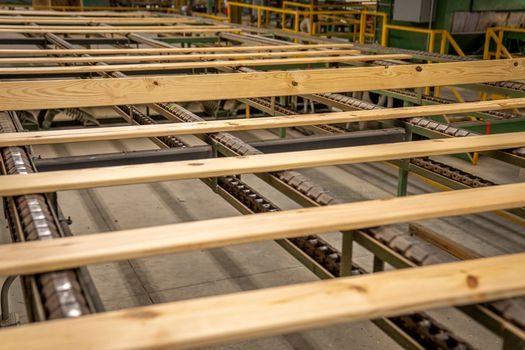
The four failures that dominate chain-conveyor downtime are: (1) pin/bushing wear leading to pitch elongation past 3% (the standard replacement trigger), (2) sprocket tooth hook from running with a stretched chain, (3) attachment-plate loosening under shock load, and (4) take-up screw seizure when re-tensioning is skipped. For engineered lines the chain should be specified to ISO 606 (short-pitch transmission) or ISO 1977 (conveyor chain), with chain attachment dimensions per ISO 4873; working load is derived as 1/8 to 1/10 of UTS per the same family, not the catalogue headline figure. On pallet conveyors specifically, the pallet conveyor selection guidance referenced from a comparable roller-conveyor spec map highlights that transfer-machine compatibility is the make-or-break decision point when mixing EUR 800×1200, ISO 1000×1200, and FIN 1000×1200 pallets on one line [S1]. Two trackable signals worth watching into late 2026: tighter EU machinery noise directives pushing more plants toward enclosed or silent-chain retrofits, and Chinese conveyor-chain makers (Wuyi, Hangzhou Xingda, Donghua) adding pre-stretched, sealed-pin variants to compete on the export pallet-line market.