
Automotive-tier foundries casting aluminum pistons, brass fittings, and zinc die-cast trim overwhelmingly specify tilting crucible furnaces in the 100-500 kg holding range, with crucible bodies of clay-graphite or silicon carbide rated for continuous 1000-1200°C service [S5].
Selection in this segment is dominated by four variables: alloy chemistry (Al, Cu, Zn, Mg), melt rate in kg/h, crucible material class, and the choice between electric resistance and gas-fired heating. The same vendor families (Entec, Støtek, Inductotherm) cover both the small-job die-cast shop and the tier-1 OEM line, but the spec sheet looks very different at each end [S4][S5].
Crucible Type, Heating Source, and Where Each Fits
Electric resistance crucible furnaces dominate the sub-300 kg segment because they install on a standard 3-phase 415 V or 480 V supply with no combustion permit, and they hold melt temperature within ±5°C of setpoint under PID control, which is the tolerance most zinc and lead-free aluminum alloys need for repeatable pour weight [S5]. Gas-fired crucible furnaces remain the default above 500 kg because the per-kg melt cost on natural gas or LPG is roughly half that of a 200-400 kW electric resistor bank, and the higher thermal headroom handles copper and brass melts above 1100°C without element degradation [S4].
For an aluminum piston or cylinder-head line, the typical configuration is a tilting crucible furnace with a 200-400 kW electric resistance heater, a silicon-carbide or clay-graphite crucible, and a hydraulic tilt cylinder rated for 90° pour within 8-12 seconds. For a brass radiator-component or zinc trim die-cast cell, the same shop may add a smaller holding furnace downstream to keep the melt at pouring temperature between shots, separating the high-power melting duty from the steady-temperature holding duty [S4][S5].
Crucible Material Class and Service Life
Clay-graphite crucibles (typically 60-70% SiC/SiO₂, 30-40% graphite) are the lowest-cost option for aluminum and zinc, with published service life of 200-400 heats at 750-900°C in intermittent duty. Silicon-carbide crucibles roughly double that life at the cost of 1.5-2× the purchase price, and are the default for continuous 24/7 production cells [S5].
For copper and brass melts above 1100°C, the practical choice is a silicon-carbide or fused-silica crucible, because clay-graphite oxidizes rapidly above 1000°C in oxidizing atmospheres. Magnesium alloys push the spec further: a steel-bodied crucible with a protective wash or a flux cover is standard, since standard graphite crucibles react with molten Mg. Crucible life is the single largest consumable line on a foundry P&L, so the per-heat cost (crucible price ÷ rated heats) is the right comparison metric, not the sticker price [S5].
Melt Rate, Capacity, and Throughput Math
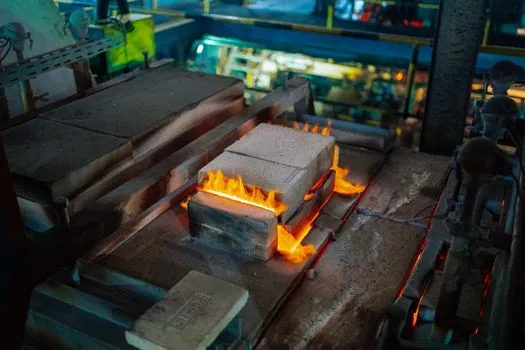
Rough rule for sizing: an electric resistance crucible furnace delivers about 0.7-0.9 kg of molten aluminum per kWh at 750°C, and a 200 kW unit hits a melt rate near 140-180 kg/h from a cold start, dropping to 100-130 kg/h once the crucible is hot. A 400 kW twin-crucible unit pushes the line to 280-360 kg/h, which is the throughput band most automotive tier-1 foundries target for a single die-cast cell [S5].
Støtek markets shaft melting and high-capacity dosing as a way to cut per-kg furnace cost on aluminum lines, and the same engineering logic translates to the crucible-furnace segment when a casting cell runs two or more shifts: the bigger crucible that melts faster per kWh almost always wins on total cost of ownership, even though the unit price is higher [S4]. For low-volume job shops running a single 8-hour shift on zinc or lead-free alloys, the math inverts and a 50-100 kg electric unit is the rational buy.
Comparison: Electric vs Gas-Fired vs Induction Crucible
For automotive parts foundries, three options compete on the same shop floor. The table below lines up the realistic decision criteria; the right pick depends on the alloy, the shift pattern, and the local energy tariff. [S3]
Electric resistance crucible: 50-500 kg capacity, 100-400 kW, 700-1000°C continuous, ±5°C control, low NOx/no combustion permit, best for Al and Zn in intermittent or clean-shop duty. Gas-fired crucible: 200-2000 kg, 0.5-3 MW burner input, 900-1300°C, lower per-kg fuel cost, requires stack and emissions permit, best for Cu/Brass and high-throughput Al. Induction crucible: 50-2000 kg, 100-2000 kW medium-frequency, 700-1600°C, fastest melt, cleanest melt (low hydrogen), higher capital and spare-parts cost (SCR stacks, coil, chill blocks); see induction furnace for the broader category [S2][S4][S5].
In practice, the spec gate most buyers run first is alloy: Al and Zn → electric; Cu and brass → gas; high-purity Al or magnesium → induction. The second gate is throughput: under 200 kg/shift, electric; 200-1000 kg/shift, either; over 1000 kg/shift, gas or large induction [S2][S5].
Control, Safety, and Standards Discipline
Modern crucible furnaces for automotive work are specified with PID temperature controllers, thermocouple break protection, crucible over-temperature cutout, and a tilt-axis interlock that prevents pour unless the ladle or launder is in position. Combustion-gas units add flame-failure detection and a redundant gas shutoff valve. Compliance with CE machinery safety and, for European sites, ATEX 2014/34/EU for any Zone 1 dust-rated area around the charge door is the standard expectation [S5].
Spare-parts planning matters: induction crucible lines (Inductotherm, AJAX Tocco, Electrotherm, Megatherm, Pillar) need a stocked bench of inverter SCRs (e.g. 9102/9112/1133/9109), rectifier SCRs (C431PM), rectifier diodes, snubber assemblies, semiconductor fuses, water-cooled power cables, coil supports, chill blocks, and flow switches, because a single failed SCR can idle a 24/7 cell [S2]. For related components on the same automotive line, the angular contact bearing selection for automotive production lines spec map and the holding furnace selection for hardware manufacturing guide cover adjacent procurement decisions.
Limitations and Failure Modes Buyers Miss
The most common under-spec is crucible material: a clay-graphite crucible run above 1000°C in a copper melt will fail in days, not months, and the failure mode is a bottom pour that drops molten metal into the element well. The second is power supply: a 400 kW electric resistance furnace on a 415 V site needs a 630-800 A breaker, and undersized supply cable will trip on every cold-start surge. [S5]
For induction crucible furnaces, the failure path most often traces to cooling water (chill-block fouling, flow-switch failure) or coil insulation breakdown after 18-30 months in continuous service. Stök a preventive-spare kit (coil support, snubber components, semiconductor fuses, flow switch, current-limiting reactor) on hand at commissioning, because lead time on a custom coil is 6-10 weeks and that is the real downtime risk on an automotive line [S2].
Procurement Signal Map for the Next Buying Cycle
Trackable signals for the next 3-6 months: vendor lead times on silicon-carbide crucibles in the 200-500 kg size (currently the supply bottleneck per industry channels), CE/ATEX re-certification timelines for gas-fired units under revised EU machinery rules, and the roll-out of medium-frequency induction crucible packages below 200 kW, which are now reaching price points that compete with electric resistance on per-kg melt cost for sub-300 kg aluminum cells [S4][S5].
