Fiber laser source pump diodes are commonly rated near 100,000 hours and the laser itself runs roughly 8-14 years under stable chiller temperature and a clean cutting head, while CO2 laser tubes typically last 1,000-10,000 hours with steady power decay [S1].
Across all cut-off platforms the wear hierarchy is the same: low-cost consumables (blades, nozzles, protection windows, lenses) fail first, then drive system components, then the frame; replacement schedules should track hours, cut quality and counters rather than fixed calendar dates [S1][S5].
Laser Cutters: Fiber vs CO2 Service Life and Wear Signals
Fiber lasers age slowly because the beam travels through a sealed fiber optic cable, so dust and smoke do not contaminate the optical path; aging signs are minimal and gradual, eventually requiring higher power settings or slower feed speeds [S1].
CO2 lasers expose mirrors and an open beam path to the shop environment, so output declines with use and three common aging flags appear: the operator must raise tube current to recover cut quality, results become inconsistent, and beam alignment drifts more frequently between sessions [S1]. Optics on either platform should be inspected and cleaned every 10-40 work hours with proper lens fluid and lint-free paper, and capped when not installed, since small defects quickly kill beam quality [S1]. Consumables like protection windows and nozzles wear fastest and account for most cut-quality complaints; replacing them on time protects the expensive laser source [S1].
Cut-Off Saws and Pipe Cutters: Blade RPM, Lubrication and Hydraulic Schedules
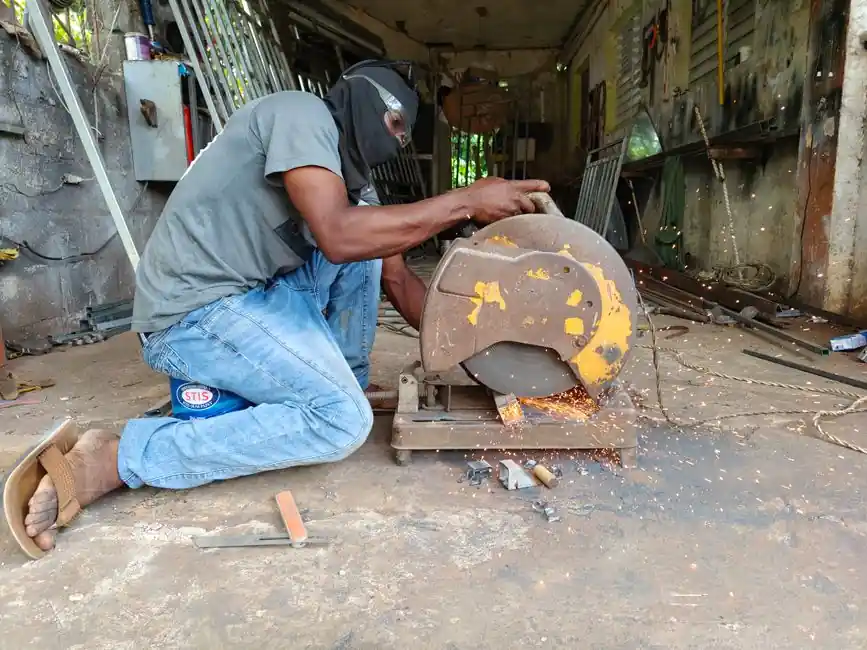
Cut-off saw blades must be matched to the saw's RPM rating; operators should look for cracks, warping, or worn segments daily, and replace any blade showing damage before the next shift [S2]. Dust and debris are the primary killers: concrete slurry, metal shavings, and clogged vents should be cleared with compressed air or a soft brush after each job, and the air filter cleaned or replaced to prevent engine overheating [S2].
Pipe cutting machines follow a layered schedule: clean guides, screws and the worktable after each use, lubricate guides, screws, gears and the hydraulic system on a monthly cadence, then run a periodic calibration of blade alignment, cutting depth and guide parallelism annually [S3]. Hydraulic oil level and quality must be checked monthly because insufficient lubrication shows up as abnormal noise and accelerated wear on key components [S3]. Electrical checks on power cords, switches, plugs and the control panel are part of the same cycle, since a single aging cable can shut a line down faster than a dull blade [S3].
Die Cutters and Digital Cutters: Daily, Weekly and Monthly Service Tiers

Die cutting machines are vibration-heavy workhorses, so a start-of-day and end-of-day routine should clean the work surface, cutting bed and die area with a dry cloth or soft brush, then inspect the die holder, pressure plate and feed rollers for loose screws before torqueing to spec without stripping threads [S4]. Weekly, the die itself should be checked for blade sharpness, bent or damaged blades, and trapped debris between blades; dull or damaged dies must be sharpened or replaced because a bent blade can ruin the cutting bed [S4].
Digital cutters follow a parallel tiered plan. A daily checklist should cover the blade and tool holder, the cutting strip, material path, feed rollers, registration cameras and sensors, waste collection, accessible safety covers, and a known test file compared against an approved sample [S5]. Weekly or periodic checks add deeper cleaning, permitted belt or guide inspection, consumable tool condition, and an approved calibration or registration test; replace parts based on operating counters, cutting quality and the machine manual, not assumed universal service lives [S5]. If a problem persists, the documented baseline should be restored and the issue escalated to technical support rather than chasing symptoms by changing parameters [S5]. The same logic maps to cut-off machine commissioning, where baseline records set the reference for every later wear judgement.
Cutting Machine Consumables: Optics, Belts, Rollers and Filter Service Windows
Across laser, abrasive and digital platforms, consumables are organised by wear rate rather than by machine family. The fastest-retiring items on a fiber laser are protection windows and nozzles, which absorb spatter and degrade cut quality long before the 100,000-hour diode rating is approached [S1]. On cut-off saws, the diamond or abrasive blade is the primary consumable and is replaced when segments are worn, the body is cracked, or cut quality drops even though the spindle still runs at the rated RPM [S2].
Drive-train consumables sit on a longer cycle. Drive belts on a cut-off saw should be inspected weekly for looseness or glazing and adjusted to manufacturer spec, since a slipping belt throws away power and causes uneven cuts [S2]. Feed rollers and guides on die and digital cutters should be cleaned monthly to remove adhesive and dust buildup, since glazed rollers cause misfeeds and registration drift before any blade wear is visible [S4][S5]. A useful comparison anchor: an abrasive cut-off saw blade in concrete service is typically retired in days to weeks, a die blade in weeks to months, a digital cutter blade holder in months, a fiber laser protection window in weeks to months, and the fiber laser source itself in years, so spare-parts inventory and replacement budgets should mirror that pyramid [S1][S2][S4].
Maintenance Schedules by Family: From Daily 5-Minute Checks to Annual Calibration

A practical rule: daily checks on a cut-off saw include pre-use inspection, post-job cleaning, air filter check and blade inspection, weekly checks add pivot, throttle and bearing lubrication plus fuel and drive-belt inspection, and monthly or seasonal checks cover spark plug replacement on gas models and water-delivery verification on wet-cutting setups [S2].
Pipe cutting machines layer the same way: daily cleaning and blade check, monthly hydraulic and electrical-cabinet service with filter replacement, and an annual comprehensive inspection with replacement of worn parts and full cutting-depth, blade-alignment and guide-parallelism calibration [S3]. Digital and die cutters collapse the tiers into a checklist anchored on the machine manual, operating counters and the actual wear condition rather than a fixed date, with the additional safeguard of running a known test file each shift and only changing parameters after recording the abnormal result [S4][S5]. Comparable hour-based service tiers appear in skid steer maintenance in mining, where counter-driven replacement similarly beats calendar-driven replacement for heavy industrial fleets.
Who a Cut-Off Machine Lifespan Program Is For, and Where It Fails
An hours-and-quality driven replacement program is built for fabrication shops, packaging lines, construction crews and pipe workshops that run their cut-off equipment on multi-shift duty and need predictable downtime, since a documented counter and cut-quality record lets maintenance plan a swap before a part fails in production [S1][S3][S5]. It is less useful for very low-duty or hobby use, where a calendar-based service every three months is enough to keep the machine serviceable [S6].
The approach breaks down when the operator skips the test-file or quality baseline, because without that reference there is no defensible threshold for "replace" and the team either over-replaces consumables or runs a degraded blade until something downstream breaks [S5]. It also assumes a clean, temperature-controlled environment: dusty, hot or vibration-heavy sites compress every service interval on the list above, so the same maintenance program in a stone yard or a foundry will not match a clean-room packaging line [S2][S3].
Replacement Triggers and Sourcing Standards for Cut-Off Machine Spares
The cleanest replacement trigger set, applicable across families, is: (1) measured hours or cycles on the operating counter versus manufacturer rating, (2) cut quality versus an approved reference sample, (3) visible wear beyond a defined limit (cracks, warping, dulling, glaze, debris contamination), and (4) safety component failure on guards, interlocks, emergency stops or limit switches [S2][S3][S5].
For sourcing, default to OEM or OEM-equivalent spares that ship with the same material specification and dimensional tolerance as the original, and keep a small buffer stock of the fastest-wearing items (nozzles, protection windows, abrasive blades, die blades, feed-roller cleaning supplies) sized to one to two replacement cycles [S1][S2][S4]. Generic consumables on cut-off saws and die cutters can usually be sourced from independent industrial suppliers without affecting performance, but laser optics, pump diodes and digital-cutter tool holders are usually best kept on OEM part numbers because small optical or registration errors propagate directly into scrap [S1][S5]. Trackable signals to watch over the next maintenance cycle: (a) fibre-laser chiller temperature stability versus nameplate, (b) CO2 tube current trend versus cut-quality log, and (c) digital-cutter registration drift versus the test file baseline, with each metric tied to a documented replacement threshold before the next scheduled service [S1][S5].
Spec-level background on the components involved: linear guide, crossed roller guide, and construction machinery and equipment.