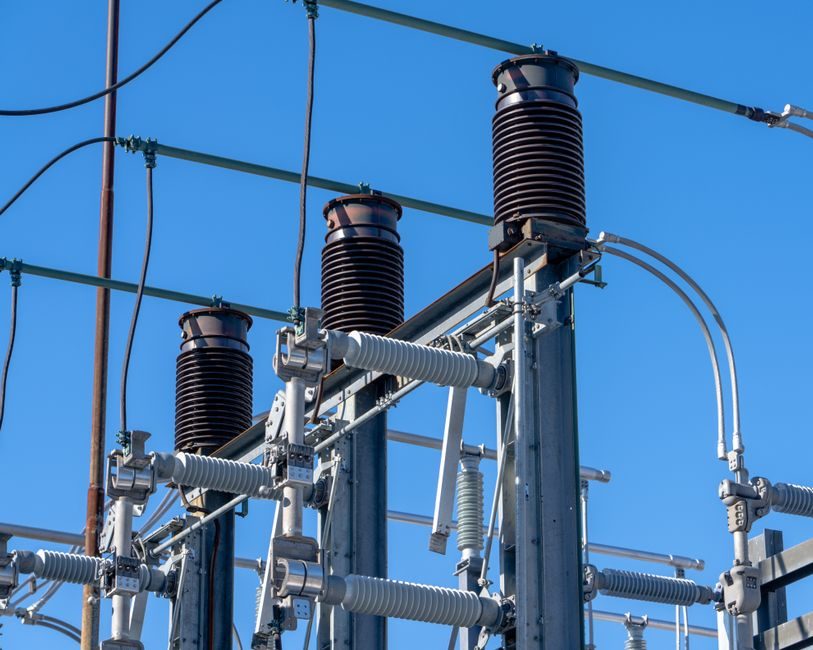
Specifying a distribution cabinet in 2026 is decided by four measurable numbers first: connected-load kVA, enclosure IP/IK rating, busbar rated current, and short-circuit withstand (Icw). The MERZ AVEV series covers 24-173 kVA at IP54 with RAL 2000 polyester powder coat on galvanized sheet steel [S1], and the M-VEV 125 line extends that envelope to 24-277 kVA at the same enclosure class [S2] — these are the two product bands most mainland-European EPCs compare against.
Chinese supply-side data confirms the price spread: a 3-phase steel power-distribution panel (Fujian Guozhiyun) lists US$218-428 per piece at 3-piece MOQ [S5], while a custom stainless battery/power enclosure (Yantai Deshibo) drops to US$2-5 per piece at 10-piece MOQ [S5]. A specifier should treat those as two different SKUs (commodity paint-grade panel vs. custom stainless sheet-metal build), not competing options for the same job.
Connected-load kVA: how to size the cabinet, not the breaker
Connected load is the sum of downstream nameplate kVA, not the size of the incomer breaker. MERZ specifies AVEV at 24-173 kVA with socket outlets up to 125 A and RCD (residual-current device) protection on every outgoing way [S1]; M-VEV pushes the same architecture to 277 kVA with terminal/connector distribution downstream of a group or main distributor [S2]. Apply a 1.25 diversity factor to the nameplate sum and confirm the result still sits inside the published kVA window before selecting the enclosure size.
For a 400 V three-phase site, 173 kVA equals roughly 250 A at the busbar; 277 kVA equals roughly 400 A. If your calculated load exceeds 250 A, jump straight to the 400 A-class M-VEV build rather than cascading two AVEV units — cascading introduces two RCD discrimination problems and extra 35 mm² copper that costs more than the larger cabinet.
Enclosure rating: IP54 vs IP65 vs IP66 and what each really costs
IP54 (dust-protected + splashing water) is the baseline for sheltered outdoor site-distribution work and is what both MERZ series ship as standard [S1][S2]. Each step upward (IP65 = jetting water, IP66 = powerful jetting) typically adds 15-25% to enclosure cost and forces a redesign of gland plate entries. For tunnel, coastal, or wash-down food-grade sites, pay the IP65 premium; for indoor riser columns, IP54 is over-spec and wastes budget.
Material choice is the second enclosure decision. Hot-dip galvanized sheet steel (1.5-2.0 mm) with polyester powder coat is the default for IP54 outdoor builds — MERZ uses RAL 2000 yellow-orange as the visible identifier [S1]. Stainless 304/316 is mandatory for chemical, marine, and pharmaceutical zones; this is the segment where the US$2-5/piece Yantai Deshibo custom enclosures sit [S5], although at that price point you are buying an unassembled sheet-metal box, not a wired cabinet with busbar, RCD, and meter.
Busbar, RCD and short-circuit: the three internal specs that drive safety

Three internal numbers determine whether a cabinet is safe to energise, independent of the enclosure: busbar rated current (125 A, 250 A, 400 A, 630 A), Icw short-circuit withstand (typically 10 kA for 250 A class, 25 kA for 630 A class), and RCD type (Type A for AC + pulsating DC, Type B for smooth DC, Type AC for AC-only loads). MERZ AVEV explicitly integrates "protective-insulated up to and including RCDs" plus 125 A socket outlets [S1]; M-VEV extends the outgoing way count to terminal/connector distribution downstream of a group or main distributor [S2].
Specify Type A RCD at minimum on any cabinet feeding EV chargers, VFD-driven motors, or LED drivers — these loads produce pulsating DC residual current that a Type AC device will not detect. The standard reference for RCD behaviour in Europe is IEC 61008-1 (electromechanical) and IEC 61009-1 (RCD+MCB combined); cite the standard on the drawing, not on the supplier quote.
Who it is for, and who should not buy a cabinet at all
A distribution cabinet is for the specifier who needs to subdivide an incoming supply (from a transformer or MCC cabinet) into multiple metered or unprotected outgoing ways for downstream loads, sub-distribution, or site socket outlets. It is NOT for motor control — that is what a motor control centre does, and the two should not be mixed in the same enclosure because the thermal management and the contactor switching transients are different problems. [S1]
It is also NOT for hazardous-area Zone 1 or Zone 2 work unless the cabinet is built to explosion-proof distribution standards with Ex e or Ex d certification; a standard IP54 outdoor cabinet like the MERZ AVEV is fine for non-classified outdoor industrial yards but must never be installed in an area where flammable gas or dust is normally present. Confirm the zone classification on the PID before quoting any cabinet.
Standards, certification and the CCC customs angle for cross-border buyers
For buyers importing AC distribution cabinets into China, the HS-code reference for "a.c. distribution cabinet" is the relevant customs line, with MFN tariff, declaration norms and CCC (China Compulsory Certification) requirements published on the ETCN customs lookup [S3]. CCC applies to specific product categories under the CNCA catalogue; a general low-voltage distribution assembly may or may not fall inside the mandatory list depending on rated voltage and intended use — verify with the latest CNCA catalogue before shipment rather than relying on a supplier's verbal assurance.
For IECEx/ATEX zones, the governing standard family is IEC 60079 (parts 0, 1, 7, 11 for the common protection types). A specifier working on a European chemical plant should require the ATEX 2014/34/EU EU-type-examination certificate for any cabinet going into Zone 1, with the certificate number printed on the enclosure nameplate, not just quoted in a PDF cover letter.
2026 sourcing landscape: factory tiers and price reality
Made-in-China lists StarDynamic Power Equipment (Fujian) as a dedicated OEM/ODM distribution-cabinet manufacturer [S4], which is the typical mid-tier custom shop for export builds at 50-500 piece annual volume. The retail-search price range on the same platform spans two orders of magnitude — US$218-428 for a 3-phase steel power panel (Fujian Guozhiyun, 3-piece MOQ) and US$2-5 for a custom stainless enclosure (Yantai Deshibo, 10-piece MOQ) [S5] — and the gap reflects build completeness, not supplier markup. A "cabinet" at US$2-5 is a bare enclosure; a "cabinet" at US$218-428 includes busbar, breaker provision, and finish.
For project buyers, the practical sourcing rule is: ask for a GA drawing plus a single-line diagram plus the bill of materials with part numbers, and reject any quote that returns only a price. The BOM is where you will find out whether the supplier is quoting galvanized sheet at 1.2 mm (too thin, will oil-can) or 1.5-2.0 mm (the MERZ-class default [S1]); whether the RCD is Type AC, A, or B; and whether the busbar is copper or aluminium. A power distribution box variant for smaller commercial jobs typically uses 1.2 mm sheet and 63-100 A busbar, which is a different SKU class entirely.
Comparison at a glance: AVEV vs M-VEV vs custom stainless
Three common 2026 product classes, lined up against four decision criteria that a specifier actually writes on a drawing: [S2]
Criterion 1 — Connected-load kVA: MERZ AVEV 24-173 kVA [S1]; MERZ M-VEV 24-277 kVA [S2]; custom stainless enclosures are application-specific and quoted per build [S5].<br> Criterion 2 — Enclosure rating: AVEV and M-VEV both IP54, RAL 2000 powder on galvanized sheet [S1][S2]; custom stainless typically IP65 with brushed or 2B finish [S5].<br> Criterion 3 — Outgoing configuration: AVEV = socket outlets up to 125 A + RCDs [S1]; M-VEV = terminal/connector distribution downstream of a main [S2]; custom = wired to drawing.<br> Criterion 4 — Typical unit price (2026): AVEV/M-VEV are project-quoted in EUR; a 3-phase steel panel on Made-in-China runs US$218-428 at 3-piece MOQ [S5]; a bare custom stainless enclosure runs US$2-5 at 10-piece MOQ [S5].
For mid-range industrial site distribution (50-250 A, IP54, outdoor) the AVEV class is the right default. For larger sites (250-400 A) step to M-VEV. For chemical, food, or coastal zones, go custom stainless at IP65+ and accept that the cabinet will be 2-3× the AVEV unit price once wired and certified.
For broader selection context, a spec-first approach also governs adjacent building-envelope procurement — see the concrete admixture buying guide 2026 for a parallel spec-driven methodology. Two trackable signals to watch through Q3-Q4 2026: copper busbar spot price (LME Cu, drives every cabinet BOM by 8-15%), and the CNCA CCC catalogue revision cycle for low-voltage distribution assemblies — both will move the 2026-2027 sourcing economics more than any single supplier decision.