
DRAM contract prices moved counter-seasonally higher into 3Q26 as AI-driven HBM3E/HBM4 allocation pulled wafer capacity away from DDR5 commodity lines, with the 3Q26 hike flagged on DIGITIMES on 2026-07-07 [S3]. On 2026-07-21 DIGITIMES reported Haesung DS adding CXMT as a DDR5 substrate customer while weighing panel-based production for the DDR6 transition, signaling that Chinese DRAM makers are now firmly in the Tier-1 substrate qualification pipeline [S3].
Buyers serving hyperscale, automotive, and industrial-embedded workloads should expect tight DDR5 allocation through 4Q26, with verified-channel sourcing — including China-based supply networks handling DDR, NAND, eMMC and DRAM categories [S1] — becoming a structural rather than emergency lever. A related 2026 supply review of HBM allocation and the CoWoS bottleneck covers the upstream constraint now dictating DRAM wafer economics.
What "DRAM supply chain 2026" actually means in scope
DRAM in 2026 is no longer a single commodity bucket — it splits into HBM (HBM3E in mass production, HBM4 sampling), DDR5 (server, desktop, embedded), DDR4 (legacy industrial/automotive tail), LPDDR5X (mobile), and GDDR7 (discrete GPU) [S3]. Wafer starts are dominated by three suppliers (Samsung, SK hynix, Micron), with CXMT scaling as the principal Chinese DRAM entrant now appearing in substrate-vendor customer rosters [S3].
The packaging and substrate layer is the active bottleneck: HBM stacks use TSV + microbump, mainstream DDR5 uses fine-pitch BGA substrates, and the next DDR6 generation is being prepared for panel-level processing rather than 300 mm wafer-based substrate [S3]. Buyers mapping 2026 capacity should plan around substrate lead-time, not raw wafer availability, because substrate allocation gates finished-DRAM output.
Selection criteria for 2026 DRAM procurement
Three engineering parameters now drive device selection more than die density alone: (1) JEDEC speed bin (DDR5-4800 to DDR5-8800 MT/s for native, higher via overclocked modules), (2) power envelope (DDR5 VDD = 1.1 V core, VDDQ = 1.1 V, VPP = 1.8 V per JEDEC JESD79-5), and (3) on-module PMIC presence (DDR5 moved voltage regulation on-DIMM, which is invisible to host boards but reshapes thermal and validation work). For industrial buyers, additional gating factors include operating-temperature grade (-40 °C to +95 °C for automotive/industrial vs 0 °C to +95 °C commercial) and row-hammer mitigation (DDR5 includes on-DIMM RMF; legacy DDR4 does not).
Industrial and embedded designs still on DDR4 should audit lifecycle risk: DDR4 EOL notices from the three majors have been issuing for several years, and second-source industrial distributors [S1] report constrained DDR4 SODIMM/UDIMM supply as a routine RFQ category. Where a redesign is not feasible, conformal-coating, locked-BOM, and extended-temperature screening push effective cost up materially.
DDR5 vs HBM vs LPDDR5X — decision comparison
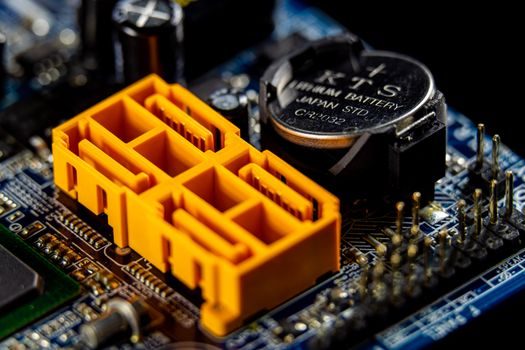
Buyers specifying memory for 2026 platforms should weigh four axes side-by-side. (1) Bandwidth: HBM3E delivers 800–900+ GB/s per stack, DDR5-6400 modules peak around 51.2 GB/s per DIMM, LPDDR5X-8533 64-bit channels sit near 68 GB/s — HBM wins for accelerator memory but loses on cost-per-bit. (2) Capacity: HBM stacks ship 8-Hi/12-Hi/16-Hi (24 GB typical, 36 GB sampling); DDR5 RDIMMs reach 256 GB; LPDDR5X package caps remain in the 16–32 GB mobile range. (3) Power: HBM uses a wide I/O with lower pJ/bit than DDR5 for high-bandwidth workloads, but board-level integration cost is far higher. [S1]
(4) Sourcing posture: HBM is locked into accelerator-vendor allocation (and is the root cause of the CoWoS-related DRAM tightness that DIGITIMES flagged on 2026-07-07 [S3]); DDR5 RDIMMs are quotable through distribution and now through verified China channels handling DDR and DRAM categories [S1]; LPDDR5X remains mobile-OEM dominated. For industrial-control and edge-AI boards, the practical answer is almost always DDR5 SODIMM/UDIMM or LPDDR5X solder-down — HBM is irrelevant. Readers looking at the broader allocation picture should also see the analysis of advanced packaging suppliers and manufacturers in 2026, since substrate and CoWoS are the same upstream queue.
Real use cases: where each DRAM type is specified in 2026
Hyperscale AI training platforms consume HBM3E/HBM4 stacks paired with advanced packaging — the proximate driver of the 3Q26 DRAM price firmness that DIGITIMES reported on 2026-07-07 [S3]. General-purpose servers (AMD EPYC, Intel Xeon, Nvidia Grace-class CPUs) rely on DDR5 RDIMMs at 4800–6400 MT/s with on-DIMM PMIC, eight-channel designs typically populating 768 GB to 1 TB per node. Networking and edge hardware lean on DDR5 SODIMM and ECC variants, and on LPDDR4/LPDDR4X where power and thermals dominate.
Industrial PCs, machine-vision controllers, and HMI panels mostly sit on DDR4 SODIMM or DDR5 SODIMM depending on CPU generation. For high-bandwidth industrial-AI inference (vision inspection, predictive maintenance, robotic cells), LPDDR5X solder-down is increasingly the right answer because of bandwidth-per-watt and solder-down security against vibration — an area where conformal coating on SODIMM is not a substitute. The industrial Ethernet spec map for smart manufacturing shows how memory bandwidth and deterministic networking co-design on these lines.
Constraints, failure modes, and what to watch next
Three failure modes hit 2026 DRAM programs most often. (1) Row-hammer induced bit-flips on long-uptime industrial systems — mitigated by DDR5's on-DIMM RMF, not by DDR4. (2) Power-rail noise: DDR5 on-DIMM PMICs require 5 V or 12 V supply from the host and tight bulk-decoupling, and many industrial carrier boards were not designed for that. (3) Thermal: DDR5 DIMMs run hotter at 1.1 V with PMIC losses; industrial chassis need verified airflow before the rated JEDEC speed bin is reliable. [S1]
On 2026-07-21 DIGITIMES separately flagged power and water constraints casting doubt on South Korea's Honam memory cluster — meaning even where DRAM demand is firm, new fab capacity is gated by utilities, not by tool delivery [S3]. Trackable signals for the next quarter: CXMT DDR5 substrate volume with Haesung DS [S3], DDR6 panel-process qualification decisions, and the read-through into liquid cooling demand for AI server memory as HBM stack height and power density continue to climb.
The underlying component specifications are covered under dc power supply, switching power supply, and industrial ups.