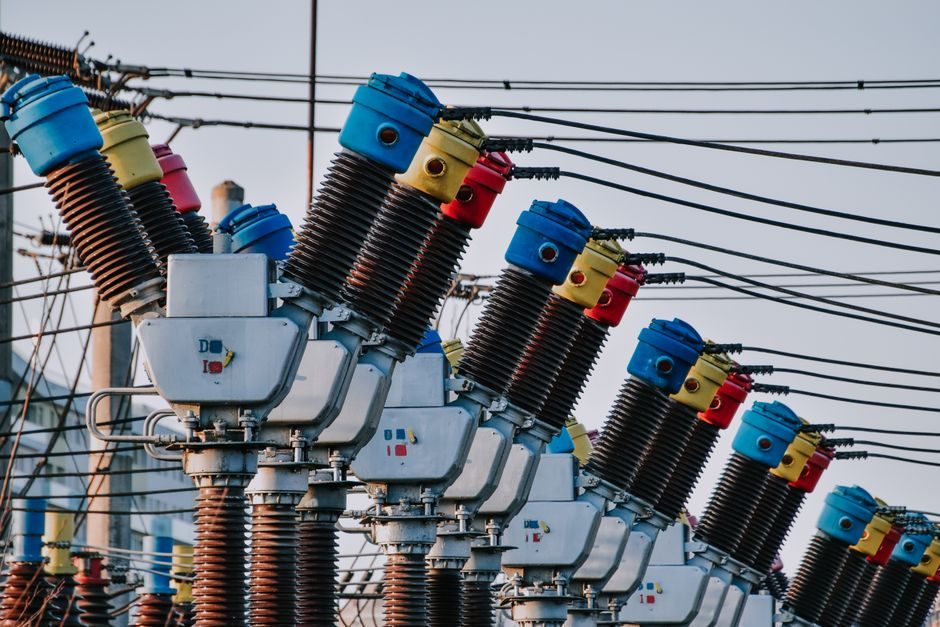
Industrial electric motors draw about 40% of global electricity and about 69% of all industrial electricity, with over 30 million new units sold each year and an installed base near 300 million [S8]. Industry 4.0 work on those assets has narrowed onto three concrete fronts: data-driven remanufacturing of stator and rotor assemblies, digital retrofit of brownfield motor lines, and energy-efficiency reporting under IEC 61800-9-2:2023 for variable-speed drives [S2][S3].
Remanufacturing research documented in the MDPI review of UK electrical-machining practice describes two reference process routes for high-efficiency motors: retaining the rotor core while replacing shaft, bearings, insulation, impellers, fan covers, and rewound windings, or retaining the stator core while the rotor core, shaft, bearings, insulation, impellers, fan covers, and winding are all replaced [S1]. The framing matters for AC motor buyers because the retained component defines the design-of-experiment boundary for digital-twin and condition-monitoring pilots.
Where Industry 4.0 lands on the motor manufacturing stack
Mayr et al. at the 2018 International Electric Drives Production Conference mapped the application potential of Industry 4.0 inside electric motor production and concluded that data-analytics and machine-learning use cases offer the largest payoff, ahead of purely additive-manufacturing pilots [S3]. Subsequent work modelled the interdependencies of deformable copper wire in the winding process, showing that wire tension and winding speed are the dominant input parameters governing final electrical properties and defect rates [S3 citation graph]. For process engineers, this validates a layered data strategy: instrument the winding cell first, then push models outward to lamination, impregnation, and final test.
Timed Petri net models for electric-motor manufacturing explicitly account for design and process uncertainty, and the 2020 IEEE Green Energy and Smart Systems Conference paper demonstrates cost-effective Industry 4.0 adoption while minimising lifecycle waste [S4]. A separate review of next-generation EV motor roadmaps catalogues the same body of work, with 80+ peer-reviewed sources, and confirms that the production-side bottleneck is no longer materials cost but data continuity from coil to end-of-line test [S4].
Remanufacturing as a circular-economy entry point
The 2021 Sheffield survey of UK repair and remanufacturing firms found that roughly half of respondents performed no component-level repair on electrical machines, yet the same respondents expressed intent to migrate toward more sustainable operations [S1]. Permanent-magnet motor cost breakdowns in the same review attribute 40–60% of unit cost to rare-earth materials, with a global recycling rate under 3% [S1]. That imbalance is what positions digital retrofit, rather than greenfield linear motor or hydraulic motor replacement, as the highest-leverage Industry 4.0 play for small and medium motor shops.
For AC motor fleets, the practical retrofit path is to fit current and vibration sensors, link them to an Asset Administration Shell, and feed the stream into a winding-defect classifier, an architecture validated by the 2020 Procedia CIRP paper on digital retrofit of SMEs (cited inside the Mayr review) [S3]. Buyers specifying retrofit kits should expect edge gateways supporting OPC UA, MQTT, and at least one legacy fieldbus, with cybersecurity aligned to IEC 62443 at the cell level.
Energy efficiency: IE5, IEC 61800-9-2, and variable-speed drive losses
The March 2025 UNEP U4E policy guide references IEC 61800-9-2:2023 (Edition 2) as the reference standard for energy-efficiency indicators covering power drive systems, motor starters, and power electronics plus their driven applications [S2]. The same guide cites the IEC 60034-30-2 efficiency class framework that defines IE5 (premium) for motors operated on variable-frequency drives. Together, these two standards give a single comparable envelope: motor efficiency class on the rotating machine, drive-system efficiency class on the converter-and-motor combination.
Selection criteria for industrial motor-control upgrades under Industry 4.0 thus reduce to four gates: (1) motor class at fixed duty, (2) drive-system class IE0 to IES2 under IEC 61800-9-2 partial-load operating points, (3) sensor and edge-gateway coverage for vibration, current, and temperature, and (4) the Asset Administration Shell or equivalent digital-nameplate integration with the plant historian.
Adoption signals in 2025-2026: robotics, automotive EV, and policy
The Coherent Market Insights outlook for electric motor cores to 2033 lists robotics, IoT, and process automation as the structural growth driver, noting that collaborative robots use servo motors as the primary motion element [S5]. Automotive electrification is the second visible driver, with a 2025 Swansea working paper on sustainable Industry 4.0 adoption in EV powertrain plants documenting that digital integration now spans the full product lifecycle rather than only the assembly cell [S7]. For heavy industry, the WEG specification guide observes that the electric motor represents more than 68% of industrial energy consumption and that inverter-driven operation requires a separate standardisation track from direct-on-line operation [S6].
For decision makers, the comparison that matters between AC induction, synchronous reluctance, and permanent-magnet-assisted synchronous reluctance motors in 2026 is now a four-axis table: (a) IE class at the operating duty point, (b) IEC 61800-9-2 drive-system class on the matched VFD, (c) digital-nameplate completeness for retrofit or predictive-maintenance rollouts, and (d) rare-earth exposure for circular-economy compliance. Permanent-magnet motors still lead on power density, synchronous reluctance variants lead on rare-earth avoidance, and AC induction units remain the lowest-cost retrofit baseline. Pick the axis your plant cannot compromise on first; the rest follow as constraints.
Limits, failure modes, and what the standards still do not cover
Data coverage gaps remain the single largest documented failure mode. The Mayr review warns that data-driven use cases stall when there is no consistent information model between winding, lamination, and final test, an issue Klein, Wirth, and Fleischer re-confirmed at the 2023 International Electric Drives Production Conference [S3]. Cybersecurity on brownfield motor lines is a second unresolved exposure: IEC 62443 zone-and-conduit design is rarely retrofitted alongside the OPC UA gateway, leaving the motor cell as a soft entry point into the plant network.
For an end-user auditing a supplier claim, the verifiable next nodes are: (1) the exact IEC 61800-9-2 drive-system class (IES0, IES1, or IES2) printed on the VFD datasheet, (2) the Asset Administration Shell submodel templates used for the motor and drive pair, and (3) the OEM's published remanufacturing take-back flow per the two reference process routes in [S1]. Plants that can produce all three documents in under 48 hours are the ones most likely to convert the U4E guide's 20–30% saving range into a measured number on the next quarter's utility bill.
Spec-level background on the components involved: electric actuator.
Related analysis: Hospital Concrete Release Agent Selection: Formwork, IAQ, Biocompatibility.