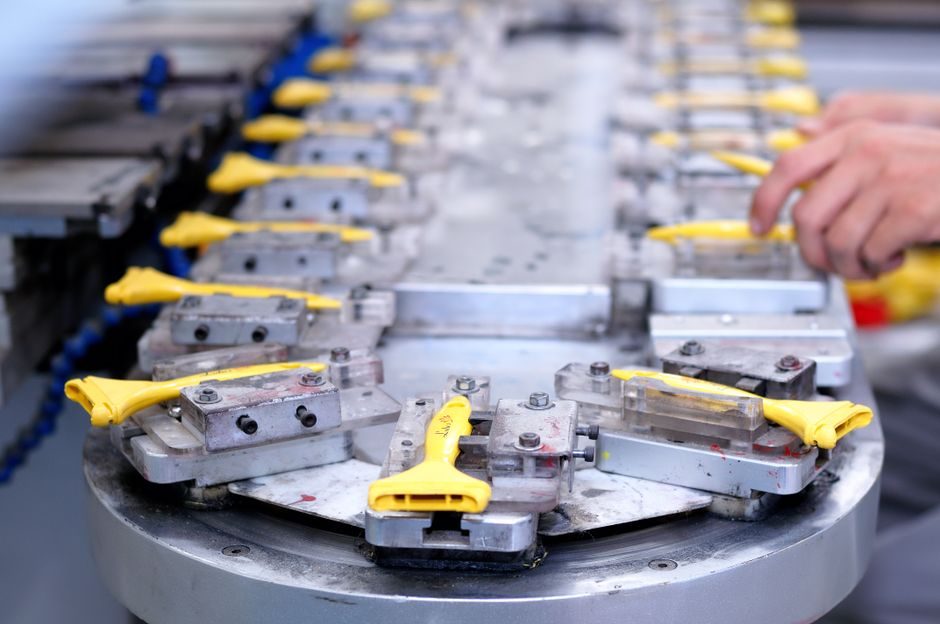
Electrolyzer gigafactory lines are now specified to the same automation envelope as fuel-cell stack lines, with LEAD Intelligent's published cycle of 1 s/pcs at ±0.1 mm positional tolerance cited as the reference benchmark for bipolar-plate handling in hydrogen-electrolyzer production [S6].
What the past six months actually shifted is the stack layer: ERP-MES-PLC-SCADA integration, robotic cell loading, machine-vision QA, and PHM (Prognostics and Health Management) analytics — the same ISA-95 pyramid integrators have been deploying for batteries and EV assembly, now retargeted at PEM, alkaline, AEM, and SOEC electrolyzer stack lines [S2][S6]. Mechtech Automation Group and Allied Automation are both marketing reconfigurable robotics and cobot-centric cells as off-the-shelf answers for stack-assembly shops, while Quadruple Automation Services packages the software layer as a tiered Disconnected → Connected → Smart → Autonomous journey that integrators are selling directly to electrolyzer OEMs [S1][S2][S3].
What "smart manufacturing" actually means on an electrolyzer line
The ISA-95 automation pyramid (Level 0 sensors/field devices through Level 4 ERP) is the de-facto reference architecture integrators sell to electrolyzer OEMs, with Quadruple Automation Services explicitly framing the entire stack — ERP, MES, PLC, SCADA, IIoT, and data intelligence — as a "unified digital manufacturing ecosystem" for cell-level control and end-to-end traceability [S2]. On the field layer, pressure transmitters and flow meters feed Level 1 PLCs that close the loop on gas pressure, electrolyte flow, and cell-temperature safety limits; vendors like Rockwell Automation, Allied Automation, and Renishaw provide the PLC, motion, and metrology hardware the integrators assemble into working cells [S3][S4][S5].
Renishaw's smart-manufacturing data platform for industrial process control — built around in-process probing, inline gauging, and ballbar/encoder calibration — is now being positioned for electrolyzer stack-assembly where bipolar-plate flatness and tie-bar concentricity directly drive cell voltage efficiency [S4]. Allied Automation sells the discrete-component layer (cobot cells, smart cameras for vision QA, PLCs, VFDs, servo drives, safety controllers) that small-batch electrolyzer R&D lines need before scaling to gigawatt-class plants [S3].
Robotic stack assembly: ±0.1 mm and 1 s/pcs as the published envelope
LEAD Intelligent's published "1 s/pcs × ±0.1 mm" claim — framed as breaking the "speed vs. precision" trade-off in fuel cell stack mass production — is the most concrete public cycle-time and tolerance number for hydrogen stack automation in the past six months, and electrolyzer OEMs are using it as a design target because the same bipolar-plate pick-and-place problem applies [S6]. Mechtech's Robopod product line sells "plug-and-play reconfigurable robotics" with a standardised modular platform that one integrator describes as doing "the work of an assembly line and handling personnel in a fraction of the time and cost" — a deployment model directly relevant to short-run electrolyzer pilot lines where line reconfiguration between PEM and AEM builds is the norm [S1].
Cobots (Universal Robots-class 6-axis arms, SCARAs, and EOAT/gripper cells) are the workhorses in Allied Automation's stack-assembly reference builds, and the same cells handle membrane-electrode-assembly (MEA) loading, gasket dispensing, and end-plate torque operations on alkaline and PEM electrolyzers [S3]. For SOEC lines, the high-temperature handling problem (stack operating at 700–850 °C) shifts the bottleneck from precision placement to thermal staging, and integrators like LEAD Intelligent are extending their PHM system from fuel-cell monitoring into SOEC degradation tracking [S6].
Selection criteria: which automation tier fits which electrolyzer OEM
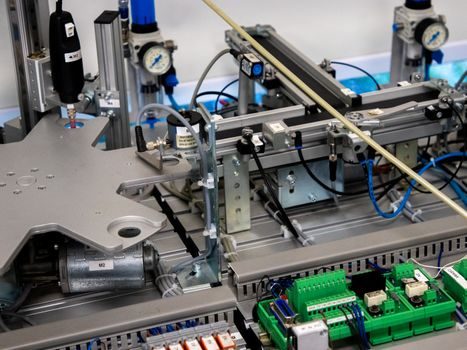
For an electrolyzer OEM choosing between a Disconnected, Connected, Smart, or Autonomous line, the decision is mostly about volume and stack design freeze: a Connected line (3–6 months, machine connectivity, real-time visibility, digital work orders, basic reporting) suits a 50–100 MW/year pilot PEM shop; a Smart line (6–18 months, MES, OEE, traceability, quality management) is the minimum for a 500 MW/year alkaline or PEM gigafactory; and an Autonomous line (18+ months, AI analytics, digital twin, predictive maintenance, self-optimising scheduling) is justified only once stack design and Bill-of-Process stabilise, which most alkaline and SOEC OEMs have not yet hit [S2]. The cost gap between tiers is roughly an order of magnitude — Allied Automation sells discrete PLC/cobot components and controls for small batches, while full MES/ERP/SCADA integration is the integrator-led engagement Quadruple and LEAD Intelligent pitch [S2][S3][S6].
On the stack-handling hardware, three credible options exist for a 2026 line: (a) Robopod-class reconfigurable robotics (modular, fast re-tool, lower throughput, suited to multi-product R&D); (b) dedicated gantry + servo + vision cells (higher throughput, ±0.05 mm class placement, dedicated to one stack design); and (c) cobot cells with EOAT and force-torque feedback (mid-throughput, lower capex, easier redeployment between pilot lines). The trade-off is throughput vs. flexibility, with cost-per-stack dropping sharply as the cell is amortised over more units [S1][S3].
Software stack: MES, OEE, digital twin, and PHM
Quadruple Automation's reference architecture names SAP integration, Ignition by Inductive Automation (Gold Certified integrator), and N3uron IIoT Platform (Certified Integrator) as the software backbone it uses for end-to-end traceability, OEE monitoring, and digital-twin deployment in regulated industries like pharma and EV battery assembly — the same stack now being repurposed for electrolyzer lines where stack serialisation, leak-test records, and per-cell voltage data must be retained for warranty [S2]. LEAD Intelligent's PHM (Prognostics and Health Management) system extends the same model into hydrogen-stack degradation analytics, using cell-level voltage and temperature data to predict stack end-of-life — a capability that electrolyzer OEMs are now demanding as a standard deliverable in stack line-build contracts [S6].
Renishaw's smart-manufacturing data platform adds the metrology and calibration layer — inline probing, encoder feedback, and process-control data — that lets an integrator verify the assembly cell has not drifted out of spec after a thousand cycles, which is a hard requirement for ISO 9001- and IATF 16949-style quality systems on electrolyzer lines [S4]. On the industrial-controls side, Rockwell Automation remains the default North American reference brand for PLC, motion, and HMI stacks, while European electrolyzer OEMs typically standardise on Siemens or Beckhoff; integrators bridge both worlds and the line-build contract is usually written around the integrator's choice rather than the OEM's [S5].
Failure modes, constraints, and what 2026 lines still cannot do
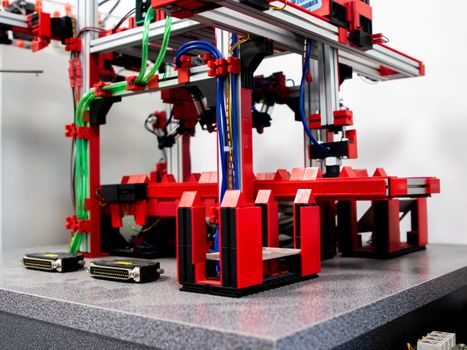
The most common failure mode in a 2026 electrolyzer smart-manufacturing line is a precision-loss drift in the robotic placement cell after extended operation: a published ±0.1 mm spec is a cold-start number, and stack vendors report real-world drift of 0.02–0.05 mm over a 12-hour shift without in-line re-calibration [S6]. Vision QA is the second pinch point: bipolar-plate coating defects (pinholes, delamination) and MEA mis-alignment can be caught by smart camera inspection, but the false-reject rate on matte-finish nickel and stainless plates is still high enough that most lines retain a manual review gate [S2][S3].
AEM (anion-exchange membrane) electrolyzers are at the other end of the maturity curve, with stack design still in flux and line automation therefore biased toward reconfigurable robotics rather than dedicated gantries [S1][S3].
Standards, sourcing, and the link to battery-line automation
Electrolyzer smart-manufacturing lines inherit their quality and traceability backbone from adjacent industries: ISO 9001 for general QMS, ISO 14001 for environmental management, IEC 61508 / IEC 61511 for functional safety on the gas-handling side, and ATEX 2014/34/EU or IECEx for hazardous-area equipment in hydrogen-producing cells — the same compliance envelope the fuel cell stack smart manufacturing ecosystem already operates under [S6]. Integrators like Quadruple Automation explicitly cite FDA 21 CFR Part 11 (electronic records and signatures) as a reference for batch records and serialisation on regulated lines, and the same software configuration is being ported to electrolyzer warranty and traceability flows [S2].
Battery-line automation is the closest functional twin: battery cell manufacturing process 2026 and battery pack manufacturing process both run electrode-to-formation or cell-to-pack flows with vision QA, OEE monitoring, and PHM analytics, so electrolyzer OEMs that already own a battery gigafactory (or share a contract manufacturer with one) get a head start on the software layer and the integrator relationships [S2][S6]. The dry-electrode and solid-state process specs now landing in solid-state battery smart manufacturing lines are also worth tracking, because the same solvent-free coating and calendering cell architecture maps directly onto next-generation PEM and AEM electrolyzer electrode production [S2].
Trackable signals for the next quarter: (1) a public SOEC-specific cycle-time number from any major integrator — currently absent in the published research and the largest unfilled gap in the automation spec stack; (2) a second published ±0.1 mm-class electrolyzer cycle benchmark from an integrator other than LEAD Intelligent, which would confirm or break the 1 s/pcs envelope; (3) any 2026 line-build announcement tying an electrolyzer gigafactory directly to a battery gigafactory's MES/SCADA backbone, which would signal the convergence of the two automation ecosystems at gigawatt scale [S2][S6].