A road maintenance crew pulling bent or coil-set rebar out of storage needs a straightener matched to the bar grade, diameter range, and the mobile or yard-fixed workflow, not a one-size spec sheet [S1].
For typical bridge-deck, parapet, and pavement-slab work the operating envelope is D6–D16 mm coil at 30–50 m/min line speed, with light-gauge mandrel drives in the 1.5–3.0 kW band and heavy-coil frames in the 5.5–7.5 kW band; matching that envelope to the bid list is the whole selection problem [S3].
Road-Maintenance Use Case: Lane, Bridge-Deck, and Parapet Reinforcement
Road crews consume straight, cut-to-length rebar in three recurring patterns: bridge-deck rebar mats (D10–D16 mm grade 60, typically 300 to 500 pieces per deck panel), parapet and crash-barrier cages (D8–D12 mm, with stirrups), and pavement-slab dowel baskets (D6–D10 mm grade 40 or 60) [S3]. A615 grade 60 (≈414 MPa yield) covers most U.S. state-DOT work, with grade 75 (≈517 MPa) showing up in seismic zones and high-cycle bridge approaches; the straightener frame must be rated for the highest grade the yard ever sees, not the average [S3].
For road jobs that re-use bent off-cuts pulled from a salvage pile, a handheld hydro-electric straightener with a 20 mm (3/4 inch, #6 bar) capacity covers roughly 80% of in-field salvage work, weighs 18.5 lb, runs on an 18 V DeWalt battery pack, and rotates its head 90 degrees for access inside formwork cavities [S2]. Anything heavier in diameter than 20 mm on a salvage pull should be sent back to a yard bench, not worked on the deck.
Selection Gates: Bar Grade, Diameter, and Throughput
Selection is driven by three coupled decisions, and getting any one wrong cascades: the ASTM A615 grade processed (40, 60, 75, or 80), the diameter range on the cutting list, and the daily throughput the yard or crew must clear, with residual bow of 2 mm/m as the usual bid floor [S3]. Grade 40 = 40,000 psi (≈276 MPa) and grade 60 = 60,000 psi (≈414 MPa) minimum yield, so a frame spec'd only for grade 40 will deflect or stall on grade 60 coil at the same diameter [S3].
For D6–D12 mm coil, a 1.5–3.0 kW servo-drive straightener running the mandrel at 30–50 m/min delivers 0.8–1.5 t/h; D12–D16 mm on the same frame demands 4.0–5.5 kW and a slower 20–35 m/min to keep mandrel slip below the 2 mm/m tolerance [S3]. Heavy-fabrication work at D16–D25 mm jumps to 5.5–7.5 kW with 15–25 m/min mandrel speed, and almost always needs a two-roller pre-straightener upstream so coil-set memory does not survive the cut-off shear [S3].
A YGT4-12 class-III straightener with a 7.5 kW motor, Cr12 straightening wheels, cast-steel clip, 262 kg net weight, and CE/ISO certification covers rebar up to 10 mm at production-line throughput, and is representative of the small-footprint Chinese-built bench units commonly seen on road jobs [S5].
Handheld vs Bench vs Heavy-Dual: Matching Frame to Crew
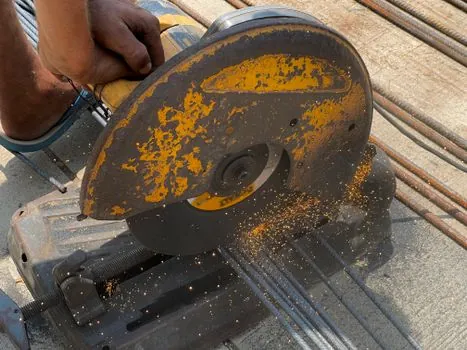
Three frame classes cover the road-maintenance envelope, and the decision is throughput-driven, not feature-driven. A handheld hydro-electric unit (18.5 lb, 20 mm capacity, 18 V battery) is correct for spot salvage and confined-space work but is a one-bar-at-a-time tool [S2]. A bench-style straightener-and-cutter with a 4–7.5 kW motor is the default for yard work feeding bridge-deck mats at 0.8–1.5 t/h [S3][S5]. A heavy-dual frame with swappable 6–16 mm and 16–25 mm mandrel cartridges is the right answer only when the same yard routinely feeds both light coil stock and heavy bar, because mandrel wear on a 6 mm bar accelerates sharply when the frame is sized for 25 mm [S3].
For comparison, the DBR-32WH carriage-free bench covers mild-steel diameters 13–32 mm and high-tensile up to 25 mm in one machine, with a 1.5 HP (1.1 kW) output, 4-second 90-degree bend cycle, and 660 x 270 x 200 mm footprint, drawing 100/115/230 V single-phase, with push capacities of 11 t and pull capacities of 8.5 t at max pressure [S4]. A dual-purpose DYNATEC rebar straightener-bender rated for 490 N/mm² tensile strength accepts rebar from 13 mm up to 32 mm in a single frame, with the same carriage-free footprint class [S8].
Spec the wrong frame and the failure mode is predictable: undersize the motor and grade 60 bar stalls the mandrel mid-cycle, oversize the frame and light 6 mm bar burns through mandrel liners in weeks, not months [S3].
Site Prep, Power, and Acceptance Test
Plan at least 800 mm of clearance on the feed side and 1500 mm on the exit side for coil payout and cut-length stacking, otherwise the cut pieces will not stage cleanly and the crew ends up re-handling every bar [S6]. Power supply must match the nameplate exactly: a YG-6 draws 5.5 kW, YG-9 draws 9 kW, and a dual-motor YG-16 combines 9 + 5.5 kW, so a dedicated breaker and a contactor sized at 1.25× full-load current are mandatory before the first coil is loaded [S6].
Acceptance test: feed three coils of the hardest grade on the bid list, measure residual bow with a 1 m straightedge at five points along the bar, and reject if any reading exceeds 2 mm/m; this is the same tolerance bar that downstream rebar coupler threading equipment demands for the 0.5° end-straightness window on the threading length [S3].
Linking the Straightener to Cut, Bend, and Splice Stations
For a road crew running cut, straighten, bend, and splice on a single bench, the cut, straighten, and thread stations should share a common PLC bus from the same vendor class; mismatched feed rates are the leading cause of thread overshoot in yards running both coupler and bent-bar assemblies [S3].
Position couplers (for bars that cannot be rotated) are the most sensitive downstream consumer: any helical twist left in the bar after the straightener shows up as thread-runout at the coupler shoulder, and re-threading a 16 mm grade 60 bar costs 30–45 seconds of bench time that compounds across a 500-piece cage [S3]. For welded splices, the AWS Reinforcing Steel Welding Code ties preheat and interpass temperatures to bar size and carbon equivalent, so a yard switching from lap to weld must keep the straightened bar free of surface work-hardening that would skew the carbon-equivalent reading [S3].
Pair the straightener with a matched rebar cutter and rebar bender on the same cut-and-straight bench so coil-payout speed, cut length, and bend angle share one controller; for road work, the same bench can also feed rebar into a road roller compaction cell without re-tying, provided the residual bow stays under tolerance.
Failure Modes, Maintenance, and When Not to Repair
The three recurring failure modes on a road-maintenance straightener are: mandrel slip on grade 60+ bar (root cause: undersized motor or worn Cr12 wheels, fix: re-rate the motor or replace the wheel set), end-cuts that fail the 2 mm/m bow check (root cause: missing two-roller pre-straightener on coil-set stock, fix: add the pre-straightener, do not just re-adjust the mandrel), and thread-runout at the coupler shoulder (root cause: helical twist surviving the straightener, fix: add a twist-straightening roller or replace the straightener if the frame is undersized for the bar) [S3].
Select a frame with accessible wear parts and a design that allows easy maintenance, because the leading cause of mid-shift downtime on road crews is not catastrophic failure but slow degradation of straightness as mandrel liners wear [S1]. Replace the mandrel cartridge when the bow reading drifts above 2 mm/m on three consecutive coils, do not re-calibrate and continue, because the downstream coupler thread and the AWS weld preheat window will both reject the bar anyway [S3]. Escalate to a heavier frame class when the same yard routinely handles 25 mm+ bar, not when a single large bar appears on a one-off basis.
Trackable signals for the next planning cycle: state-DOT bridge-deck rebar tonnage (drives the 1.5–3.0 kW vs 5.5–7.5 kW frame decision), and the share of yards switching from lap splices to mechanical couplers (drives the 0.5° end-straightness tolerance at the threading station) [S3]. For demolition-heavy corridor work where the straightener feeds a recovery bench, stud welder selection for demolition and heavy steel cutting jobs covers the downstream welding end of that same bench.