
EV battery cell quality control is dominated by three measurable process windows: electrode coating weight tolerance within ±1-2%, dry-room dew point held below -40 °C to keep moisture ingress under 100 ppm, and formation cycling capacity check at C/20 with coulombic efficiency above 99.8% for grade-A cells [S1][S2].
Demand pressure has made those windows tighter: capacity and quality are the two recurring challenges cited across cell-makers, while capital exposure was demonstrated in February 2025 when Tiger Group and Liquidity Services auctioned roughly $82 million of brand-new Northvolt cell-manufacturing equipment stored in Belgium and South Korea [S4]. That sale is a hard data point on how much fixed-asset risk sits behind every scrap-rate decision.
Slurry Mixing and Coating: Where Defects Are Forged
Slurry homogeneity directly drives cell energy density; the coating process is repeatedly flagged as the single most yield-sensitive step, with online thickness gauges deployed on 2,000+ commercial systems on the strength of five decades of measurement development [S1][S2]. A typical spec sets dry coating weight at 15-25 mg/cm² per side for NMC811 automotive cathodes, with a coating amount measurement tolerance held inside ±1% to keep cell-to-cell capacity variance below 0.5% [S1].
Defect modes that fail audit and must be caught in-line include agglomerates larger than 50 µm, streaks from slot-die lip contamination, and uncoated stripes that cause lithium plating during fast charge [S5]. Cognex-class machine-vision systems are now standard for surface defect detection on electrode and motor lines, where any lapse in quality control translates directly into scrap and recalls [S3].
Dry Room, Drying, and Pressing: Moisture and Density
Drying ovens after coating need uniform temperature profiles, which is why distributed temperature visualization across the furnace length is treated as a control loop rather than a data display [S1].
Calendar roll pressure during compaction targets electrode density in the 3.4-3.6 g/cm³ range for graphite anodes; deviation outside ±0.1 g/cm³ changes porosity and raises the risk of lithium plating on fast-charge cycles [S5]. Slitting and notching follow, where burr height above 15 µm and edge burrs wider than 10 µm are typical reject thresholds used by tier-1 cell-makers.
Electrolyte Fill, Formation, and Aging: The Final Yield Gate
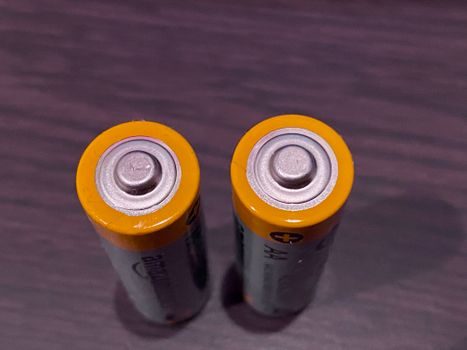
Electrolyte injection takes place inside the dry room with moisture checks before and after fill; injection volume accuracy within ±0.5% by mass is the practical spec across pouch and prismatic formats, with moisture measurement as the release step [S1][S2]. Formation cycling — the first slow charge/discharge — is where cell voltage and transient current measurements determine grade-A versus grade-B sortation, and where the 99.8% coulombic efficiency benchmark effectively decides the cell's commercial fate [S1].
Cell voltage measurement during formation is typically performed at C/20 over the full 2.5-4.2 V window for NMC/graphite, with a 24-72 hour aging period at 25-45 °C before the final OCV check, and any cell outside a 5 mV pack from its siblings is downgraded. The economic gravity of those windows is covered in Lithium Battery Manufacturing Cost Breakdown: Cell, Pack, and TCO, where formation and aging drive a disproportionate share of capex per GWh.
Inline Inspection, Vision, and Laser Welding: Closing the Loop
Inline defect detection is built on a layered stack: laser thickness gauging at the coater exit, optical surface inspection after calendaring, OCR/code reading on the winding or stacking station, and laser welding monitors at the tab-join step with spatter detection thresholds set in the 50-200 µm range [S3][S5]. Cognex-style vision systems for motor and battery lines target defect capture above 99.5% with false-call rates under 0.1% to keep line OEE above 85% [S3].
Laser welding parameters for aluminum-to-copper and aluminum-to-aluminum tabs typically run 1-4 kW peak power with pulse widths of 1-10 ms, and a pull-test threshold above 30 N is the typical acceptance limit for automotive-grade packs. Process mapping for those welding cells and the PLC line architecture that drives them is detailed in Lithium Battery Industry 4.0: Laser Welding Cells, PLC Lines, and 20 GWh Throughput, which also covers the 20 GWh throughput class that tier-1 lines are now designed around.
Instrumentation and Process Control: Sensors Behind the Spec
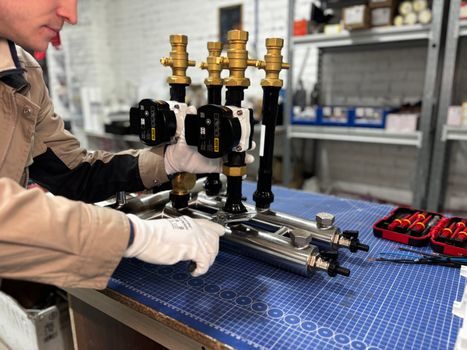
The cell line is instrumented end-to-end: pressure transmitter loops on electrolyte tanks and dry-room gas lines, flow meter devices on slurry and electrolyte dosing with ±0.5% accuracy, industrial valve manifolds for vacuum and inert-gas routing, air quality monitor stations for dew-point and particulate counts, and power quality analyzer instruments at the formation rectifiers to catch ripple that would skew coulombic efficiency readings [S1][S2].
Mixing vessels are quality-assessed through viscosity and density endpoints, the coater is closed-loop on coating amount, the drying furnace is mapped for temperature distribution, and the pressing/slitting/assembly stages are watched for anomaly detection to prevent unplanned shutdowns [S1][S2]. A 2026-style spec map covering the cell and pack line instrumentation stack — from slurry to module-PACK — is mapped in Lithium Battery Process Control and Instrumentation: Spec Map for Cell and Pack Lines, and the matching cell-format and module-PACK architecture for 2026 is in Lithium Battery Production Line Design: 2026 Cell-Format and Module-PACK Architecture Map.
Cell Format Comparison: Pouch vs Cylindrical vs Prismatic
The three dominant cell formats diverge sharply on quality-relevant parameters.
Decision criteria line up as: (1) defect-cost per kWh of capacity — prismatic highest, cylindrical lowest; (2) formation-sorting yield — cylindrical best due to uniform thermal mass, pouch worst because of edge-cooling gradients; (3) line flexibility — pouch and prismatic lines can retool between formats, while dedicated 46800 lines are 12-18 month capital commitments. Turnkey lines from vendors such as XHS Battery Machine cover pouch, cylindrical, prismatic, button, and lead-acid formats in a single integration envelope, with custom quote paths that fold in dry-room, formation, and aging sections [S7].
Capital Risk, Standards, and What to Track Next

Standards that govern EV cell quality sit across IEC 62660 (performance), IEC 62133 (safety), UN 38.3 (transport), and ISO 9001/IATF 16949 at the manufacturing-system level; the cell line itself is validated against these in parallel with OEM-specific acceptance plans. The Northvolt $82 million asset auction in February 2025 is the cleanest signal that over-spec'd capex without offtake is a binary risk for any cell-maker aiming at automotive-grade volumes [S4].
Both are engineering decisions, not marketing, and both materially change the cost of a quality audit on a 20 GWh line.