China-based OEM and ODM suppliers account for the majority of EV charger line items listed on industrial sourcing platforms as of 2026-06, with 20 kW–360 kW DC fast chargers and 7 kW–22 kW AC wallboxes forming the two dominant product tiers [S1][S4].
Three connector protocols — CCS1 (North America), CCS2 (Europe), and GB/T (China) — co-exist on most export-spec DC units, while CHAdeMO appears on a smaller subset of 20 kW–40 kW models aimed at the Japanese and Southeast Asian retrofit market [S1][S4]. Reference pages on pressure transmitter, flow meter and PLC sit on separate instrument supply chains, but the OCPP back-end and Ethernet/4G gateway stack on modern chargers reuses the same industrial-control module families.
Two product tiers and where they sit on a spec sheet
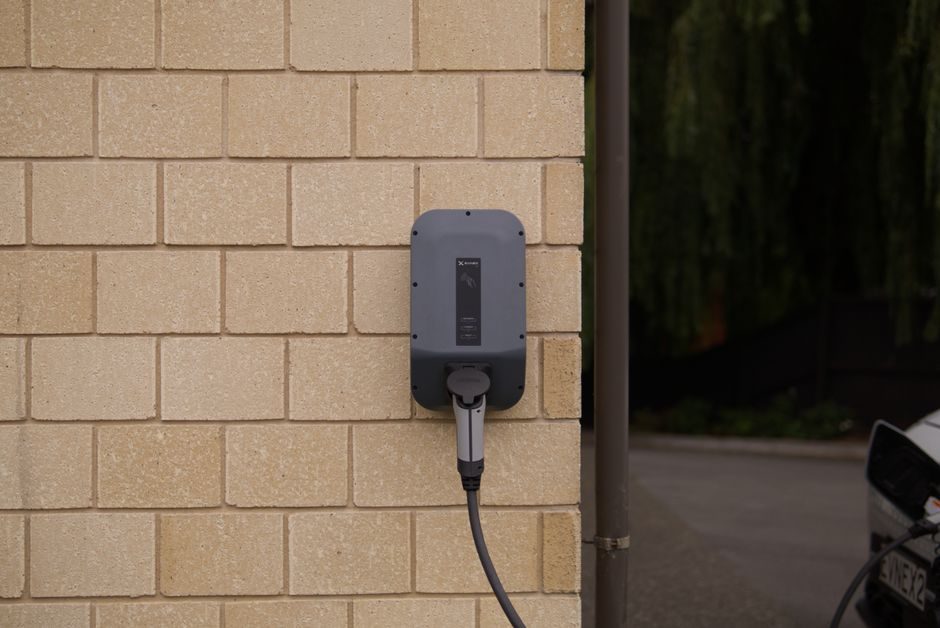
AC wallbox units cluster at 7 kW (32 A single-phase) and 22 kW (32 A three-phase) outputs, with J1772 and Type-2 connector variants priced in a US$ 1,200–1,299 per-piece range on 2024 listing data [S4]. The IP55 ingress rating is the dominant enclosure class for outdoor wallbox SKUs, and dual-port (J1772 + Type-2) housings are common for EU-bound commercial builds [S4].
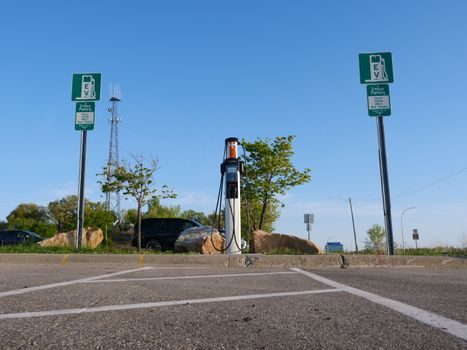
DC fast units split into three power bands: 20 kW–40 kW mobile/emergency-caddy units with CCS1/CCS2/GB/T/CHAdeMO quad-cable heads [S1]; 60 kW–180 kW pedestal chargers (the most quoted band, US$ 4,800–17,000 per piece depending on output and connector mix) [S4]; and 240 kW–360 kW all-in-one charging hubs in the US$ 100,000+ per-piece band, targeted at motorway-corridor depots [S4]. OCPP 1.6-J is the de-facto back-end protocol quoted across the 60 kW–180 kW range [S4].
Supplier map: Shenzhen, Wenzhou, and the second-tier ODM ring
Shenzhen remains the highest-density cluster for portable and emergency mobile DC units, with 20 kW–40 kW quad-connector products dominating the Made-in-China.com category page on 2025-07 snapshot data [S1]. NEWCOM (cn-newcom.com) lists DC charging station, AC charging station, portable EV charger, and DC roadside rescue EV charger as four distinct product lines on its 2026-06 home page, indicating a full-portfolio approach rather than a single-SKU maker [S2].
Wenzhou Chuhan Technology Co., Ltd. (chinachuhan.com) overlaps the same four-line taxonomy — EV charger, DC-to-AC inverter, and energy storage system — and exposes multilingual front-end pages (English, French, German, Japanese, Italian, Spanish, Portuguese, Russian, Finnish, Bulgarian, Icelandic, Czech, Swedish, Malay, Indonesian, Irish, Romanian, Welsh, Maltese, Slovak, Serbian, Dutch, Ukrainian, Polish, Latvian, Urdu, Bengali, Greek, Turkish, and Chinese variants), a strong signal of export-OEM focus as of 2026-06-28 [S6]. Honlix (honlix.com) sits one tier down on vertical scope: M5/M8/M12/M16 industrial connectors and cable-harness assemblies that feed into EV charger builds, illustrating the connector-cable sub-tier that supplies charger ODMs rather than selling finished chargers directly [S3].
Selection criteria a sourcing engineer should pin down first

Five gates decide whether a Chinese OEM is fit for a 2026 EV charger procurement: (1) connector protocol mix (CCS1 / CCS2 / GB/T / CHAdeMO / NACS retrofit), (2) power band (7 kW AC, 22 kW AC, 20 kW–40 kW mobile DC, 60 kW–180 kW pedestal DC, 240 kW+ hub DC), (3) enclosure rating (IP55 wallbox, IP54 pedestal indoor, IP65 outdoor liquid-cooled), (4) back-end protocol (OCPP 1.6-J is the floor; OCPP 2.0.1 appears on 2024+ premium SKUs [S4]), and (5) certifications and grid-side compliance (CE-EMC, UL 2202/2231 for North America, IEC 61851-1 for EU, and CQC/CNCA for the GB/T domestic market — confirm in the supplier's test report pack, not on the marketing page).
Pricing on the Made-in-China.com category page for the 60 kW CCS/GB dual-connector pedestal sat at US$ 4,800–17,000 per piece in 2024-07 listing data, with a 120 kW bidirectional GB/T-CCS unit at US$ 4,950–5,500 per piece and a 22 kW dual-port J1772/Type-2 wallbox at US$ 1,200–1,299 per piece [S4]. For comparison, a 360 kW integrated hub carries a US$ 100,000+ per-piece list — roughly 20× a 60 kW pedestal — so hub pricing is not a linear function of output. MOQ was not disclosed on the public listing snapshot and must be pulled from the supplier's RFQ response [S4].
AC vs DC: who each tier is for
AC wallboxes (7 kW and 22 kW) suit depot charging for overnight-fleet vehicles, residential multi-family installs, and small-retail destination sites where dwell time exceeds two hours; the 22 kW three-phase SKU is the only band that can add ~100 km of range per hour on a 400 V European vehicle [S4]. DC pedestal units (60 kW–180 kW) fit motorway-corridor fast-charge sites, ride-hail fleet depots, and retail fuel-station retrofits where dwell time is 15–30 minutes [S1][S4].
DC hubs (240 kW–360 kW) and 20 kW–40 kW mobile/emergency units serve different ends: hubs are written off against capex on high-utilisation motorway or commercial-fleet sites, while mobile caddy units serve roadside rescue, dealership loaner pools, and pop-up event sites where a fixed install is impractical [S1]. Buyers targeting the latter should compare NEWCOM's DC Roadside Rescue product line against Wenzhou Chuhan's mobile SKU list on the 2026-06 supplier pages [S2][S6].
Adjacent spec layers: connectors, cables, and the back-end gateway
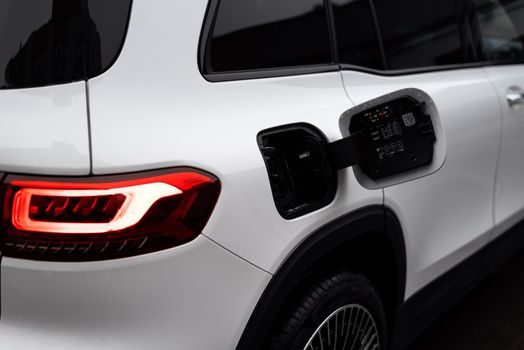
EV charger builds pull from three industrial supply chains: the connector and cable-harness tier (M5/M8/M12/M16 industrial circular connectors, IEC 62196 Type-1/2 inlets, GB/T 20234 plug bodies) [S3]; the power-conversion tier (AC/DC rectifier modules, IGBT or SiC stacks, DC-to-AC inverter modules for bidirectional/V2G SKUs) [S6]; and the control-and-telemetry tier — a PLC-class controller running the OCPP 1.6-J or 2.0.1 stack over Ethernet/4G, plus metering blocks that use a pressure sensor-class transducer family only loosely (coolant pressure and inlet manifold pressure are the dominant sensing points on liquid-cooled hubs).
Wenzhou Chuhan's co-listing of "DC-to-AC Inverter" and "Energy Storage System" alongside the EV charger line is a direct signal that the same enclosure, bus-bar, and gateway modules are reused across PV-coupled and V2G SKUs [S6]. A procurement engineer can use that overlap to negotiate cross-line volume rebates on the 2026-06 supplier-snapshot data [S6]. The servo motor and industrial valve encyclopedia pages sit on different supply chains and are not on the EV charger critical-path BOM, but the cooling-loop shutoff valves and pump motors on liquid-cooled hubs reuse the same vendor base.
Limitations, constraints, and failure modes to spec against
Four failure modes recur on Chinese-OEM EV charger builds at the 60 kW–180 kW tier: (a) OCPP 1.6-J implementations that fail charge-point-management-system (CPMS) handshake regression tests — pin the protocol test report, not just "OCPP-compliant" marketing copy [S4]; (b) connector cable cold-flow failures below −20 °C on outdoor pedestal units — verify the cable jacket rating and the plug body's IEC 62196-3 cold-test documentation; (c) rectifier derating above 40 °C ambient on enclosed pedestal SKUs without active cooling — pull the derating curve, not the nominal kW figure [S4]; (d) enclosure water-ingress on IP55 wallboxes installed in coastal or car-wash-adjacent sites — confirm the salt-fog test pass on the supplier's IEC 60068-2-52 report.
Compliance gating by destination market is non-negotiable: UL 2202 / UL 2231 / Energy Star for North America, CE-EMC + IEC 61851-1 for EU, and CQC for the GB/T domestic Chinese market. Bidirectional / V2G SKUs (the Ruisu 120 kW GB/T-CCS unit on the 2024-07 listing at US$ 4,950–5,500 per piece [S4]) carry a separate grid-side compliance pack — ISO 15118-20 for the vehicle-to-grid protocol layer, plus the local DSO's pre-qualification test — and should not be ordered on a standard pedestal SKU quote.
Sourcing gates and a comparison frame for 2026 procurement
A short-list of sourcing gates for a 2026 EV charger RFQ, ordered by what kills deals fastest: (1) confirm the supplier's own-brand/OEM/ODM split — Made-in-China.com category data shows 1,580 manufacturers and 4,740 products in a parallel solar-charger category alone [S5], so the "manufacturer" label on a sourcing platform is a weak signal; (2) pull the OCPP 1.6-J conformance test report, not the marketing bullet; (3) ask for a 2025-vintage test report on the IEC 61851-1 / UL 2202 / IEC 62196 family for the exact SKU, not the family; (4) confirm enclosure rating documentation (IP55 wallbox, IP54–IP65 pedestal) against the install environment; (5) cross-check the connector protocol mix against the destination market — CCS2 for EU, CCS1 (or NACS) for North America, GB/T for China, CHAdeMO for Japan retrofit [S1][S4].
A criteria-based comparison for the three product tiers, drawn from the 2024-07 Made-in-China.com listing snapshot and the 2026-06 supplier pages [S1][S2][S4][S6], looks like this. AC wallbox (7 kW / 22 kW): low cost (US$ 1,200–1,299 per piece [S4]), long dwell time required, residential / depot / destination retail, J1772 / Type-2 connector mix, OCPP 1.6-J standard. DC pedestal (60 kW–180 kW): mid cost (US$ 4,800–17,000 per piece [S4]), 15–30 min dwell, motorway-corridor / fleet / retail-fuel retrofit, CCS1 / CCS2 / GB/T mix, OCPP 1.6-J or 2.0.1 premium. DC hub (240 kW–360 kW): high capex (US$ 100,000+ per piece [S4]), 10–15 min dwell, high-utilisation motorway / commercial-fleet hub, CCS1/2 + liquid-cooled cable, OCPP 2.0.1 + ISO 15118-20 for V2G-ready SKUs. Mobile/emergency DC (20 kW–40 kW): mid cost, no fixed install, roadside rescue / dealership / events, quad-cable CCS1/CCS2/GB/T/CHAdeMO [S1].
Two trackable signals for the next sourcing cycle: the OCPP 2.0.1 adoption rate on 2025-vintage pedestal SKUs, and the rollout of NACS (Tesla-derived) inlet support on Chinese-OEM units bound for North America — both will reshape the connector-mix line on 2026-Q3 RFQ responses. For context on the upstream battery and storage SKUs that couple to DC hub sites, see the Battery Energy Storage Suppliers 2026 reference, and for the steel/enclosure and packaging-equipment supply chains that sit adjacent to charger production, see the Scaffolding 2026 Price & Cost Guide.