2026 Tier 1 EV charger suppliers separate into two hardware bands: a megawatt and sub-megawatt vanguard spanning 600-1500 kW, and a mass-deployment ultra-fast tier covering 300-500 kW, with every listed cabinet liquid-cooled and OCPP 1.6J or 2.0.1 capable [S3].
US public charging ports grew 34.6% in the 2026 update (from 180,000 to over 242,000) and registered EVs rose 26.7% to over 4.5 million, framing a market where the hardware bottleneck has moved from port count to per-port power and grid integration [S1].
Tier 1A: Megawatt and Sub-Megawatt Vanguard (600-1500 kW+)
The 2026 vanguard is defined by liquid-cooled dispensers rated from 600 kW to 1500 kW, using centralized matrix topologies or dedicated grid-buffering to localize immense power draw [S3]. The reference units are Alpitronic HYC1000 (1000 kW, MCS-ready, OCPP 2.0.1), BYD Flash Charging Gen II (1500 kW, battery-buffered, OCPP 2.0.1), Zeekr V4 Supercharger (1200 kW, OCPP 2.0.1), Xpeng S5 Supercharger (800 kW, OCPP 2.0.1), Huawei FusionCharge DS720 (720 kW, OCPP 1.6J/2.0.1), and Kempower Power Unit C503 (600 kW, USD 467,300 list) [S3].
Plug & Charge and AutoCharge are table stakes across this band, every model in the S3 vanguard table carries both, which is consistent with ISO 15118-2 PnC over CCS being the 2026 volume default rather than ISO 15118-20 V2G [S2][S3]. For a spec engineer, the practical takeaway is that megawatt hardware is no longer a 2027 prototype: BYD, Zeekr, and Xpeng are already deploying in Asia, with European and US rollouts timed between 2026 and 2027 [S3]. This is also where the boundary between an EV charger and a servo motor-driven load-shedding scheme starts to matter, because megawatt peaks cannot be drawn from a depot feeder without dynamic power electronics on the site side.
Tier 1B: Core 300-500 kW Ultra-Fast (Mass-Deployment Battleground)
The 300-500 kW band is described as the most fiercely contested bracket for mass commercial deployment, balancing capex, grid requirements, and the 800 V vehicle envelope that dominates 2026 model-year EVs [S3]. Reference cabinets include ABB Terra 360 (360 kW, USD 89,000, OCPP 1.5S), Alpitronic HYC300 (300 kW, USD 63,999, OCPP 1.6J), Alpitronic HYC400 Series 2 (400 kW, OCPP 1.6J/2.0.1), BTC Power Gen4 360 (360 kW, USD 173,208), ChargePoint Express Plus (500 kW), Circontrol Raption 400 (400 kW), EVBox Troniq High Power (400 kW, OCPP 1.6J/2.0.1), Flo Ultra (320 kW), and GAC Aion A480 (480 kW) [S3].
At the bottom of the DC fast envelope, the pressure sensor and flow meter content per cabinet is similar to the megawatt class; the difference is cooling-loop sizing and the number of paralleled 30-60 kW power modules. A 2026 commercial DC fast charger line-up is typically quoted as 30, 60, 90, 120, 150, 180, 240, and 360 kW modules, with paralleled-module architectures allowing output scaling inside the same cabinet footprint [S2]. Buyers should not over-spec: a 360 kW cabinet fed by a depot with mostly 400 V vehicles will spend most of its duty cycle at 50-150 kW, so the right spec is 4-6 paralleled 60 kW modules, not a single 360 kW stack.
AC Level 2 and Fleet Depot Tier (7-22 kW)
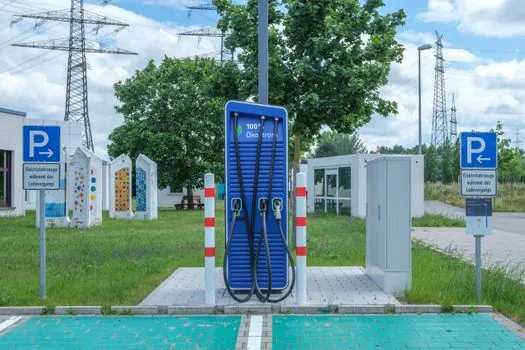
AC Level 2 hardware in 2026 clusters at 7 kW (single-phase 32 A), 11 kW, and 22 kW (three-phase 16 A / 32 A), with Type 2 (Mennekes, IEC 62196-2) dominant in the EU and Type 1 (SAE J1772) plus NACS (SAE J3400) in North America [S2]. This is the destination and fleet-depot band, where Energy Star certification is often a procurement gate for US utility rebate programs and CE marking under the Low Voltage and EMC directives is the EU equivalent [S2].
North American 2026 deployments additionally require UL 2594 (EV supply equipment) and UL 2231-1/-2 (personnel protection), with FCC Part 15 for EMC; EU sites require IEC 61851-1 (general conductive charging) plus EN 62196 connector parts [S2]. For a depot spec, the practical 2026 call is to standardize on a single cabinet family across the 7-22 kW band rather than mixing enclosure types, because OCPP firmware and connector SKUs diverge faster than the underlying PLC back-office integration.
Connector Standards: CCS2, NACS, and the CHAdeMO Long Tail
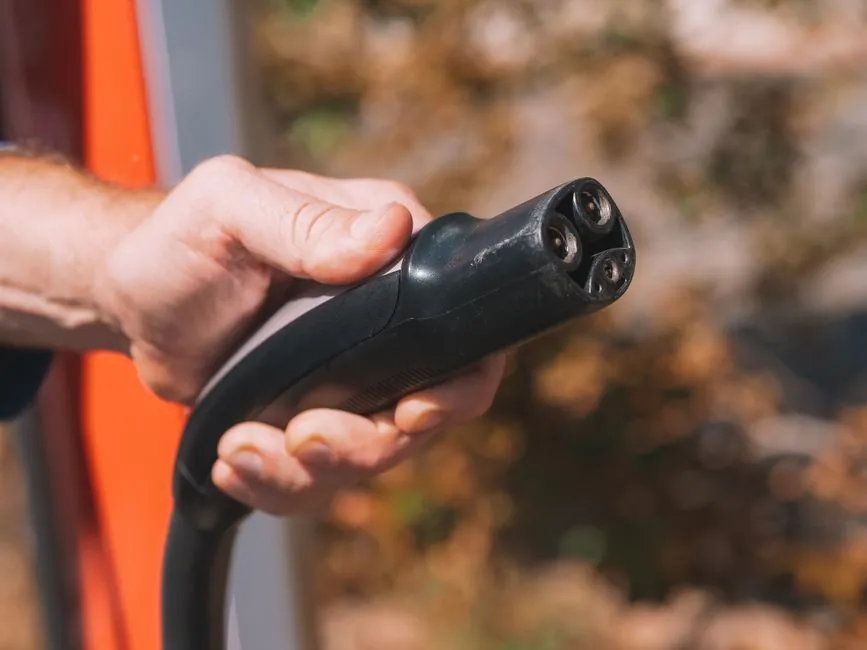
The 2026 connector landscape is a three-way contest: CCS2 (Combo 2, IEC 62196-3) is the EU default, NACS (SAE J3400, the Tesla-derived compact coupler) is the North American OEM default for new EV platforms, and CHAdeMO (JEVS G105) holds the Japanese market and a slice of the legacy DC fast installed base [S2]. Dual-head cabinets that mount CCS2 + CHAdeMO or NACS + CCS1 are the most common 2026 retrofit configuration for highway sites with mixed traffic [S2].
For new procurement, the safer 2026 path is a multi-standard DC fast charger (CCS1 + CCS2 + NACS selectable via cable set) when shipping to mixed-region fleets, or a single-standard cabinet (NACS-only for US-only depots, CCS2-only for EU depots) when the duty cycle is locked [S2]. CHAdeMO-only has effectively become a special order rather than a stock SKU as global DC fast demand consolidated around CCS and NACS [S2]. This is also where the spec boundary meets a pressure transmitter on the coolant loop, because NACS and CCS2 both push liquid cooling into the cable at the 350 kW+ bands, and that loop needs instrumentation.
Communication Protocols: OCPP 1.6 vs 2.0.1 and ISO 15118

Open Charge Point Protocol (OCPP) is the de-facto charger-to-network-management-system interface, with OCPP 1.6 (SOAP and JSON) the 2026 baseline for interoperability testing and OCPP 2.0.1 the target for ISO 15118 Plug & Charge and smart-charging profiles [S2]. Across the S3 vanguard, every Tier 1 cabinet is at least OCPP 1.6J, and the 2026-spec'd 800 kW+ units (BYD Gen II, Zeekr V4, Xpeng S5) ship OCPP 2.0.1 native, which is the safer procurement call [S2][S3].
Hardware that ships with OCPP 2.0.1 firmware-upgradeable from 1.6 is the practical 2026 spec, because it lets a depot deploy on an existing 1.6 back office today and migrate to PnC later without a cabinet swap [S2]. Smart-charging features (load balancing across a depot, peak-shaving against site load, solar-following modes) ride on OCPP 2.0.1 smart-charging profiles rather than the lower-layer protocol [S2]. ISO 15118-20, the V2G-capable higher-bandwidth revision, is the next step for bidirectional pilots, but 2026 volume hardware still defaults to ISO 15118-2 (PnC over CCS) [S2].
Bill of Materials and Industrial-Valve Content
Megawatt chargers are not just bigger power modules; they are a different BOM class. Liquid-cooled dispensers, battery-buffered cabinets (BYD Gen I carries a 200 kWh BESS, Ads-Tec ChargePost carries 201 kWh), and matrix topologies pull in industrial valve content on the coolant loop, harmonic filters on the AC side, and a much heavier pressure transmitter count than a 50 kW DC fast unit [S3]. For buyers running a multi-vendor rollout, this is the BOM risk to map before signing a frame agreement. A useful cross-reference is the EV Charger Key Components and Bill of Materials Map, which lines the same Tier 1 units against connector, power module, and cooling components, and the EV Charger Raw Material Sourcing piece for the copper, silicon, and NdFeB exposure that comes with liquid-cooled dispenser production.
What to Track Next: NEVI Rollout, ISO 15118-20, and Megawatt Pricing

Two signals will move the 2026 Tier 1 shortlist. First, NEVI-funded corridor awards through the rest of 2026 will determine whether 350 kW CCS1+NACS dual-head cabinets or 600 kW Kempower/ABB units anchor the US highway build-out, since per-port utilization favors the higher-power cabinet only above ~30 sessions/day [S1][S3]. Second, Alpitronic, BYD, Zeekr, and Kempower are the four vendors to watch on published USD list price for the 600 kW+ band: today only Autel MaxiCharger HiPower (640 kW, USD 99,999) and Kempower C503 (600 kW, USD 467,300) carry public list prices, and the gap is wide enough that a single tender award will reset the reference [S3].