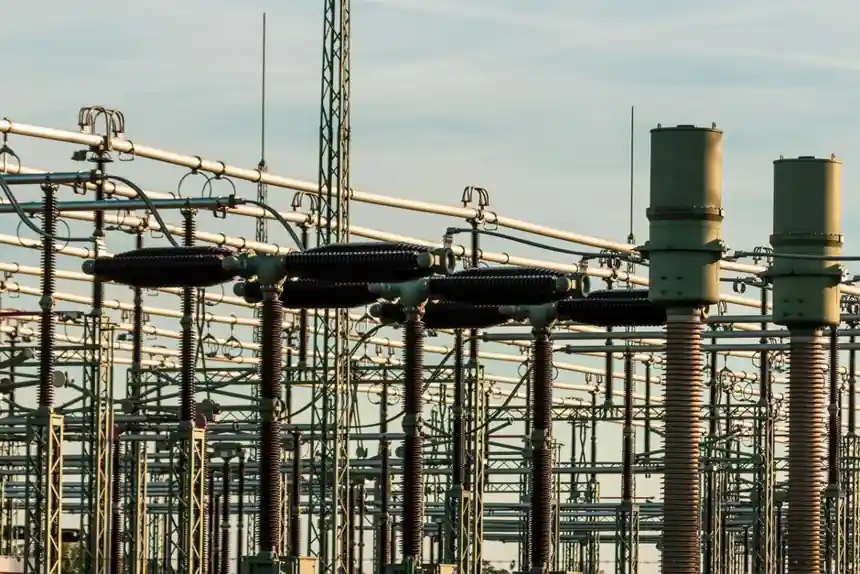
Soft ferrite cores, ceramic compounds of iron oxide combined with nickel, zinc, or manganese, remain the default magnetic path for transformers and inductors from AM-band loopstick antennas up to multi-megahertz SMPS chokes [S2].
Global stock at major distributors such as DigiKey lists thousands of ferrite SKUs across toroidal, E-core, pot, and planar shapes, reflecting demand from switching power supply designers, RF engineers, and EMI filter integrators [S3].
Two Material Families, One Hard Frequency Split
MnZn ferrite (Mn(a)Zn(1−a)Fe2O4) delivers higher permeability and saturation flux density than NiZn, making it the workhorse for frequencies below 5 MHz, while NiZn ferrite (Ni(a)Zn(1−a)Fe2O4) wins above 5 MHz because its higher resistivity suppresses eddy currents that would otherwise burn the core [S2].
The 5 MHz crossover is a hard rule of thumb in magnetics design: a 100 kHz SMPS transformer wants high inductance and low loss, an RF transformer wants low loss at high frequency with moderate inductance, and a suppression ferrite accepts a high loss factor across a wide band to kill EMI [S2]. For common-mode chokes the decision point shifts upward to 70 MHz because the application rewards NiZn-class resistivity over MnZn permeability [S2].
Shape, Size, and Where Each Geometry Fits
Toroidal cores, E-cores, pot cores, and planar (E38/8/25-class) sets each address a different packaging constraint: toroids minimize stray field and offer self-shielding for EMI-sensitive boards, E-cores carry high power and accept bobbin windings, pot cores concentrate flux in a closed cavity for filters and wideband inductors, and planar cores keep profile height below a few millimetres by using PCB-trace windings [S1][S5].
Magnetics, a long-standing US supplier, breaks its catalogue into Ferrite Toroids, Ferrite Shapes, Ferrite Pot Cores, Gapped Cores, and supporting Hardware, and pairs each with permeability-versus-frequency and loss-versus-frequency curves so designers can match material to switching frequency [S1]. For a 1 mH DC-to-DC converter example, the E38/8/25 planar core in Ferroxcube 3F3 material is preferred over 3C90 across 0 to 100 °C because 3F3 holds permeability closer to its 100 kHz value of around 2000 as temperature rises, and 3F3 also shows lower loss at 1 MHz [S5].
Selection Workflow: From Target Inductance to Gap Decision
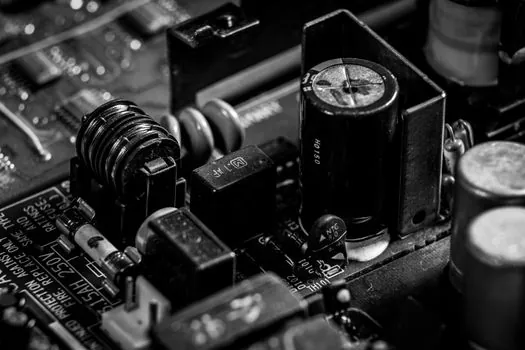
The seven-stage ferrite design process used in published reference designs runs: target core size, study ferrite materials, choose material, calculate turns, calculate current, calculate peak flux density, then decide if a gap is required [S5].
Three engineering facts drive every iteration: a 400 mT flux density brings core saturation losses, the upper operating frequency is bounded by eddy-current losses that grow with frequency squared, and temperature drift shifts inductance enough to detune a narrow filter [S5]. Designers working on industrial UPS output filters and PFC chokes typically budget peak AC flux density well below 200 mT to keep core loss low across the 50 to 100 °C operating range that Magnetics lists for UPS, telecom, renewable, automotive, and industrial segments [S1].
Options Compared Against the Decision Criteria That Matter
On the four criteria a magnetics engineer actually weighs, MnZn vs NiZn vs powder core vs tape-wound nanocrystalline split cleanly: MnZn offers the highest permeability and lowest cost below 1 MHz but saturates earlier and loses efficiency above 5 MHz; NiZn holds losses flat into the tens of MHz at the price of lower permeability; powder cores (Kool Mu, MPP, High Flux, XFlux) trade peak permeability for a soft saturation curve that tolerors DC bias; nanocrystalline tape cores deliver the highest saturation flux density and lowest loss for high-power chokes at premium cost [S1][S2].
On the geometry axis, toroids give the best EMI self-shielding per cubic centimetre but are harder to wind on automated production lines; E-cores and bobbins dominate DC power supply and SMPS main transformers because they accept high-voltage safety isolation between primary and secondary; pot cores enclose flux for stable inductors in band-pass filters; planar E-core sets enable low-profile, surface-mount-compatible power magnetics where total height under 10 mm is a hard constraint [S1][S5].
Use Cases, Constraints, and Common Failure Modes
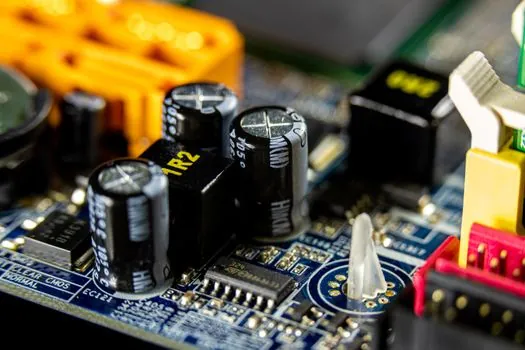
Switched-mode power supplies and DC-DC converters account for the bulk of ferrite inductor and transformer demand, with secondary use in RFID signal conditioning, power transformers, EMI noise filtration, and industrial AC-DC converters [S4].
Three failure modes recur in field returns: thermal runaway when an MnZn core is driven above its 100 °C Curie-region knee and permeability collapses, audible noise and saturation when a powder-core inductor sees a DC bias higher than its soft-saturation design point, and EMI re-radiation when a suppression ferrite with the wrong impedance-versus-frequency curve is placed on a data line instead of a power line [S2][S4][S5]. For toroidal ferrite and multi-aperture balun cores bought through surplus channels, expect looser tolerance on initial permeability (often ±20% versus ±10% on factory-fresh parts) and verify Q at the target frequency before committing to production [S8].
Sourcing, Standards, and Supply Signals
Ferrites were invented in 1930 by Yogoro Kato and Takeshi Takei at the Tokyo Institute of Technology, with TDK starting mass production in 1937 for radio equipment, and the technology was recognized as an IEEE Milestone in 2009 [S2].
Mainstream suppliers include Magnetics (powder cores, ferrite shapes, tape-wound cores), Ferroxcube (planar E-core sets referenced in published design guides), TDK, and a long tail of Asian vendors shipping through broadline distributors and marketplaces; DigiKey's ferrite-cores filter page exposes several thousand active SKUs and is a useful proxy for cross-brand availability [S1][S3]. When evaluating power supply core lots, request the manufacturer's permeability-versus-temperature and loss-versus-frequency curves, confirm Curie temperature for the target ambient, and cross-check effective length (ℓe) and effective area (Ae) before computing peak flux density [S1][S5].
Track two signals over the next sourcing cycle: distributor-reported lead times for MnZn toroids in the 20 to 50 mm OD range, which remain a proxy for SMPS build rates, and any 3F3-class planar core restock notices from the major European suppliers, since planar geometry is winning share in low-profile industrial brick converters. Industrial buyers sourcing magnetics alongside other power-electronics hardware will also be evaluating selection criteria for adjacent components, and the decision-matrix approach used for Alloy Steel vs Tool Steel for Dies and Molds applies the same way: pin each candidate material to a quantified criterion before committing.