A fettling grinder for foundry cleaning is sized by three coupled spec gates: motor power band 0.3-15 kW, wheel diameter 100-610 mm, and casting-mass class from sub-1 kg handheld duty up to several-hundred-kilogram swing-frame work, with spindle RPM and dust port size acting as tie-breakers [S5].
The format question dominates the purchase order. Ganesh PG-12 to PG-20 pedestal snagging line covers 3.7 kW at 2700 rpm to 11 kW (15 kW optional) at 1600 rpm with 300-500 mm resinoid-bonded wheels and a fixed 860 mm centre height; the matching SG-12 to SG-20 swing-frame line holds the same motor and wheel bands but adds 2000-2300 mm overall length and 180-220 kg net mass to absorb pivoting load [S1].
Five Format Classes and Their Spec Bands
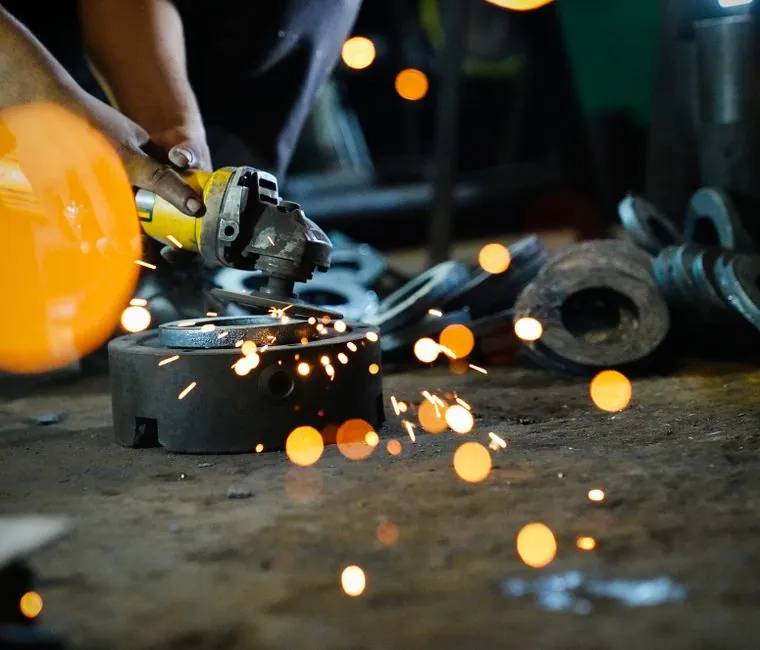
Fettling grinders split into five format classes spanning 0.3-15 kW, 4-24 in wheels, and 80-3821 rpm operating speed, with selection driven by casting mass, alloy, and dust-explosion zone rather than by brand [S5]. The handheld angle grinder format covers 4-7 in (100-180 mm) wheels at 0.3-1.5 kW and is the only class light enough for sub-1 kg cosmetic shells and thin-wall housings, where swing-frame wheel mass would overpower the part.
Pedestal snagging grinders (3-10 HP, 12-24 in wheels) are the workhorse for small-to-medium castings where the workpiece moves to the wheel, and Ganesh capacity bands of 12 in, 16 in, 18 in, 24 in map to 3, 5, 7.5, and 10 HP motors with double-row ball-bearing main shafts and dust-proof sealed bearings [S2]. Double-ended pedestal units mount two wheels on one spindle, typically one roughing and one finishing grit, sharing the 3-10 HP, 12-24 in band of the single-ended pedestal [S5].
Swing-frame grinders (5-15 HP, 12-24 in wheels) hang the wheel on a heavy pivoting arm and are the only format that handles castings from 25 kg up to several hundred kilograms without wheel deflection, with Ganesh SG-12, SG-16, and SG-20 covering 3.7 kW, 5.5 kW, and 11 kW at 2700, 2100, and 1600 rpm respectively [S1]. Robotic and automatic cells round out the five classes, using industrial robots carrying grinding spindles and resin-bond or diamond cutting discs for unattended high-volume batch runs [S5].
Spec Gates That Decide the Quote
Four spec gates actually change the quote: wheel diameter versus motor power, spindle RPM versus wheel rated RPM, dust port diameter matched to foundry extraction, and ATEX/IECEx zone rating [S4]. Ganesh PG and SG spec sheets explicitly exclude grinding wheels and dust collecting units from the machine price, so the apparent quote is roughly 70-80% of the in-service cost once resinoid wheels, dust extraction, and arbor hardware are tallied [S1].
Wheel-to-power matching is non-negotiable. PG-12 pairs a 300 mm wheel with 3.7 kW, PG-20 pairs a 500 mm wheel with 11 kW (15 kW optional), and forcing a 300 mm wheel onto an 11 kW spindle strips the abrasive grain before the bond fractures, while mounting a 500 mm wheel on a 3.7 kW spindle stalls the motor and burns the workpiece. Cast Grind Solutions' CWG-DT400 single-end pedestal rough grinder anchors the lower mid-band at 5.5 kW, 400x40x100 mm wheel, 80 m/s peripheral speed (3821 rpm), 380 V supply, and 340 kg machine mass, purpose-built for brazed diamond wheels on grey and ductile iron [S5].
Rated-RPM match is the single most common cause of wheel burst on first spin-up. The Ganesh PG line drops spindle speed as wheel diameter grows (2700 rpm at 300 mm down to 1600 rpm at 500 mm) precisely to hold peripheral speed inside the resinoid-bond rated band, and every blotter has to show a rated RPM equal to or higher than the stamped nameplate spindle speed [S1]. For dust port sizing, the Ganesh pedestal line does not publish a port diameter, so buyers must match extraction to the wheel guard face area; undersized extraction is the dominant cause of visible-dust violations in iron foundry cleaning rooms [S2].
Power Class Comparison: Electric, Pneumatic, Hydraulic

Three power classes compete for the fettling slot, and the 5-year TCO ranking flips depending on duty cycle and available utilities. The bands are 5-9 kW direct-drive electric, 3-7 kW vane-motor pneumatic, and 4-7 kW hydraulic-driven via an existing rig, with electric scoring on energy cost because 1 kWh equals roughly 5-7 m³ of compressed air at 7 bar, so pneumatic is roughly 70-80% less efficient wall-to-wheel [S4].
Pneumatic still wins on intrinsic safety in Zone 1/21 where Ex-rated electrics add 25-40% to capital cost, and hydraulic wins where an existing rig and high-cycle duty make the parasitic motor loss irrelevant. Foundries that already run 7 bar compressed-air mains at the cleaning cell almost always pick pneumatic for compliance simplicity, while greenfield iron and steel cells with cheap grid power default to direct-drive electric. For buyers comparing fettling grinder options across power classes, the source data confirms the spec bands above and the energy-efficiency delta, but the duty-cycle and zone-rating crossover has to be re-checked per cell [S4].
Abrasive Grain and Wheel Selection by Alloy
For ferrous castings the workhorse grains are brown and zirconia alumina on ductile and grey cast iron and on carbon and alloy steel, while silicon carbide (C24-C36) is reserved for low tensile strength or sand-burnt surfaces including grey iron with adhered burnt sand, aluminium, copper, brass, and bronze because it is hard and friable [S4]. White aluminium oxide suits heat-sensitive steel where burn must be minimized, and the Ganesh spec sheet confirms all PG and SG ratings are derived with resinoid-bonded wheels, not vitrified [S1].
Stock removal above 15 mm per pass needs a 5-7.5 kW drive and a reinforced wheel rated at least 80 m/s peripheral speed, which is why swing-frame work over heavy gates pairs SG-16 or SG-20 (5.5 kW and 11 kW) with reinforced resinoid wheels rather than standard wheels [S9]. The Ganesh PG-12, PG-16, PG-18, and PG-20 series all run resinoid-bonded wheels at 2700, 2100, 1800, and 1600 rpm respectively, with bore diameters of 38.10, 50.80, 127, 152.40, and 203.20 mm so the arbor has to match the wheel exactly [S1]. For a detailed format-by-format comparison including pedestal snagging grinder and swing frame grinder specs, the Ganesh and SpecForge source data lines up the five format classes with numeric thresholds.
Who Should Not Pick the Standard Pedestal
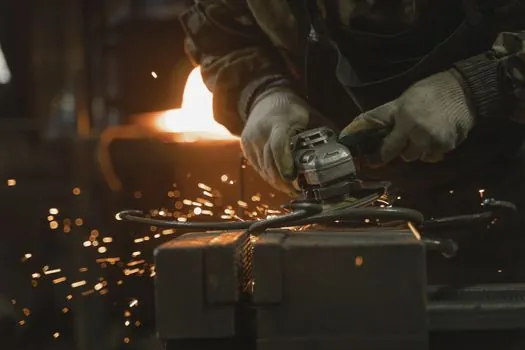
Foundries mixing sub-1 kg cosmetic shells with 200 kg valve bodies should not standardise on one pedestal snagger. The Ganesh swing-frame scores highest on stock removal but worst on cosmetic and thin-wall fit because the wheel mass and pivot geometry overpower delicate parts, so cells mixing both weights should run one PG-12 or PG-16 class pedestal plus one or two handheld angle stations for thin-wall work, with the swing-frame reserved for the heavy-gate cell [S7].
Magnesium and aluminium casings push the decision the other way. Pneumatic handheld angle grinders (4-7 in, 0.3-1.5 kW) are the only practical class for sub-1 kg cosmetic shells because the wheel mass of any pedestal or swing-frame would damage the part, and the lower ignition risk of the workpiece alloy does not relax the ATEX zone requirement on the dust side [S5]. For pump and valve production specifically, the crossed-roller guide and linear guide selection for the swing-frame carriage matters less than the wheel-and-power match, because the pivoting arm absorbs the grinding load long before the guide runs out of travel [S9].
5-Year TCO Stack and Hidden Costs
A 5-9 kW fettling grinder running two shifts a day in a foundry cleaning line will accumulate 5-year cost equal to roughly 3-5x its purchase price once wheel consumption, labor, dust extraction, and downtime are tallied [S6]. TCO covers purchase, use, maintenance, support, and disposal, and the Ganesh data sheet confirms that grinding wheels and the dust collecting unit are extra-cost items, not bundled with the machine, so the sticker price is the smaller half of the 5-year stack [S1].
Wheel consumption dominates the variable cost line. A 500 mm resinoid-bonded wheel on an SG-20 at 1600 rpm removes gate material at the rated 80 m/s peripheral speed, but the bond fractures faster on sand-burnt iron than on clean ductile, so silicon-carbide wheels on cast iron with high chill and on non-ferrous pump housings wear at a different rate than zirconia on ductile iron [S9]. Downtime is the second-largest line, and pneumatic handheld stations score worst here because 7 bar air leaks at every coupling; electric pedestal and swing-frame units score best because the only wear parts are the bearings, the belt, and the wheel [S4].
Sourcing Logic and Supplier Shortlist
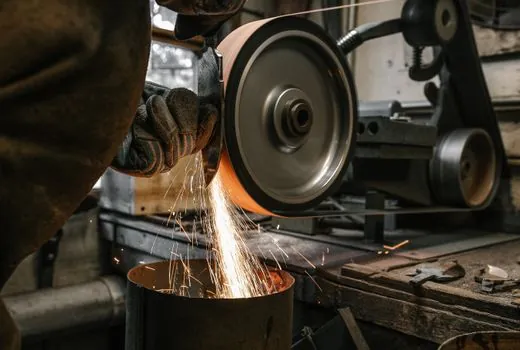
Indian suppliers dominate the small-to-medium pedestal and swing-frame market, with Ganesh (Kolhapur, Maharashtra) publishing PG and SG spec sheets covering 12-24 in wheels, 3-15 HP motors, and 1600-2700 rpm spindle speeds [S3]. Sri Vivegha Engineering (Coimbatore) publishes a near-identical PG-12 to PG-20 range (3.7-11 kW, 2700-1600 rpm) plus an SG swing-frame line and CG abrasive cutoff line with 2.2-5.5 kW motors and 300-400 mm cutoff wheels, so the two catalogues can be cross-checked wheel-for-wheel [S1].
Foundries running a fettling grinder fleet of 5+ stations should standardise on one supplier for bearing and belt spares, since the Ganesh PG/SG line uses double-row ball bearings on the main shaft and dust-proof seals, and the Sri Vivegha PG line uses the same architecture, so cross-sourcing is feasible but warranty terms usually favour a single OEM [S2]. For high-volume iron and steel cells, the sand blasting machine suppliers and manufacturers and robotic-cell builders sit one tier up the capital stack, but the fettling grinder shortlist logic still starts with the PG-12 to PG-20 power-wheel matrix and only then narrows by zone rating, dust port, and brand preference.
Trackable signals over the next quarter: any new Ganesh or Sri Vivegha release of an 18 kW PG-22 class pedestal (the current PG-20 tops out at 15 kW optional), and any IEC 60079 or ATEX 2014/34/EU zone-rated electric pedestal that closes the pneumatic-versus-electric TCO gap in Zone 1/21 cells.