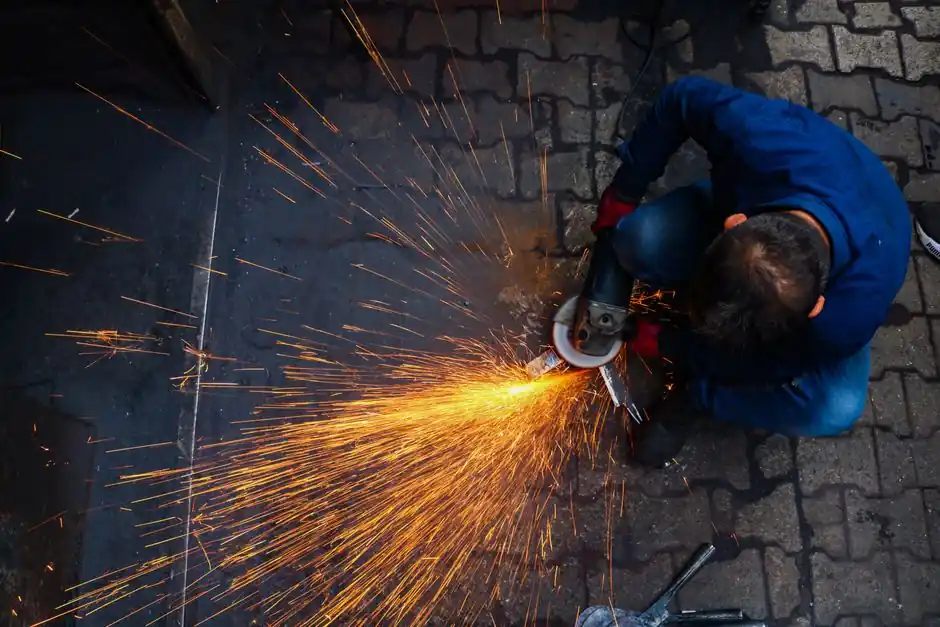
A fettling grinder is a heavy-duty pedestal or swing-frame grinder used in foundry cleaning rooms to knock gates, risers, and parting lines off castings; the realistic spec band runs 3 to 15 HP with 12 to 24 inch resinoid wheels [S4][S5]. The decision is not the brand, it is the format (bench/pedestal snagging vs swing-frame), the motor power matched to gate mass, and the abrasive grade matched to casting alloy [S4].
Foundry buyers typically shortlist from two format families: pedestal snagging grinders sized 3 to 10 HP with 12 to 24 inch wheels, and swing-frame grinders sized 5 to 15 HP with 12 to 24 inch wheels [S5]. A representative single-end pedestal unit, the CWG-DT400 from Cast Grind Solutions, ships at 5.5 kW (7.5 HP) with a 400×40×100 mm wheel running 80 m/s peripheral (3821 rpm) and weighing 340 to 360 kg [S3]. That single data point defines the mid-band of the pedestal family.
Format Decision: Pedestal Snagging vs Swing-Frame vs Handheld Angle
Pedestal snagging grinders mount the motor at the base with the spindle held in double-row ball bearings sealed against dust, and rigid two-side guards to contain wheel-burst fragments; this format is the workhorse for small to medium castings up to roughly 20 to 30 kg per piece [S4]. Swing-frame grinders hang a larger wheel from a pivoted swing arm, with the main body in a heavy seamless tube and a dynamically balanced spindle; the pivot geometry lets an operator drive a 16 to 24 inch wheel across a casting face that a pedestal cannot reach [S4]. The selection rule: pedestal for repeat work on small parts, swing-frame for large gates and risers where reach and wheel mass matter, handheld angle grinder (4 to 7 inch, 0.3 to 1.5 kW) for cosmetic control on thin-wall housings under 1 kg [S8].
The Sri Vivegha pedestal ladder illustrates the power-vs-wheel scaling that a buyer has to navigate: PG-12 at 300×40×38.1 mm, PG-16 at 300×40×50.8 mm or 400×50×127 mm, PG-18 at 400×50×127 mm, PG-20 at 400×50×152.4 mm or 450×50×152.4 mm, with a 1 HP metal polisher (MP 14) at 2880 rpm as the light-duty benchmate [S10]. Ganesh's matching snagging ladder runs 12, 16, 18, 24 inch wheel capacities at 3, 5, 7.5, 10 HP motors, and the swing-frame ladder runs 12, 14, 16, 24 inch capacities at 5, 7.5, 10, 15 HP [S4]. Buyers should reject any single-format recommendation that ignores this two-axis (HP × wheel diameter) ladder.
Spec Gates: Motor Power, Wheel Diameter, Wheel Speed, Spindle Balance
Motor power must be sized to the heaviest gate or riser the operator will routinely remove, not to the average piece; a 5 HP snagging bench will stall on a 24 inch wheel against a 30 mm riser stub, while a 15 HP swing-frame wastes capital on a 12 inch wheel doing 5 mm flash [S5][S9]. The Ganesh spec band places the snagging line at 3 to 10 HP and the swing-frame line at 5 to 15 HP, with wheel diameter 12 to 24 inches common to both formats [S4][S5]. Wheel peripheral speed is the second hard gate: conventional abrasive wheels are rated to a maximum 33 to 35 m/s, while the Cast Grind Solutions CWG-DT400 runs 80 m/s, a band that requires specifically rated diamond or CBN wheels, not generic resinoid [S3].
Spindle balance and bearing arrangement are the third gate and they decide whether the machine stays within operator-vibration exposure limits over a 5 year horizon; a dynamically balanced spindle and complete rotating assembly, with double-row ball bearings that take both heavy radial and axial loads, is the Ganesh baseline for both formats [S4]. The published fettling grinder trade-off map ties these three gates together and ranks swing-frame highest on stock removal, pedestal highest on repeatability, and handheld angle grinder highest on cosmetic control for sub-1 kg shells [S5][S8].
Criteria-Based Comparison: Three Formats on Four Decision Axes
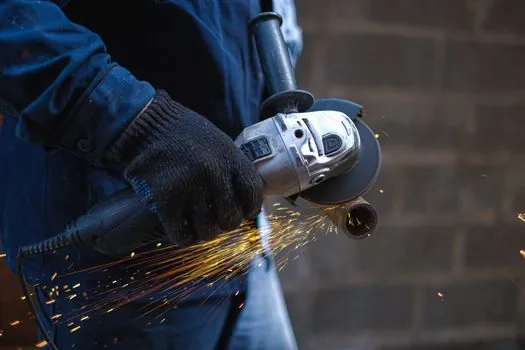
For a foundry cell weighing castings from under 1 kg up to 200 kg, the format shortlist sorts cleanly on four axes: stock removal rate (kg of gate per hour), reach on large faces, cosmetic control on thin walls, and capital cost per HP. Pedestal snagging (3 to 10 HP, 12 to 24 inch) scores high on repeatability and low cost per HP but low on reach; swing-frame (5 to 15 HP, 12 to 24 inch) scores highest on stock removal and reach but worst on thin-wall cosmetics; handheld angle grinder (0.3 to 1.5 kW, 4 to 7 inch) scores highest on cosmetics and lowest on stock removal [S5][S8].
A standard cell mixing casting weights therefore runs one PG-12 or PG-16 class pedestal (300 to 400 mm wheel, 3 to 7.5 HP) plus one or two handheld angle grinder stations for cosmetic work; large-iron foundries with castings over 50 kg add a swing-frame on a separate booth with full extraction [S8]. The CWG-DT400 at 5.5 kW with a 400 mm wheel and 80 m/s peripheral speed sits at the centre of the pedestal band and is a defensible default for mixed foundries [S3]. Reject any shortlist that places a 24 inch swing-frame on a thin-wall electronics housing cell, the wheel mass and pivot geometry will overpower the part [S8].
Duty Matching: Casting Weight, Alloy, Gate Geometry, Booth Layout
Match the grinder to the heaviest expected gate, not the median. For castings under 10 kg with thin risers, a 12 to 16 inch pedestal at 3 to 5 HP is the right band, paired with a handheld angle grinder for cosmetic flashing [S4][S8]. For 10 to 50 kg castings with 20 to 40 mm gate stubs, step up to a 16 to 18 inch pedestal at 7.5 to 10 HP, or move to a 16 to 24 inch swing-frame at 10 to 15 HP if the casting geometry blocks operator reach on a pedestal [S4][S9]. For castings over 50 kg with heavy risers, swing-frame at 10 to 15 HP with 20 to 24 inch wheel is the only format that delivers the required metal-removal rate without operator fatigue [S5][S9].
Alloy and abrasive selection are coupled: resinoid-bonded alumina or silicon carbide wheels cover most iron and steel work, while the 80 m/s peripheral speed class (CWG-DT400 and similar) is only usable with rated diamond or CBN wheels and is justified on hard, abrasive castings where wheel consumption dominates operating cost [S3][S6]. Booth layout decides dust extraction duty: pedestal units can share a fixed booth extraction, swing-frame units need an extraction hood that follows the swing arc, and handheld angle grinder stations need on-tool extraction or a downdraft bench [S4][S5]. The published TCO model shows that on a 5 to 9 kW pedestal running two shifts, 5 year cost runs 3 to 5× purchase price once wheel consumption, labor, dust extraction, and downtime are included; that ratio is the right number to defend capital requests [S6].
Limitations and Failure Modes: Wheel Burst, Vibration, Dust, Noise
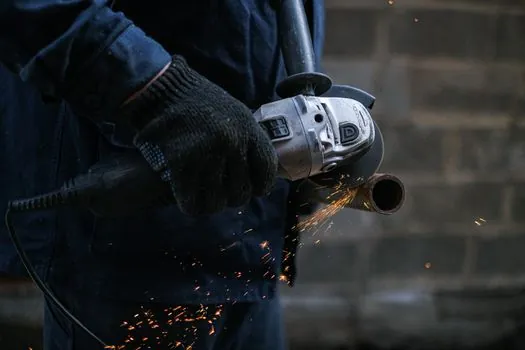
A 24 inch wheel bursting at 1800 to 3600 rpm stores enough kinetic energy to cause fatal injury, which is why both formats require rigid two-side guards and the swing-frame design must keep the guard concentric with the wheel across the full pivot range [S5]. Wheel RPM, abrasive-grade selection, and ring-test inspection are operator-controlled variables that no machine design can fully absorb; the published failure mode is wheel-burst fragment injury, not electrical failure [S5]. Buyers should reject any quotation that does not include documented ring-test procedures, wheel-RPM verification on the nameplate, and a documented wheel-change protocol.
Secondary failure modes: unshielded 5 to 15 HP grinders run above the 85 dB(A) action threshold, so hearing protection and acoustic booths are mandatory, not optional; airborne dust from the abrasive plus casting sand drives the dust-extraction sizing and is a regulatory driver in most jurisdictions; operator vibration on the swing-frame line is mitigated by the dynamically balanced spindle but is not eliminated, so shift-rotation policy matters as much as spindle balance [S4][S5]. The sand reclamation loop sits downstream of the fettling booth, and the fettling grinder's dust output is a feed stream to that loop, not a substitute for it, a point that fettling-grinder buyers often miss when they compare capital costs in isolation [S7].
Standards, Sourcing Signals, and Shortlist Logic
No single ISO or EN standard governs fettling grinder selection; relevant rule sets cover abrasive wheel safety (ISO 525, EN 12413 for bonded abrasive products), electrical safety for industrial machines (IEC 60204-1), and operator vibration exposure (ISO/TR 19664 for hand-arm vibration), but none of these dictate a specific HP or wheel-diameter choice for a given casting weight. Buyers should treat compliance with these standards as a baseline gate, not a selection criterion, and apply the Ganesh and Cast Grind Solutions product spec ladders as the selection framework [S3][S4].
The shortlist logic, in order: confirm format (pedestal vs swing-frame vs handheld) by casting weight and reach; lock motor power to the heaviest expected gate mass; lock wheel diameter to the format's capacity ladder (12, 14, 16, 18, 20, 24 inch); lock wheel speed class (33 to 35 m/s for resinoid, 80 m/s class only with rated diamond/CBN); require dynamically balanced spindle, double-row ball bearings, dust seals, two-side rigid guards, and external belt-tensioning provision; require dust extraction sized to format; run a 5 year TCO at 3 to 5× purchase price as the capital defense [S3][S4][S5][S6]. Track two signals over the next procurement cycle: a vendor offering 80 m/s peripheral speed on a non-diamond wheel (reject), and a vendor quoting swing-frame HP without naming the wheel diameter (reject). The Ganesh and Sri Vivegha spec ladders, and the Cast Grind Solutions CWG-DT400 data point, are the public benchmarks to compare any quotation against [S3][S4][S10].
Spec-level background on the components involved: fettling grinder, and floor grinder.