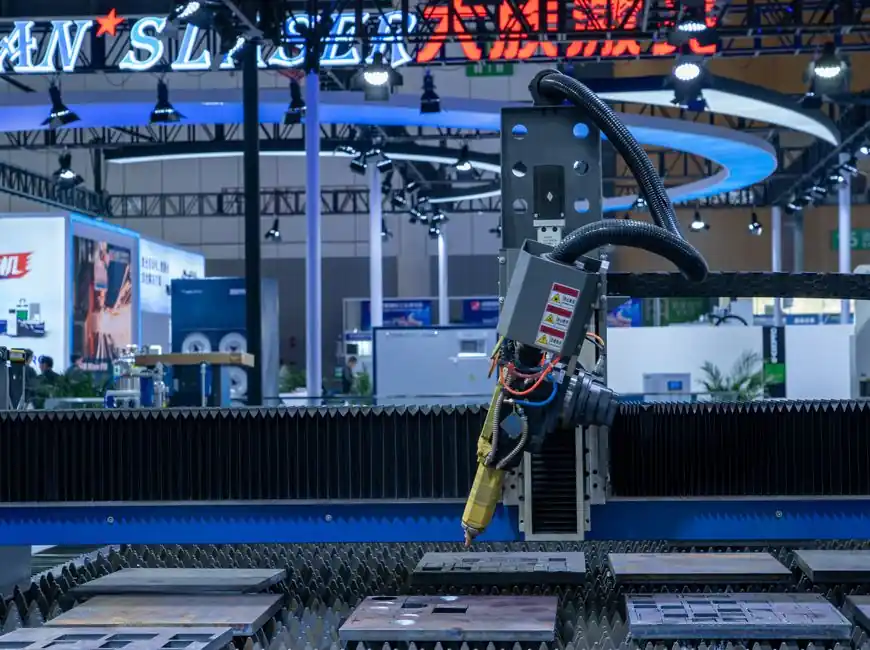
Public 2026 listings show fiber laser cutting machine prices spanning from about $13,000 for a 1 kW compact cutter to over $600,000 for a 20 kW+ automated cell, with laser wattage itself adding roughly $8,000–$12,000 per additional kilowatt at the 3–20 kW tier [S3].
Entry systems cluster at 1–3 kW in the $15,000–$50,000 band, mid-range industrial 3015 workhorses at 3–6 kW land in $50,000–$150,000, and 12–20 kW+ sheet cells push into $150,000–$400,000+ before automation and high-end 30 kW configurations reach $200,000–$600,000+ [S2][S3][S4].
Price Bands by kW Class (2026 Public Listings)
At 1–3 kW, Accurl's 2026 manufacturer pricing guide places compact cutters at $15,000–$40,000, with 1.5 kW units commonly listed around $20,000–$30,000 using Raycus or Max Photonics fiber sources on a standard 4×8 ft bed [S3]. Above 3 kW, a 3015 enclosed workhorse in the 3–6 kW class benchmarks at $60,000–$150,000, while a 5×10 ft mid-range machine from QLTEK through US distributors starts near $54,000 for 3 kW and scales to 6 kW across 5×10, 6½×13, and 5×20 ft tables [S3][S4].
At 12–20 kW, public industrial references converge on $150,000–$400,000+, with the 12–20 kW band shortening cycle time on thick plate and bright-edge stainless and forcing larger enclosures and utility feeds [S4]. At 30 kW and above, where 30 kW+ configurations are listed, the band opens to roughly $200,000–$600,000+ depending on automation stack and beam-delivery options [S2]. Across these tiers, observed incremental cost runs near $8,000–$12,000 per added kW once the chassis, motion, and optics are already specced [S3].
What Actually Moves the Price per kW
Laser power is the single largest cost driver, but it does not act alone. Bed size scales cost almost independently: a 3015 (5×10 ft) chassis, a 4020 (5×20 ft), and a 6025 (8×25 ft) for heavy plate each carry a different steel, motion, and enclosure cost. Plate-and-tube integrated cells start near $46,900 and climb past $110,000 once a tube chuck, drive, and optional auto loader are added [S4]. A tube-only 6 m line, by contrast, runs $19,000–$82,000 driven mostly by chuck spec, loader, and power [S4].
Above the chassis, three line items swing a quote more than the kW number itself: (1) cutting head and auto-focus unit, where a premium bus-controlled head can add several thousand dollars versus a basic unit; (2) nesting and process software licenses, which are usually itemized separately on quotes over $100,000; and (3) automation, including shuttle tables, dual-pallet changers, and tower loading, where a full automated production line commonly pushes a quote from $200,000 to $500,000+ for the same kW class [S2][S4]. Sourcing origin is the fourth swing factor: Chinese-manufactured machines list 30–50% below equivalent US or European systems, but freight, import duties, and remote support gaps close that spread within one to two service events [S3].
Comparison: 1–3 kW vs 3–6 kW vs 12–20 kW+ on Decision Criteria
For a buyer choosing between tiers, the four decision criteria that actually map to job mix are kW class, purchase band, total cost of ownership (TCO) headroom, and fit for purpose. A 1–3 kW entry system in the $15,000–$50,000 band is best for thin steel and aluminum up to about 6 mm, with TCO headroom of 20–40% per year on top of purchase and almost no automation [S3]. A 3–6 kW mid-range system in the $50,000–$150,000 band handles mixed sheet metal up to about 12 mm with a shuttle table as the most common upgrade, and represents the workhorse configuration most job shops standardize on [S3][S4].
A 12–20 kW+ system in the $150,000–$400,000+ band targets thick plate and high-throughput stainless, requires utility upgrades, and is the first tier where the incremental kW cost (about $8,000–$12,000 per kW) is most defensible because it directly shortens pierce and cut time on heavy stock [S3][S4]. For selection depth on a closely related laser marker class, the kW-versus-price logic is similar though power bands are far lower. The same physical principle of beam-delivery and focusing economics also drives a laser screed or a laser profiler cost curve, where more working range and tighter tolerance add a near-linear premium.
Operating Cost per kW: Electricity, Gas, and Maintenance
Operating a fiber laser is not a 1:1 ratio with nameplate laser power. Published consumption data for fiber cutting systems shows a 10 kW fiber laser drawing approximately 25 kW from the wall and a 20 kW fiber laser drawing approximately 50 kW, with average cutter consumption sitting between 1.5 kW and 10 kW depending on duty cycle [S8]. This is the first place buyers underestimate TCO: a 20 kW machine idling between cuts still draws a meaningful auxiliary load, and assist gas flows scale with kW and cut time.
Sticker price alone misleads. Across 2026 reference data, operating costs (assist gas, electricity, consumables, maintenance, and installation) typically add 20–40% annually on top of purchase price, so a $150,000 mid-range system realistically carries $30,000–$60,000 per year in running cost before labor [S3]. Maintenance exposure also scales with kW: cutting head consumables, lens sets, and nozzle wear accelerate on 12 kW+ systems cutting thick plate, which is why some 2026 buyers size the kW to the thinnest material they run 80% of the time, not the thickest. For facilities planning utility feeds, a laser tracker or other optical metrology line that shares the same clean-power bus should be budgeted into the same electrical upgrade.
Who a kW Tier Is For, and Who It Is Not For
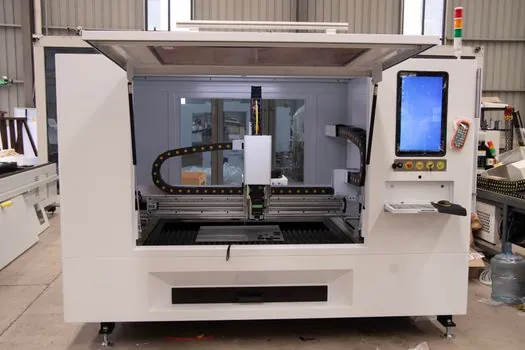
A 1–3 kW system in the $15,000–$50,000 band is for hobbyists, prototyping shops, and small fabricators cutting thin steel or aluminum up to about 6 mm; it is not for shops running daily production in 6–12 mm stainless or carbon steel, where pierce time and edge quality will bottleneck throughput. A 3–6 kW mid-range system in the $50,000–$200,000 band is the right answer for general sheet metal work and mixed-job production, with shuttle-table automation as a common upgrade; it is not for thick-plate-only shops that will leave the 3 kW end of the range underused. [S4]
A 12–20 kW+ system in the $150,000–$400,000+ band is for thick-plate and high-volume stainless production, including heavy structural and yellow-goods work; it is not for shops where more than 20% of jobs are under 4 mm, because the 6 kW mid-range tier handles those parts faster at lower consumable cost. The 30 kW+ tier, at $200,000–$600,000+, is a specialized purchase for very heavy plate work and is rarely justified outside structural steel, shipyard plate, and heavy-equipment OEMs. For shops looking at alternatives to fiber for thicker stock, a laser level or a precision laser displacement sensor attached to a plasma or oxy-fuel cell can substitute on parts where edge finish tolerances are less demanding [S3][S4].
Procurement Reality in 2026: Sourcing, Duties, and Lead Time
Lead time and sourcing origin now matter as much as kW. Locally supported industrial systems in the US market carry a 2026 reference band of roughly $150,000–$500,000+, which is 30–50% above equivalent Chinese-manufactured units but folds in installation, training, and warranty response [S1][S3]. The financial trade is concrete: a Chinese 6 kW import at the bottom of its band lands near $30,000–$50,000, while a domestically supported 6 kW at the same wattage lands near $80,000–$150,000, and the gap closes within one to two major service events plus any retroactive automation retrofit [S3].
Tariff exposure and import-duty re-export rules have also moved in 2026, which is why procurement teams are now asking whether a machine can be re-exported under drawback if a US plant shuts; the 2026 duty drawback rules for re-exported industrial equipment materially affect the TCO of an imported fiber cell, because a $200,000 machine that can be drawback-eligible on re-export has a different lifetime cost than one locked to a single site. Lead times for industrial kW-tier machines in 2026 commonly run 8–16 weeks for stocked configurations and 16–26 weeks for built-to-order 12 kW+ systems, comparable to the power transformer lead time bands of 30 to 160+ weeks by MVA class for the utility feed that powers the cell, which is why electrical infrastructure should be ordered in parallel rather than after the laser is on the floor.
Bottom-Line Sizing Rule and Trackable Signals
The sizing rule that holds across the 2026 reference data: pick the kW that cuts your 80th-percentile material thickness in nitrogen or oxygen at the edge quality you ship, then automate around that kW rather than upsizing kW to chase the 20th-percentile thick-plate job. Applied to 2026 bands, that lands most mixed-job fabricators in the 3–6 kW tier at $50,000–$150,000, pushes stainless-focused production into 6–12 kW at $80,000–$200,000+, and reserves 12 kW+ for shops where thick plate is the daily mix, not the exception [S2][S3][S4].
Two signals are worth tracking through the rest of 2026: (1) whether 30 kW+ list prices drift down as more Chinese suppliers enter that band, which would compress the $200,000–$600,000+ reference range; and (2) whether the per-kW incremental cost holds near $8,000–$12,000 or tightens as 12 kW+ becomes the new default for plate work, since a drop in the per-kW slope would reset the break-even math between 6 kW and 12 kW mid-range purchases [S2][S3].