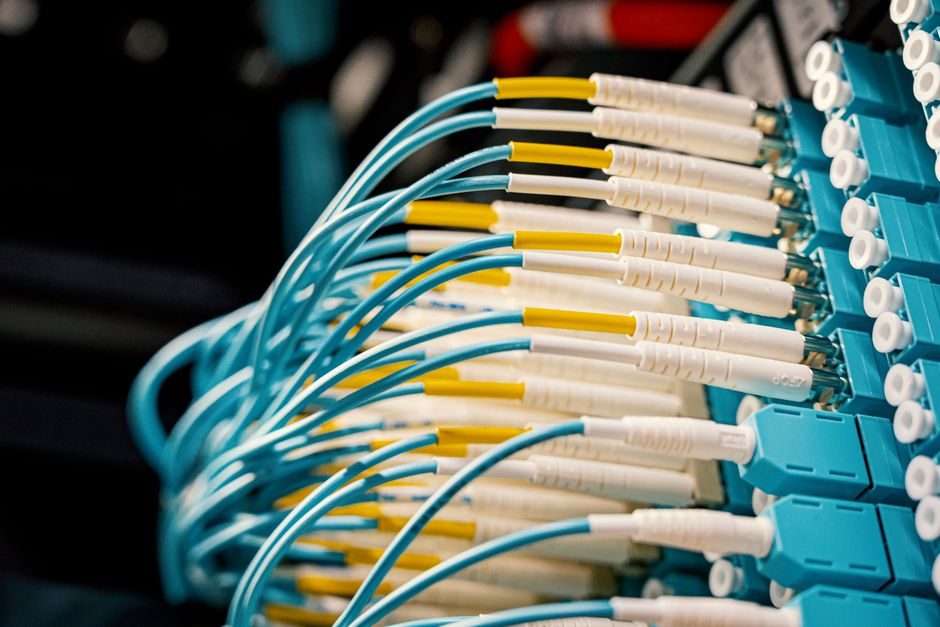
Engineers sourcing a fiber optic sensor in 2026 face a market segmented by sensing principle rather than brand, with intensity-modulated, Fiber Bragg Grating (FBG), and distributed (Rayleigh/Brillouin/Raman) variants each tied to a measurand class and a hostile-environment duty cycle [S1][S6].
The right pick is decided by four gates — measurand-to-mechanism fit, environmental envelope, interrogator signal format, and fiber/cable termination — and the wrong gate kills the project faster than a wrong brand [S1][S2].
Gate 1 — Sensing Mechanism vs Measurand
Intensity-modulated through-beam and reflective sensors are the dominant pick for discrete presence/position detection in factory automation, with the Keyence FS-V30 series advertising roughly 64 times the beam power of its conventional predecessors for long-range, dust-tolerant industrial part detection [S2].
FBG sensors are wavelength-modulated devices that encode strain and temperature directly into a shift of the Bragg wavelength, allowing absolute measurement and multiplexing of many gratings on a single fiber — a structural-health and civil-engineering workhorse [S6].
Distributed sensors map strain/temperature along the full fiber length via backscatter, used for pipeline and dam monitoring where the measurand is the spatial profile, not a point value [S1][S3].
Gate 2 — Environment Envelope and Material Limits
Standard silica glass fiber operates continuously near 85 °C and tolerates short excursions to 300 °C, while polyimide- and metal-coated grades push continuous use to 300 °C and beyond for turbine, downhole, and aerospace duty [S1].
In high-EMI zones (switchgear rooms, VFD cabinets, welding cells), the dielectric, EMI-immune construction of fiber is itself the spec argument — Broadcom catalogs industrial-grade fiber-optic transmitters and receivers explicitly for power generation/distribution and transportation environments where copper-based sensors are unreliable [S4].
For explosive atmospheres and intrinsic-safety loops, fiber removes the spark/ground-loop risk that constrains conventional steel-fiber strain gauges or active electronics; the same property suits MRI rooms and high-voltage substations [S1][S4].
Gate 3 — Signal Format, Range, and Interrogator

FBG interrogators resolve picometer-class wavelength shifts, with commercial units typically covering the C-band (≈1525–1565 nm) and a strain range of ±2000 µε to ±5000 µε depending on gauge length and recoat [S6].
Discrete digital amplifiers (FS-V30 class) output NPN/PNP push-pull or analog 4–20 mA equivalents with sub-millisecond response and detection ranges from a few millimeters (diffuse-reflective) to several meters (through-beam), driven by the 64× beam-power figure Keyence quotes for long-range rugged work [S2].
For absolute measurement, FBG and encoded Fabry-Perot sensors win over intensity-based designs because intensity drifts with connector loss, fiber bending, and LED aging; wavelength is an absolute parameter [S6].
Gate 4 — Fiber Type, Termination, and Network Fit
Single-mode fiber is mandatory for FBG and distributed sensing because the Bragg gratings and backscatter peaks require coherent narrow-linewidth sources; multimode fiber (typically 50/125 µm or 62.5/125 µm) suffices for short-range intensity sensors and is the default on discrete-amplifier fiber-optic pairs [S1][S6].
Connectorization and patch-panel integration reuse the same fiber converter and SFP ecosystem that data networks rely on, which is why industrial fiber-optic component suppliers (Broadcom and peers) sell into both automation and Ethernet/Profinet backbones [S4].
For plant retrofits where the control cable tray is already specified, confirm minimum bend radius (typically 30 mm for 3 mm jacket) and tensile rating (≥100 N short-term for sensor leads) before the installer pulls the run.
Options Compared: Which Variant Fits Which Duty
Three realistic options cover roughly 90% of industrial spec work: (a) intensity-modulated through-beam for short-range presence and counting on conveyors — fast (sub-ms), cheap, NPN/PNP digital out, with Keyence-class models suited to dusty, long-range cells [S2]; (b) FBG arrays for multi-point strain and temperature on bridges, turbine blades, and composite structures — absolute, wavelength-encoded, hundreds of gratings multiplexed on one fiber [S6]; (c) distributed Raman/Brillouin systems for kilometers-long pipeline or dam leak monitoring, where the measurand is temperature or strain along the cable itself [S1][S3].
Decision thresholds: pick intensity if the measurand is binary and the fiber run is under ~20 m; pick FBG if you need 10–1000 absolute strain points within −40 °C to +250 °C on a single fiber; pick distributed if the asset is linear (pipeline, tunnel, levee) and the question is "where along the line" rather than "what is the value at point X" [S1][S6].
Who Should NOT Pick the Mainstream Option
If the measurand is chemical concentration (pH, dissolved oxygen, hydrocarbons), mainstream intensity and FBG sensors are a mismatch — evanescent-wave and surface-plasmon-resonance specialty probes exist, but they belong to a different supply chain and need a different quoting path [S1].
If the application demands a 0–10 V or 4–20 mA analog output to an existing DCS, an FBG + interrogator chain is a capital project in miniature; a discrete amplifier with analog output is the lower-friction pick, but it is still point-measurement, not distributed [S2][S6].
If the vision controller on the line is already making the measurement through image processing, adding a fiber sensor is duplication — spec it out only when the camera is blind to the parameter (e.g. internal strain, embedded temperature).
Failure Modes and Sourcing Watch-Outs
The most common field failure is not the sensor but the fiber: macrobend loss above the cable's minimum bend radius, water ingress at field terminations, and connector contamination — the latter typically raises loss by 1–3 dB and silently kills an intensity sensor before an FBG one [S4].
Second, FBG cross-sensitivity: strain and temperature both shift the Bragg wavelength, so a bare FBG cannot separate them — pairing a strain FBG with a temperature-compensation FBG (loose tube) is the standard fix in structural-health deployments [S6].
Third, long lead times for specialty fiber (polyimide-coated, metal-coated) and the interrogator — plan 10–14 weeks for non-stock variants versus 2–3 weeks for FS-V30-class stock amplifiers [S2].
Standards, Sourcing, and Trackable Signals
Industrial fiber-optic components for power and transportation environments are specified against IEC 60079 series for hazardous areas and against generic data-comms standards (IEEE 802.3 Ethernet over fiber) for the communications layer; confirm the exact certificate scope with the vendor datasheet, not the catalog summary [S4].
For pricing context on the converter/SFP side that pairs with sensor heads, the fiber media converter market in 2026 is dominated by Gigabit Ethernet and PoE+ variants at single-unit price points that swing sharply with temperature and EMC ratings.
Two trackable signals to watch into Q4 2026: (1) broader availability of FBG interrogators with on-board Ethernet/IP or PROFINET, which would let FBG arrays drop into existing PLC architectures without a dedicated gateway; (2) cheaper Raman distributed units under USD 15k, which historically sat above USD 50k and limited adoption outside pipeline operators [S1][S4].