A vision controller is the deterministic hub between cameras, lighting, encoders and a PLC: choose it on hard I/O count, cycle-time budget, processor class, industrial I/O (GigE Vision, USB3 Vision, RS-232), and environmental rating, then match the housing class to the line [S3][S4][S7].
For 2026 spec maps the shortlist splits into three families — compact vision sensors with built-in amplifier (Keyence IV2-G30F class, 24 VDC ±10%, 1.8 A max, 0 to +50 °C [S7]), PC-based machine-vision controllers (Cognex VC5, Voltrium Nuvis/Nuvo), and GPU-accelerated smart cameras such as the In-Sight 6900 line [S3][S4][S5]. The first gate is the application, not the brand.
Gate 1 — Trigger I/O, Encoder Feedback and PLC Handshake
Vision controllers expose optically isolated triggers and discrete outputs sized for direct PLC wiring; the Cognex VC5 lists eight independent inputs (INPUTS 0–7) used for triggering vision events, wired either to a PLC or a photoelectric sensor with voltage measured between INPUT and INPUT COMMON [S3]. Counting inputs and outputs before counting pixels is non-negotiable: every reject signal, every encoder phase, every camera-ready handshake must have a physical pin.
Compact vision sensors compress the same I/O into an amplifier head and 24 VDC rail, typically pulling 1.8 A or less including the communication unit and output load [S7]. For PC-based controllers, GigE Vision and USB3 Vision provide cable-side triggering, but discrete trigger latency and dry-contact outputs still need a budget — keep at least two opto-isolated trigger inputs and two high-speed outputs in reserve, even on a one-camera job, because the second station always appears within twelve months.
Gate 2 — Cycle Time, Resolution and Processor Class
Cycle-time budget is set by line speed: a controller running 5 MP at 30 fps on GigE Vision can spend no more than 33 ms total on acquisition, processing, I/O and PLC handshake, and the CPU class has to carry that load. Compact sensor amplifiers run fixed pipelines at sub-50 ms on small ROI; PC-based controllers scale from embedded AMD Ryzen V1807B with up to 16 GB DDR4-3200 (Voltrium Nuvis-534RT) to 6th-Gen Intel Core i7/i5 LGA1151 with up to 32 GB DDR4-2133 (Nuvis-5306RT) for vision-specific I/O and real-time control, and on to 9th/8th-Gen Core i7/i5/i3 with 7 PCIe/PCI slots (Nuvo-8034) for multi-camera cells [S4].
The Cognex In-Sight 6900 is positioned as a modular AI machine vision controller with configurable hardware and GPU-accelerated processing for advanced inspections, sitting between compact sensor and full industrial PC in cost and capability [S5]. General-purpose machine-vision controllers from wenglor centre on i7-class CPUs because the inspection toolchain — PatMax, blob, caliper, OCR — is CPU-bound until deep-learning inference shifts the load to a GPU accelerator [S9]. For selection: AMD Ryzen Embedded V1807B is a fit for 2–4 camera cells running classic tools; Intel 6th-Gen i7 with 32 GB RAM fits 4–8 cameras with mixed 2D/3D; 9th-Gen i7 with 7 PCIe slots is the right answer when the cell grows a frame grabber, a lighting controller and a motion card on the same backplane [S4].
Gate 3 — Vision-Specific I/O vs General-Purpose I/O
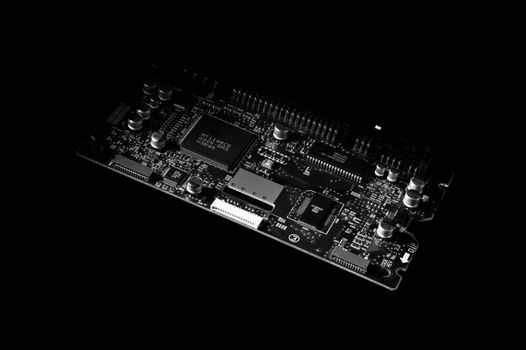
Vision-specific I/O is not the same as PLC-style discrete I/O: it includes encoder inputs for tracking, lighting strobe outputs synchronised to exposure, and trigger-to-image timestamping. A dedicated machine-vision controller with vision-specific I/O and real-time control is the right product class for conveyor tracking and indexed-dial applications; a general-purpose industrial PC only wins when the surrounding PLC already owns the encoder and lighting [S4][S8].
Selection rule: if the application reads an encoder to trigger or to look up a position-to-image transform, specify a controller with vision-specific I/O; if the trigger is a single photoeye into a stationary part, a compact sensor amplifier will do the same job at one-tenth the system cost. The Intelgic Live Vision architecture exemplifies the alternative path — multi-camera industrial-grade connections with real-time processing on a single controller — useful when the line is fixed and the inspection recipes are software-defined [S8]. STEMMER IMAGING's product filter even surfaces "Max. trigger frequency (Hz)" as a primary filter, on the rationale that controllers and dynamics must be matched at the spec stage, not after install [S10].
Gate 4 — Environmental, Power and Mechanical Budget
Environmental gates are binding because cameras live on the line, not in the cabinet. The Keyence IV2-G30F amplifier head runs at 0 to +50 °C ambient, 35 to 85 % RH non-condensing, from a 24 VDC ±10 % supply including ripple, and draws 1.8 A maximum [S7]. That is the floor for a sensor-class head; PC-based controllers need similar thermal headroom but more attention to shock, vibration and dust.
Weight also matters in decentralised mounting. STEMMER IMAGING notes that typical machine-vision controllers range from a few hundred grams to under one kilogram; in a control cabinet the mass is irrelevant, but on a moving gantry or robot arm the housing, mounting pattern and cable strain relief become selection criteria in their own right [S10]. For a controller that lives in a sealed enclosure on a washdown line, NEMA 4X / IP66 housing plus conformal-coated PCBs is the spec to write; for a clean factory floor, IP20 with a fanless heatsink is enough. Power-quality budget — surge, brownout, 24 V ride-through — should be written on the same line as cycle time, not as an afterthought.
Gate 5 — Communication Protocols, Software Stack and Vendor Lock-in
Protocol fit is the gate most often missed. The controller has to talk to the PLC on Profinet, EtherNet/IP, EtherCAT or CC-Link IE; it has to expose its results via OPC UA, MQTT, or a CSV push; and the cameras have to connect on GigE Vision, USB3 Vision, or CoaXPress. Mismatching any one of these means a gateway that adds 5–15 ms latency and a new failure mode. The compact sensor class hides most of this behind a vendor protocol — fine for one-line factories, painful in mixed-vendor plants [S7][S10].
Software stack separates ecosystems. Cognex VisionPro and In-Sight provide graphical toolchains such as CogIntersectLineEllipseTool for geometric intersection, with terminal inputs accepting a line and an ellipse, and outputs exposing intersection count and coordinates through CogToolBlock, with downstream CogFitEllipseTool, CogFindCircleTool and CogFitLineTool composing the tool graph [S1]. Other ecosystems — Halcon, OpenCV, LabVIEW — share the same graph-of-tools pattern but differ in licensing model, runtime cost and update cadence. Lock-in is a real selection criterion: a 5-year spares commitment is not the moment to discover the controller requires a per-seat licence that doubles on a shift add. The machine vision system reference frame helps, but the controller decision is its own spec.
Comparison Matrix — Sensor Amplifier vs PC-Based vs Smart Camera
Three architectures, three budgets. Sensor amplifier (IV2-G30F class): 24 VDC ±10 %, 1.8 A, 0–50 °C, fixed tool set, sub-1 kg, sub-50 ms cycle on small ROI, lowest cost per station, limited protocol gateway [S7]. PC-based machine-vision controller (Voltrium Nuvis-5306RT / wenglor i7 class): 32 GB RAM, GigE Vision x4–x8, vision-specific I/O, encoder tracking, GPU option, multi-vision-software compatible, requires cabinet and PSU [S4][S9]. Smart-camera controller (Cognex In-Sight 6900): modular, GPU-accelerated, IP-rated housing, integrated optics and lighting interface, mid-cost, vendor toolchain lock-in [S5].
Decision rule: pick the sensor amplifier when one inspection and one reject signal cover the requirement; pick the PC-based controller when the cell has 2+ cameras, encoder tracking, or 3D; pick the smart-camera controller when cabinet space is gone, the housing is washdown, and the application sits in one vendor's tool library. A vision controller reference is the right starting page, but the binding gates above are the actual selection criteria.
Who Should NOT Pick the Smart-Camera Default

Plants running mixed-vision ecosystems — Halcon on one cell, VisionPro on another, an open-source OpenCV line on a third — should not standardise on a single smart-camera vendor. The smart camera's tool library is fast, but its runtime licence, firmware update cadence and lack of open-API are real constraints when a second vendor enters the line two years later. The PC-based machine-vision controller with an open GigE Vision port set is the right anchor here, and a vision light source selection done independently of the camera brand. [S3]
Likewise, high-mix low-volume cells with frequent recipe changes should not pick a compact sensor amplifier just because it is cheap: the recipe-switch time on a typical amplifier is measured in hundreds of milliseconds, and a vision-pro controller with vision-specific I/O will out-cycle it on a 6-second part. Conversely, a stable high-volume single-inspection cell that needs ten stations should not over-spec a PC-based controller with GPU, 32 GB RAM and 7 PCIe slots when a sensor amplifier is already passing 99.95 % of parts [S4][S7][S10]. A vision measuring machine buyer running 12-line factories should likewise stay away from one-off bespoke controller builds.
Shortlist Logic and Trackable Signals
Map each gate to a numeric test: trigger I/O ≥ 2 inputs / 2 outputs reserve; cycle time ≤ 80 % of takt time at peak resolution; processor class matched to camera count (Ryzen V1807B for ≤ 4 cameras, 6th-Gen i7 for 4–8, 9th-Gen i7 + GPU for 8+ or 3D); protocol fit on Profinet or EtherNet/IP without external gateway; environmental rating IP54 minimum on the line, IP66 on washdown. Any controller that fails one gate drops out before the price comparison begins. [S3]
Two trackable signals for the rest of 2026: vendor firmware release notes on vision-specific I/O firmware revision (Cognex, Keyence, wenglor all publish these) and the GigE Vision / USB3 Vision camera roadmap of the cell's incumbent supplier. Either is a leading indicator of whether a shortlisted controller will need a gateway in 18 months. For a related motion controller decision the same gate pattern applies; for the camera-side anchor, the machine vision system page ties it together.
Related analysis: Busway Selection Criteria: 2026 Spec Map for Plant Engineers.