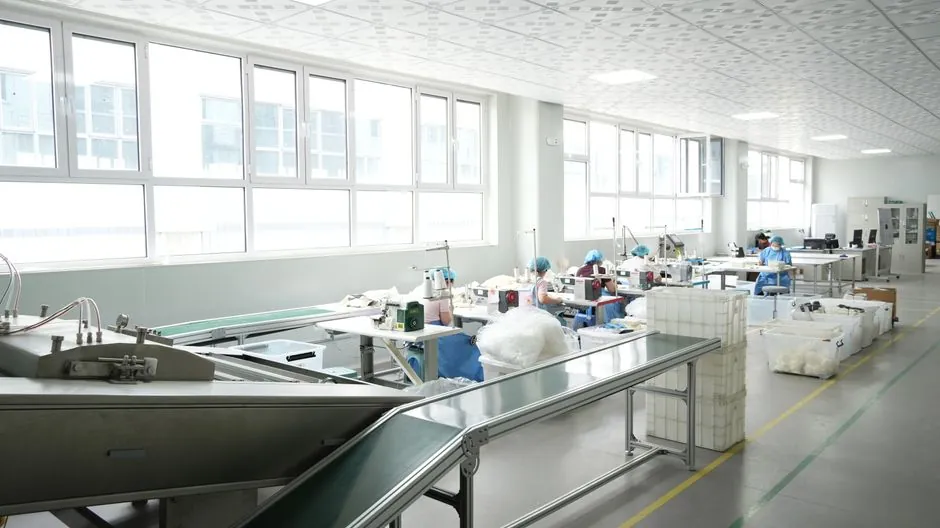
Conveyor sorting lines for packaged food and beverage applications are specified around three non-negotiable axes: hygienic contact-surface construction, throughput band matching the upstream packager, and downstream integration with checkweighers, metal detectors, and case packers [S1][S2].
For 2026 builds, the dominant mechanical architecture pairs a stainless-steel frame (AISI 304 for dry zones, AISI 316 for wet or salt-exposed zones) with VFD-controlled beltdrive, while the dominant controls scope is an Ethernet-based PLC with safety category 3/PL d on the diverter actuators [S1]. Buyers should treat any quote that does not list frame grade, belt material, IP rating, and motor kW as incomplete.
Hygienic Construction: Frame, Belt, and Washdown Rating
European food-line builders standardise on AISI 304 stainless for general-purpose frames and AISI 316L for high-care or CIP-exposed sections, with surface finishes typically Ra ≤ 0.8 µm on product-contact zones [S1]. The belt itself is commonly a modular plastic belt (PP, POM, or PE) for washdown, or a thermoplastic polyurethane (TPU) cleated belt for incline merging, selected so the belt and frame materials share comparable cleaning chemistry.
For full washdown, the motor, gearbox, and junction boxes should be rated IP65 minimum, with IP66/IP69K specified for zones exposed to high-pressure hot-water cleaning (commonly 80-85 °C, 10-15 bar) [S1]. Sloped or self-draining frame geometry (no horizontal flat ledges where wash water can pool) remains the cheapest microbiological-risk control available; any vendor drawing that shows flat catches should be questioned on Day 1.
Throughput Bands and Pack Format Windows
Converging conveyor modules sold for thermoform-fill-seal downstream infeed are commonly rated up to 180 packs/minute on a 2-to-1 or 3-to-1 lane merge, with HMI recipe control and tool-less changeover for pack-size variants [S2]. At the lower end, light-duty sortation lanes for bakery or confectionery typically run 30-90 packs/minute, where the bottleneck is the pick-and-place or vision system rather than the belt itself.
For bottle or can beverage sorting, throughput is expressed in containers/minute (often 200-600 cpm for mass-market lines) and the conveyor spec shifts to mass flow (kg/m of belt width) rather than pack count. A useful rule of thumb when comparing quotes: divide the rated cpm by the number of lanes after the merge to see if the post-merge lane speed stays within the downstream capper or labeler's accepted infeed window.
Sorting and Inspection Module Set
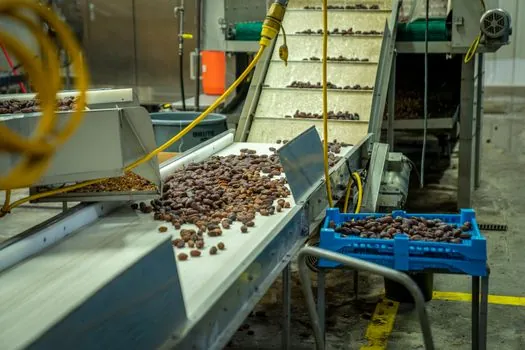
Beyond transport, a 2026 sorting line is judged by its on-belt inspection stack: seal integrity testers capable of detecting leaks as small as 0.2 mm without slowing a thermoformer, 100% in-line CAP/MAP headspace checks, checkweighers, and vision-based sortation by barcode, label orientation, or colour [S2]. Failed packs are rejected or converged onto a single reject lane, which should be physically segregated and lockable.
UV disinfection conveyors (typical UV-C dose band 30-100 mJ/cm² for surface bioburden reduction, with exact dose set by the HACCP plan) are increasingly specified at the low-care to high-care transfer point, where packaging material moves from ambient air into a positive-pressure hygienic zone [S2]. Buyers should confirm the UV source has a published end-of-life hour rating and a lamp-change interlock tied to the line PLC, not a wall calendar.
Drive and Controls: VFDs, Bus, and Safety
Variable-frequency drives from ABB and similar suppliers are now positioned as standard kit for food conveyors, with the OEM's application note covering flow-rate control, soft-start to limit product slide-back on inclined merges, and regenerative braking on declined sections returning energy to the bus [S1]. A 1.5-3.0 kW VFD per belt station is a typical mid-range line envelope; full sortation cells with diverter actuators tend to add 0.55-0.75 kW per axis.
For controls, PROFINET or EtherNet/IP are the dominant fieldbuses, with safety on PROFIsafe or CIP Safety, and HMI panels rated IP66 at the operator station. Integration with the upstream conveyor sorting line MES layer is done via OPC UA, and recipe management should be centralised rather than stored on each VFD. For a broader view of how sorting modules fit into a plant's wider material-flow stack, see the sorting system reference page.
Selection Criteria: Build a Decision Matrix Before Quoting
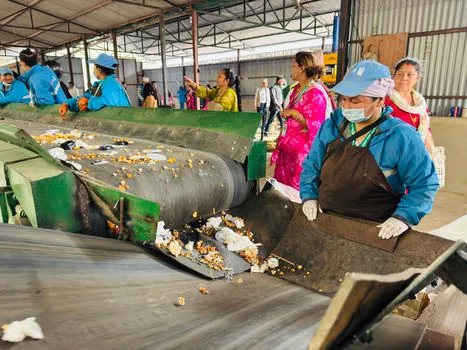
A pre-RFQ shortlist matrix for a packaged-food sorting line should rank at least four options against five criteria: hygienic rating (frame grade, IP, Ra), throughput window, inspection-module coverage, controls/safety scope, and lead time. A representative comparison looks like this: [S2]
1. Compact modular belt conveyor, 304 frame, IP65: low cost, fast lead (8-12 weeks typical), limited to dry-pack zones and modest throughput (~60-90 packs/min per lane).
2. Stainless flat-belt conveyor with VFD and integrated checkweigher, 316L frame, IP66: medium cost, 12-16 weeks lead, suited to wet/dairy zones up to ~150 packs/min.
3. Full sorting cell with vision, seal tester, UV transfer, and reject lane, 316L hygienic frame, IP69K: highest cost, 16-24 weeks lead, throughput 150-180 packs/min, full inspection stack [S2].
4. Heavy-mass beverage can/bottle conveyor, 304 frame, IP65, mass-flow rated: medium cost, 10-14 weeks lead, no pack-level inspection by default.
For operations looking beyond conveyor scope, molding line and automatic molding line pages cover the upstream pack-forming cells that often feed these sorters, while lighting equipment and electric lamps documents the inspection-area illumination that vision modules depend on.
Constraints, Failure Modes, and What to Reject at Quote Stage
The most common quote-stage red flag is a missing motor kW and gearbox ratio: a vendor that lists only "diverter conveyor" without torque data cannot be evaluated for soft-start behaviour on incline merges. The second is a food-grade belt material declared only as "PU" without a hardness (Shore A) or temperature rating, because confectionery and bakery zones routinely see surface temperatures above 60 °C where a generic soft PU creeps. [S1]
Mechanical failure modes to spec out at RFQ include belt tracking drift on long transfers, contamination traps in idler ends, and condensation on VFD enclosures in cold-store zones below 5 °C. A practical engineering heuristic: the line-frequency cabinet or line frequency furnace-style thermal control rooms are not the right reference; food-line drives are tightly sealed, and any quote that conflates industrial-drive ventilation with washdown ventilation is technically mis-scoped [S1].
Applicable Standards and Sourcing Notes
Food-contact materials should be assessed against the regional food-safety framework in force at the plant (EU 1935/2004-style requirements for Europe, FDA 21 CFR for the US, and the GB equivalent for China-built lines shipped domestically). Hygienic equipment design is typically aligned to EHEDG Doc. 2 for open equipment and to 3-A Sanitary Standards for dairy-contact lines; the line builder should be able to document which of these its frame and welding procedures meet. For ATEX/IECEx zones (e.g. flour or solvent-handling bakeries), the drive and motor certification must match the zone classification, not just the IP rating [S1].
Two verifiable next signals to track: published 2026 lead times from the short-listed integrators (modular belt lines commonly sit at 8-12 weeks in 2026, full sortation cells 16-24 weeks), and any new VFD firmware revision from ABB or its peers that adds OPC UA publish-on-change at the belt-station level rather than polling [S1]. For adjacent selection work outside the food scope, motion controller sizing and selection covers the bus and axis-count decisions that mirror the diverter-actuator scope on a sortation cell.