
Food and beverage line builders are converging on a small set of hard spec gates for electric linear actuators: IP66 or IP67 sealing, 304 or 316 stainless external hardware, NSF-H1 incidental-food-contact lubricant, and a duty cycle that matches the valve, cutter, or conveyor function rather than the generic catalog rating [S4][S6].
Selection is driven by three failure modes unique to washdown environments: corrosion pitting around mounting hardware, lubricant migration into product zones, and water ingress through cable entries during daily caustic cleaning cycles [S1][S6]. Electric actuators dominate new builds over pneumatics because they remove the compressed-air risk of oil aerosol carryover into open product streams [S2][S7].
Material and Surface Spec for Washdown Zones
304 stainless is the default housing material for general washdown zones where chloride exposure is limited to routine cleaning chemicals, while 316 stainless is specified in brine, pickling, or high-salt brining areas where chloride pitting on 304 surfaces appears within 12 to 18 months of service [S6].
Actuator bodies in direct splash zones are increasingly specified with electropolished surfaces rather than passivated only, because electropolish reduces Ra roughness and limits biofilm anchoring in CIP-rinse cycles; end-cap fasteners and cable glands should follow the same 300-series grade as the body to avoid galvanic mismatch at the mounting interface [S4][S6]. For a primer on how the linear actuator sits inside a broader motion stack, the linear actuator reference entry lays out the screw, belt, and direct-drive families against which food-grade selections are benchmarked.
IP Rating, Sealing, and Cable Entry
IP66 is the practical floor for any actuator mounted inside a washdown envelope, defined as dust-tight and resistant to powerful water jets; IP67 adds 1 m submersion for 30 minutes and is the safer call for actuators mounted below the line or inside catch-tray sumps that flood during shift changeover [S4][S6].
Stainless steel cable glands with captive O-rings outperform plastic cord grips in caustic CIP because polypropylene grips embrittle after 200 to 400 thermal cycles above 80 °C; food-grade silicone jacketing on the power cable is preferred over PVC where steam or hot-water sanitizing exceeds 90 °C, since PVC sheathers crack and shed into the product zone under repeated thermal shock [S6]. The surrounding linear motion system, including bearing blocks and guide rails, must meet the same IP gate or the actuator becomes the weak link in an otherwise sealed module.
Lubrication: NSF-H1 and Where It Actually Matters
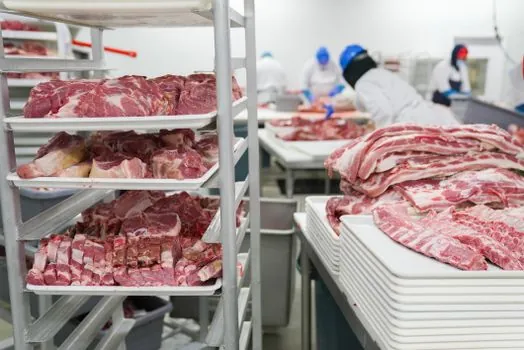
NSF-H1 food-grade lubricant is mandatory on any actuator whose failure mode could place grease into the product stream, which in practice means valve actuators on ingredient lines, divider and portioning actuators over open conveyors, and any cylinder driving a hopper gate above exposed product [S4][S7].
NSF-H1 is permitted for incidental food contact up to a defined lubricant quantity per piece of equipment, and the registration is published in the NSF White Book; H2 lubricants, by contrast, are only acceptable on actuators mounted outside the product zone where no contact is possible, such as palletizer arm drives or case-erector pushers behind a guard [S4]. Heavy-duty brushed DC actuators like the LA36 cited in 2026 motor-technology guidance typically ship on petroleum grease and require a re-lube swap to H1 before commissary acceptance in a food plant, while servo-driven cylinders such as the ESBF platform can be ordered with factory-sealed H1 cartridges that eliminate field re-greasing [S4].
Force, Stroke, and Duty Cycle Matching
Force output should be sized to the worst-case load including stall at end-of-stroke, not just the running load; a 250 N horizontal load on a 10 mm lead ball screw at 85% mechanical efficiency requires roughly 0.47 N·m of motor torque, and the actuator's rated force should carry a 1.5× to 2× margin above that calculated torque-derived figure [S4].
Stroke length is set by the mechanical envelope plus a 5 mm to 10 mm overtravel allowance on each end so limit-switch or soft-stop commissioning does not slam the mechanism; duty cycle is where most food-plant mis-specs occur, because catalog ratings like 20% at 25 °C collapse once the actuator is mounted next to a steam cooker or in an oven-proofer ambient above 60 °C, where thermal derating can cut allowable duty cycle by roughly a third [S4][S6]. Brushed DC actuators in the 6,800 N class typically cap at 10% to 20% duty, whereas servo-driven electric cylinders hold 100% duty with ±0.01 mm repeatability, which is why high-cycle cutting, filling, and labeling stations are migrating to servo actuators even at higher unit cost [S4].
Transmission Choice: Ball Screw, Belt, or Linear Motor
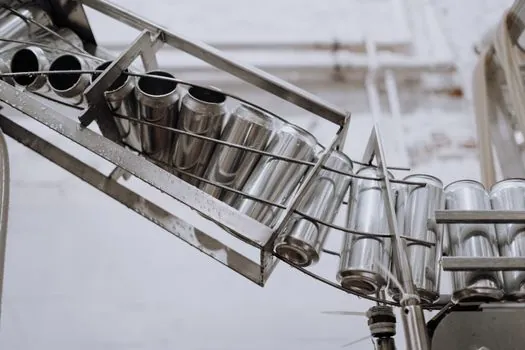
Ball screws at 80% to 90% efficiency above 1 m/s are the workhorse for valve and cutter duties where thrust stays under 30 kN and repeatability must hold under washdown vibration; roller screws are reserved for thrust loads above 30 kN, which is rare in food processing except in large bulk-bag or drum-handling stations [S4].
Belt-driven linear modules are widely used in food packaging for long-stroke, light-load indexing because they reach higher speeds than screws and tolerate misalignment better, but the belt itself becomes a contamination risk if it sheds urethane particles; food-grade belt materials and sealed belt covers are a hard requirement on any belt-driven module mounted over open product [S3]. Direct-drive linear motors eliminate screw and belt losses entirely but introduce a magnet-arc cooling channel that is hard to CIP, so they stay confined to dry-side packaging and palletizing rather than wet-processing cells [S4][S5]. For long horizontal travel, linear modules based on belt or rack drives pair naturally with linear guides selected for the same IP and lubricant class as the actuator body.
Comparison: Electric, Pneumatic, and Hydraulic in Food Plants
Electric linear actuators win on cleanliness, controllability, and energy use because they take only wall power and a low-voltage control signal, with no risk of compressed-air oil aerosol entering the product stream; pneumatic actuators still dominate low-cost, high-speed valve duty on clean ingredient lines where factory air is already oil-free and dry, but they trail electric on positioning repeatability and on integration with recipe-driven PLC setpoints [S2][S7].
Hydraulic linear actuators survive in heavy slicing, dough sheeting, and press applications where thrust density beats electric, but the mandatory use of food-grade hydraulic fluid (H1 or higher) plus leak containment raises the maintenance and audit burden, and most 2026 food-plant retrofits are replacing hydraulics with servo electric cylinders for that reason [S4][S7]. Across the three options, the only one that meets IP67 plus NSF-H1 plus closed-loop servo positioning as a stock catalog offering is the electric family, which is the reason greenfield and brownfield food builds now default to electric for any new actuator node.
Standards, Documentation, and Audit Trail

NSF registration under the H1 or H2 category, with the registration number printed on the lube data sheet, is the single document most food-safety auditors ask for first; actuator vendors that ship factory-filled with H1 grease and provide the matching NSF line entry in the build documentation shorten the commissioning sign-off by weeks on most plant projects [S4][S7].
IP ratings should be called out to the exact IEC 60529 code on the actuator nameplate, not paraphrased as "washdown rated"; CE marking under the EU Machinery Directive and, where fitted, UL 429 listing for electric valve actuators are the other two documents the SQF and BRC auditors will routinely check during a 2026 food-safety audit [S4][S6]. Engineers specifying these actuators for harsh parallel environments can cross-check the same IP, duty cycle, and force gates against the mining linear actuator selection and cement plant linear actuator spec gates reference articles, which apply identical logic under dust and heat rather than washdown.
The next trackable signal is the 2026 release of integrated servo actuators with H1 factory seals and IP67 nameplates as a catalog option rather than a custom order; on the lubricant side, watch the NSF White Book H1 listings for re-lube intervals above 5,000 hours, which would shift heavy-cycle filling and labeling lines from pneumatic to electric without re-lube downtime [S4][S7].