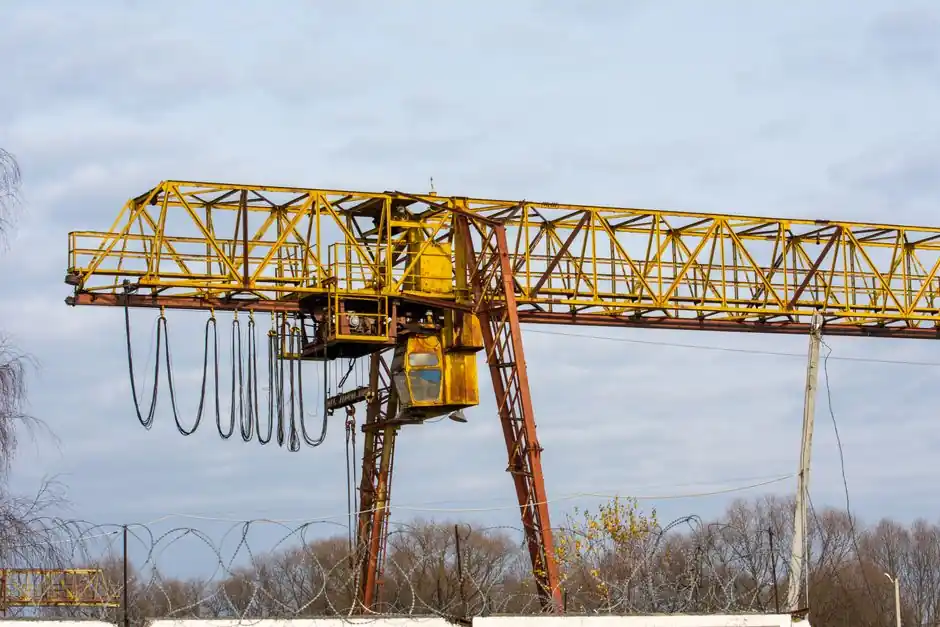
A gantry crane is a self-supported lifting structure running on floor rails or rubber tyres, common in shipyards, container yards, beam yards, and outdoor construction sites, with working load ratings that span roughly 5t to 500t and typical spans around 35 m for general-purpose units [S5].
For 2026 procurement, the core decision is not capacity alone: buyers weigh footprint, foundation cost, weather exposure, mobility, and duty cycle against the gantry crane alternative of a building-supported bridge crane, a crawler crane, or a stationary portal jib.
Structural Form and Operating Principle
A gantry crane uses A-frame or box-type legs to carry the main girder, with a hoist trolley traversing the girder and the whole frame running on rails, wheels, or rubber tyres on the ground; it needs no runway beams attached to a building, so it leaves the facility structure untouched [S1].
Common sub-types include single-girder, double-girder, semi-gantry, rail-mounted, and rubber-tyred variants; the rubber-tyred mobile gantry is the usual answer where the crane has to reposition between work zones without laying permanent track [S4].
For buyers comparing it against other lifting equipment families under construction machinery and equipment sourcing, the defining trait is independence from building steelwork: the gantry brings its own support down to grade.
Main Advantages of a Gantry Crane
Structural stability comes from the box- or truss-girder frame, which gives high resistance to wind load and dynamic sway, and the track foundation is engineered to keep wheel-rail contact continuous under full load [S2].
Operational flexibility is high: electric or manual control lets the operator vary hoist speed and travel direction, the boom can telescope, and the leg geometry can be set with or without cantilever for handling different load envelopes [S2][S5].
Application range is broad: port terminals, warehouses, construction sites, beam yards, railway transfer stations, and mining all use gantries for container handling, steel erection, and equipment installation, and OEM customization covers special duty cases [S2][S5].
Efficiency at terminals is measurable: portal-style gantry layouts can complete up to 40 picks per hour when travel distance is minimal, a benchmark from timber-yard practice that translates well to container gantries on short shuttle moves [S5].
Safety is built into the design envelope, with overload limiters, travel and hoist limit switches, and storm-pin brakes that allow operation in strong wind, all features that align with standard crane safety codes [S2][S5].
Main Disadvantages and Operating Limits

Footprint and headroom are the first constraints: a typical general-purpose gantry needs about 25% of the yard area in clear floor space, against roughly 4% for a rotating portal crane on the same site [S5].
Lift height and hook coverage are often lower than a top-running bridge crane of equal cost, and portable gantries on casters carry noticeably less capacity than fixed gantries on rails [S3].
Installation and maintenance cost is high because the structure needs civil foundations, heavy steel erection, and frequent inspection of wheel-rail alignment, especially after long outdoor exposure to weather [S4].
Transport and re-mobilization are non-trivial: the steelwork is bulky, so moving a gantry between sites demands specialized trailers, lifting crews, and a permit plan, which is why mobile cranes on rubber tyres are often preferred for short-duration, multi-site jobs [S4].
Gantry Crane vs Overhead Bridge Crane: Decision Comparison
Selection usually comes down to four criteria, summarized in the table below drawn from MHS, Kino, and Mazzella guidance, with the working load, footprint, install cost, and relocation cost as the comparison axes [S1][S6][S7].
Criterion 1, building dependence: the overhead bridge crane needs runway beams fixed to the building, while the gantry crane is self-supporting and needs only ground rails or a paved pad [S1][S6].
Criterion 2, lift height and capacity: bridge cranes typically reach higher hook ceilings and higher working load limits for the same budget, while gantries trade some hook height for site independence and lower initial install cost [S1][S3].
Criterion 3, install cost: gantries have lower upfront install cost because there is no runway beam and column reinforcement, but bridge cranes offer a higher long-term return on investment in fixed indoor duty [S7].
Criterion 4, mobility: a wheel- or rail-mounted gantry can be repositioned, dismantled, or reconfigured; a bridge crane is locked to one building, so any site change means new runway steel [S1][S3].
Selection Criteria, Site Fit, and Standards Backdrop

Gantry cranes suit outdoor yards, shipyards, beam factories, container terminals, and construction sites where no building exists or where the site will be reorganized; they are a poor fit where indoor ceiling clearance is tight, where the yard is less than roughly 4% of the open area the job demands, or where load is too heavy for a portable frame [S3][S5].
For indoor repetitive duty in a fixed plant, a top-running or underhung overhead crane plus a wall-mounted or pillar jib for local lifts is usually the lower total-cost-of-ownership path; the gantry belongs where the site itself is the variable [S3][S7].
Buyers in 2026 should anchor specs to the applicable design and duty rules (FEM/ISO 4301 for duty classification, CMAA 70/74 for indoor service, and OSHA 1910.179 for operator and inspection practice), and require documentation of overload limiter, limit switches, and storm brake at quote stage [S2][S5].
For operations that already run heavy civil equipment fleets, the same site-prep discipline used in excavator installation applies: track alignment, foundation compaction, and pre-run checks drive uptime more than the nameplate capacity on the data plate.
2026 Trackable Signals for Buyers
Watch three signals: the spread between rubber-tyred mobile gantry and rail-mounted gantry lead times, since container-yard capex is restarting in several regions; the revision status of FEM 1.001 and ISO 4301-1 duty-class tables, which feed directly into hoist and motor sizing; and the OEM shift toward regenerative drives on yard cranes, which already cuts portal-class energy draw and is migrating to mid-size gantries [S5].