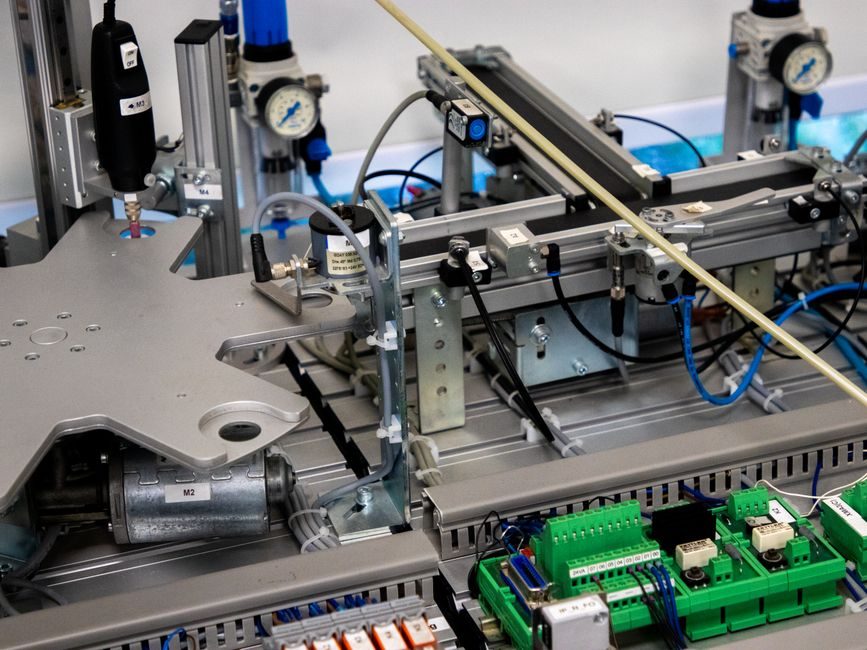
Hebei Gufan Carbon Co., Ltd. operates a 586,000 m² graphite electrode production base in Handan, supported by a separate mechanical-parts and fastener line, signalling the scale at which Chinese UHP/HP electrode producers are now integrating Industry-4.0 retrofits [S1]. In October 2025 the average China graphite-electrode market price reached 15,883 yuan/ton, up 1.03% month-on-month, with mid-May 2026 European and U.S. UHP quotes continuing an upward path [S1].
Automation spending is concentrated where current density, baking-curve repeatability and resistivity uniformity drive yield: raw-material pre-heating, pitch impregnation, ring-furnace baking, high-temperature graphitization (2,500–3,000 °C in Acheson or LWG units) and CNC electrode machining. Graphite foil, stuffing ring and electrode-probe factories certified to ISO 9001:2015 and ISO 45001:2018 form the auxiliary supply chain feeding furnace instrumentation and cell-side sensing [S2][S6].
Where Smart-Manufacturing Spend Actually Hits a UHP Electrode Line
UHP graphite electrodes (typically 600–700 mm diameter, Rp-grade, bulk density ≥1.68 g/cm³, resistivity ≤5.5 µΩ·m) demand tight process control that hand-tuning cannot repeat batch after batch, so the highest-ROI automation points are pitch-impregnation vacuum/pressure loops, ring-furnace temperature profiling, and graphitization furnace power-quality control [S1][S3]. HKUST (Guangzhou) groups these under its Systems-Hub smart-manufacturing thrust, defining it as the integration of cyber-physical systems, real-time data and AI decision loops into production lines [S3].
The measurable targets instrument engineers chase on a 50,000–100,000 t/yr UHP line are: kWh per ton of finished electrode in graphitization (LWG typically 4,000–5,500 kWh/t vs. older Acheson 6,500–8,000 kWh/t), pitch yield (target ≥88%), and rejected-electrode rate (target ≤2% for UHP, ≤5% for RP) [S1]. Smart-factory retrofits at this scale typically deploy SCADA on the ring furnace, OPC-UA bridges from legacy PLCs, and edge gateways feeding an MES, with quality variables (resistivity, CTE, modulus) pushed to a digital-twin of the extrusion and re-baking lines [S3].
Selection Criteria for Sensors and Drives in a Graphite-Furnace Retrofit
Pyrometer selection in graphitization furnaces is non-trivial: black-body conditions inside an Acheson/LWG retort push operators toward two-colour or spectral pyrometers covering 1,000–3,000 °C, with fibre-optic heads if the sighting path is long or RF-noisy [S1]. Current and voltage on the furnace transformer bus (typically 100–300 V DC at 50–150 kA in graphitization) call for Hall-effect or closed-loop transducers with reinforced isolation, not conventional CTs [S1].
For liquid-pitch and cooling-water loops, inline flow meters on DN50–DN150 cast-iron or lined-steel runs are the standard pick, paired with pressure transmitters on the impregnation-vacuum train (often –0.09 to +0.6 MPa gauge). A typical 4-electrode-per-batch impregnation cycle logs dozens of vacuum/pressure set points, and an IEC 61508 SIL-1 capable transmitter is the usual engineering floor for new Chinese builds [S1]. On the electrode-probe side of water-treatment skids that feed process water, conductivity and pH loops run on paired smart transmitters with HART or Modbus back-haul to the cell PLC.
Comparison: Conventional Line vs. Smart-Retrofit UHP Electrode Production

Looking at the two architectures side by side, the decision criteria that procurement and process teams care about are clear. Energy intensity: a conventional Acheson graphitization line sits at 6,500–8,000 kWh/t finished electrode, while a smart-retrofitted LWG line with closed-loop power-factor control drops into the 4,000–5,500 kWh/t band [S1].
Yield and quality tracking: manual sampling yields one resistivity/CTE data point per batch per shift, whereas a smart line streams per-electrode data from the forming press, baking car and final machining CMM into a MES, exposing drift 2–3 shifts earlier [S3]. Operator headcount per 10,000 t/yr of finished UHP: conventional operations typically run 18–25 operators per shift on forming, baking and graphitization; a retrofitted line with automated car handling, robotic nipple threading and CNC turning trims that to 10–14 [S1][S3]. CAPEX payback window: 4–6 years at China industrial electricity tariffs (≈0.55–0.75 yuan/kWh) and a UHP premium of roughly 4,000–8,000 yuan/ton over RP grade [S1]. A line that combines LWG conversion, smart valve positioners on pitch and gas trains, and AI-assisted baking-curve tuning recovers CAPEX faster than one that only bolts a SCADA layer onto a 1990s Acheson.
Real Use Cases: What Buyers Are Actually Specifying in 2026
EAF steelmakers driving the UHP order book continue to demand 600–700 mm RP, HP and UHP nipples and sockets machined to close concentricity (typical ≤0.3 mm TIR on a 700 mm electrode) to avoid arc deflection and breakage in the furnace [S1][S5]. Okorder-listed China suppliers such as Dandong ship needle-coke-based UHP electrodes with ISO certification, the minimum paperwork packet most Asian and Middle Eastern EAF mills now require [S5].
A second use case sits outside EAF: additive manufacturing of electrically conductive graphite–polymer composites, demonstrated in 2019 in Progress in Additive Manufacturing, opened a path to 3D-printed graphite electrodes and tooling for non-ferrous electrolysis and EDM [S4]. For broader additive manufacturing material work, the same research suggests a route to selectively conductive / insulating regions inside a single printed part — directly relevant to next-generation electrode fixtures. Process instrumentation for the supporting smart camera vision systems on the CNC electrode-machining cells is now a standard line item in 2026 retrofit RFQs [S1][S3].
Limitations, Failure Modes and What Smart-Factory Pitches Often Overstate
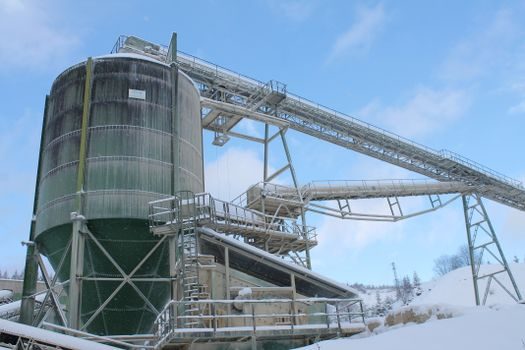
The single biggest constraint on UHP smart-factory retrofits in China is the existing brown-field Acheson fleet: the furnace shell, the carbon packing and the long thermal time-constant (a 300-hour heating/cooling cycle) cannot be eliminated by a new MES layer. Expect only incremental kWh/t gains on Acheson units; the real step-change comes from LWG conversion, which is a 5–7-year capex horizon for a 100,000 t/yr producer [S1].
A second failure mode is sensor survival: optical pyrometers in graphitization retorts see soot deposition and condensing tar that drift readings by tens of degrees within a single cycle; without a scheduled re-cal or auto-clean, the closed-loop controller will quietly bake electrodes off-spec [S1][S3]. Pitch and impregnation systems also accumulate condensate that destroys pneumatic smart valve positioners faster than they fail on clean service — filter regulators and heated enclosures are not optional on Chinese flow meters handling pitch condensate. Vendors marketing a "plug-and-play" AI baking-curve product to EAF-grade electrode plants typically understate the integration cost; budget 12–18 months of parallel-running with the old recipe before any control handover to the digital twin [S3].
Standards, Sourcing Map and Trackable Signals for the Rest of 2026
The standards stack that governs a modern UHP electrode line in 2026 is anchored by ISO 9001:2015 quality systems (now table-stakes for export mills), ISO 14001 and ISO 45001 for environmental and EHS management, and product-level specifications referencing IEC 60239 for graphite electrodes for electric arc furnaces — buyers should confirm the exact revision in the contract rather than assume a version [S2][S5][S6]. Electrical safety on the furnace transformer and bus follows IEC 61936-1 for HV installations and IEC 61508 / IEC 61511 for the SIL-1 / SIL-2 loops on the impregnation and graphitization cut-outs [S1].
On the sourcing map, three trackable signals to watch for the rest of 2026: (1) whether the 2025 electrode-paste export run-rate — up 20.01% year-on-year through the first three quarters [S1] — extends into 2026 export logs; (2) the next Baijia Yingfu monthly price print, where each 1% move on the 15,883-yuan/ton base moves mid-tier producers' margins visibly [S1]; and (3) any new HKUST-GZ or peer-university disclosure of smart meter and digital-twin deployments inside a Chinese UHP electrode plant, which would be the first hard evidence of closed-loop MES-to-furnace handover on a real production line [S3].
For related coverage, see Investment Casting Equipment Price & Cost Guide: Capex, Consumables and Sourcing Map.