
For control-panel work in 2026, the practical decision path for a time relay is function first, then supply voltage, contact rating, timing range, and repeat accuracy, in that order, because a relay picked only on price fails the moment it is asked to hold a 0.1s window or switch a 380V motor coil.
Time relays are specialised industrial relays that delay the energising, de-energising, or pulsing of a control circuit; they are distinct from protection relays, which trip on fault current. Typical panel-build units on the market cover 0.1s-120h, run on 24V DC or 100-240V AC, and switch 3A-5A at 220-380V AC (resistive) [S2][S3].
Step 1: Lock the Timing Function Before the Spec Sheet
On-delay (delay-on-make) is the most commonly stocked function and powers motor star-delta starters, fan run-on, and pump anti-hammer sequencing; the timer starts when coil power is applied and the output contact transfers only after the preset time elapses [S9].
Off-delay (delay-on-break) holds the contact closed for a set period after coil power is removed, which is the function you want for emergency-stop indicator hold and capacitor-bank discharge logic [S8]. Other common functions: interval (one-shot pulse on energise), cyclic symmetric/asymmetric, star-delta, and bistable (flip-flop on each trigger) [S8][S9].
Skip the single-function SKD-style unit if your panel has more than two timing duties; a multifunction unit (8-10 modes in one housing) is usually cheaper than two dedicated relays and one spare slot on the DIN rail [S8].
Step 2: Match Supply Voltage to the Control Transformer Tap
Most 18mm and 48mm panel-mount time relays accept a wide input: 24-240V AC/DC, or 100-240V AC with 100-125V DC, which lets one SKU ride across multiple control transformer taps in a global panel build [S1][S4].
Specialised 12V DC and 36V AC variants exist for battery-backed systems and certain Asian machine tools; XINLING's catalogue lists DC 24V, AC 24V/36V/110V/220V/380V at 50Hz, with an 85%-110% allowable voltage fluctuation window before timing drift kicks in [S2].
Pick a relay whose specified voltage window brackets your worst-case brownout, not the nominal, because most timing failures in the field are caused by control voltage sitting at 80% of nominal during a motor start, not by the timer itself [S2][S4].
Step 3: Verify Contact Rating Against the Real Load

3A at 220V AC resistive is the entry-level contact rating and is fine for pilot-duty work, indicator lamps, and small contactor coils; 5A at 250V AC (cosφ=1) covers most fractional-horsepower motor contactor coils under AC-15 utilisation [S2][S3][S4].
Always convert the contact spec to the utilisation category the load actually represents: AC-15 for inductive AC loads above 72VA (contactor coils, solenoid valves), DC-13 for DC inductive loads (solenoids, brakes); the contact that is rated 5A resistive often drops to 1.5A at 240V AC under AC-15, so a 5A relay may be necessary where the maths suggests a 3A would suffice [S3][S4].
For DPDT duty (one delayed + one instantaneous contact in the same housing), the HKTDC-listed XINLING part is the standard 81mm x 18mm x 72mm DIN-rail form with 3A 220V AC per pole [S2].
Step 4: Compare Timing Range and Repeat Accuracy
Range and accuracy are where generic timer datasheets hide their real quality, and the following four tiers line up against the bulk of panel-build work in 2026: [S4]
Tier 1 (entry): 0.1s-120h, repeat error ≤1% for ranges ≥1s and ≤50ms for ranges <1s, contact 3A/220V AC, typical for HVAC and lighting control [S2].
Tier 2 (workhorse): four adjustable sub-ranges (e.g. 0-10s, 0-100s, 0-10min, 0-30min, 0-1h), repeat accuracy ±0.2% ±50ms, 2 C/O contacts at 5A, AC-15 utilisation, IP20, pollution degree 3, suitable for general motor logic and pump changeover [S4].
Tier 3 (precision): repeat accuracy ±0.2% with digital setting and 0.05-0.5s / 5s / 30s / 3min segmented sub-ranges, contact 3A/220V AC, used where process timing is part of a quality spec [S6].
Tier 4 (extended): 0.1s up to 10 days delay-off in a single-function DIN housing with LED indication, used for pump rundown after heating shutdown, fan overrun, and similar building-services tasks where a long, single delay is all that is required [S7].
The right tier is set by the shortest and longest timing window you actually need: buying a Tier 2 to get 0.1s precision and ignoring a Tier 3 because the spec sheet is cleaner is a common way to overspend; buying a Tier 1 to save money on a 6-hour cement-kiln timer is a common way to under-spec the duty [S4][S6][S7].
Step 5: Match Form Factor, Mounting, and Indicator
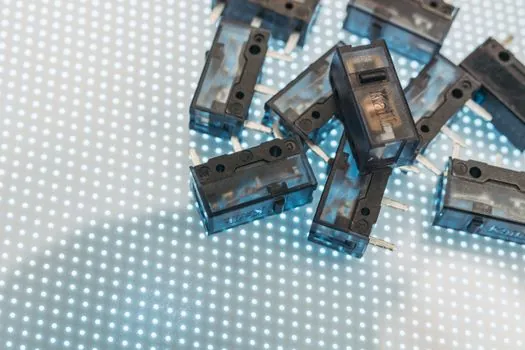
18mm-wide DIN-rail modules (single C/O) are the modern default for high-density panels and pair with standard 8-pin octal sockets (US-08, P3G-08) for retrofits; the 48 x 48 x 81.6mm panel-cutout form with surface (PS-08) or flush socket remains common on legacy MCCs and small standalone machines [S1][S8].
LED status indication and a flicker during timing are now baseline expectations on any panel-build unit; knob-set dials are giving way to digital pushbutton programming where the timer must be replicated exactly across a fleet of machines [S1][S4].
Ingress protection is usually IP20 for DIN-rail modules (finger-safe behind a cabinet door); specify IP54 or higher only for the timer if it sits outside the enclosure, which is rare, because adding a windowed cabinet door is cheaper and protects the whole relay module population, not just the timer [S4].
Step 6: Standards, Durability, and Approval Footprint
Electrical life of 100,000 operations and mechanical life of 1,000,000 to 10,000,000 operations are the two figures to compare across vendor datasheets, because a contactor in the same panel is usually rated 1,000,000 mechanical operations and you do not want the timer to be the weakest link [S1][S3][S4].
Reset time ≤1s is a typical spec and matters in cyclic applications where the off-period is short; an unclear or unusually long reset time on the datasheet is a sign that the timer is not designed for fast cycling [S3].
Approval markings to look for on entry-tier product include CE, EMC, ISO 9001, SEMKO, CCA, and RoHS; without at least CE, the unit cannot ship into the EU on a CE-marked panel, regardless of how good the timing spec is [S1].
Note that a time relay is not a safety relay; if the application is an E-stop, light curtain, or two-hand control, you need a safety relay with forcibly-guided contacts and a Cat 3/PL d or Cat 4/PL e architecture, never a time relay. Likewise, a thermal relay handles motor overload current-time curves, not timing logic, and they are often confused in catalogues but never in the panel [S9].
Failure Modes and Constraints Buyers Overlook

Drift with temperature: most analog RC-based timers drift several percent over 0-50°C; digital microcontroller-based units with ±0.2% repeat accuracy are noticeably more stable across the same window, which matters for outdoor or unconditioned-panel installations [S4][S6].
Altitude derating: many entry-tier units are rated for ≤2000m without derating, and timing accuracy can degrade above that because of the thinner air and the resulting change in RC component behaviour; check the datasheet before specifying for high-altitude mining or plateau sites [S4].
Supply dip: a timer that loses control power during a sag and then re-energises will either restart the timing cycle or hold the contact, depending on the design; for off-delay functions this behaviour is critical and must be specified, not assumed [S3][S4].
Knob vs. digital setting: knob-set units are faster to commission in the field but easier to mis-set by vibration or unauthorised operator; digital units with keypad lock are the right call for OEM skid builds and OEM machine builders shipping globally [S4][S6].
Sourcing and Selection Signals Worth Tracking
The single 8-pin octal socket (US-08 / P3G-08) remains the most widely stocked panel-build form factor and is the safest stocking choice for maintenance spares, because it accepts a wide variety of timing functions from multiple vendors without rewiring [S1].
Buyers building global panels should look for catalogued supply ranges that explicitly cover 100-240V AC and 24-240V AC/DC in the same SKU; this is the SKD and FCT18-style wide-range input and removes the need to stock multiple voltage variants of the same timing function [S1][S4][S8].
Two trackable signals over the next 6-12 months: the rate at which multifunction (8-10 mode) DIN-rail units displace single-function SKD stock in distributor catalogues, and the move toward digital setting with keypad lock as the default on workhorse-tier units above the 5A contact rating [S8]. A 2025 industry guide continues to recommend multifunction units as the safer stock choice for varied panel work [S9] (2025-10), and the same guidance is echoed in a separate 2025 selection guide focused on matching timing function, power, and contact capacity to the load [S10] (2025-10). For related control-circuit work, selector switch selection follows a similar spec-first decision path, and HVAC HOA rotary switch shows how a three-position manual override is wired around a timer-driven auto circuit.