
An RFQ line for a panel-mounted counter in an OEM control cabinet should carry four non-negotiable fields (count source, supply voltage, output type, cutout dimensions) and three optional fields that, if left blank, force the vendor to assume the cheapest configuration and reprice later. The count-source question alone (pulse input vs. quadrature vs. contact closure vs. voltage input) determines whether the unit is a 5 USD digital totalizer or a 60 USD preset counter with scaling, so it sits at the top of every well-built spec sheet.
For most European and North American small-panel builders in 2026, the default line on an RFQ reads: 6-digit LCD or LED totalizer, 24 V DC supply, NPN or PNP transistor output, 22.5 mm or 45 x 45 mm panel cutout, IP65 from the front, operating temperature 0-50 °C. Anything tighter (high-temperature zones, outdoor washdown, ATEX/IECEx areas, or counting frequencies above 1 kHz) pushes the line into preset counters, cam controllers, or dedicated MCC cabinet sub-assemblies that need a separate RFQ row.
Count Source and Counting Frequency
The first engineering decision on the RFQ is the physical input: contact closure from a relay or microswitch, NPN/PNP transistor pulse from a sensor, 0-10 V or 4-20 mA analog, or quadrature from an encoder. Vendor catalogues for industrial totalizers quote reliable counting frequencies of 30 Hz for mechanical counters, 1 kHz for basic electronic counters, and 10 kHz or higher for high-speed preset counters [S1]. A miscalled frequency is one of the most expensive requote triggers, because a 30 Hz mechanical unit cannot be silently upgraded to a 10 kHz electronic unit without changing the supply, output, and footprint.
For an OEM building small production machinery, contact-closure and 24 V PNP inputs cover roughly 80 percent of line items, with quadrature reserved for position feedback and 4-20 mA reserved for flow integration where the counter meter is wired in parallel with an existing analog transmitter. Writing the count source as a single phrase ("24 V PNP, 1 kHz max") on the RFQ saves a clarification round in almost every quote cycle.
Supply Voltage, Power Budget, and Wiring
Industrial panel counters ship in three supply variants: 24 V DC, 100-240 V AC, and 12 V DC (mainly for battery or solar cabinets). 24 V DC is the default in modern OEM cabinets because the control cable loom already carries a 24 V rail shared with sensors and PLC inputs. Specifying 100-240 V AC on the same line as 24 V sensors is a recurring mistake on first-time RFQs and forces a split into two line items. Power draw for a 6-digit LED totalizer sits around 1.5-3 W; LCD totalizers draw under 0.5 W and are the right choice for remote or solar-powered cabinets where heat and budget matter. [S1]
Galvanic isolation between the pulse input and the supply is a checkbox worth adding on every RFQ for chemical or process plants, because long control cable runs pick up common-mode noise that latches cheap totalizers into false counts. CE marking and a basic EMC immunity statement per EN 61000-6-2 (industrial) is the realistic floor for European OEM panels; tighter EMC requirements belong in a separate line and a separate price.
Output Type and Integration with the Cabinet Logic

Counter outputs fall into four functional buckets, and the RFQ must name one: (1) no output, just a local display, (2) a single PNP or NPN transistor output that fires at a preset count, (3) a relay output (mechanical or solid-state) for direct switching of a solenoid or contactor, (4) a communication output (RS-485 Modbus RTU, IO-Link, or Ethernet) feeding back into a PLC or HMI. The cheapest line is "display only," and many first-pass RFQs default to it; if the cabinet logic actually needs a "count reached" signal, omitting the output type forces the vendor to add a relay output during clarification, which is the second most common requote cause. [S1]
For cabinets feeding a MCC cabinet downstream, a relay output (typically 5 A at 250 V AC) is the practical choice because it can drive a contactor coil directly without a PLC in the loop. For cabinets tied into a SCADA or PLC architecture, an IO-Link or Modbus RTU output removes the need for a dedicated input card and keeps the wiring under 30 mA loop current per channel. The RFQ should also pin down whether the output is latching or momentary, because latching outputs need a separate reset signal that the cabinet wiring diagram must provide.
Display, Number of Digits, and Reset Method
Digit count drives both readability and price. A 6-digit totalizer covers 0-999,999 counts, which is the workhorse for piece-counting on small assembly lines; an 8-digit unit covers 0-99,999,999 and is used for batch and lifetime totals on packaging machinery. LCD displays with 8-10 mm character height are readable from 1-1.5 m and are common on IP65 front panels; LED displays with 14 mm digits read from 3 m and are preferred on high-vibration stamping or press lines.
Reset method is the field that buyers most often forget. The four options are: (1) no reset (lifetime total), (2) front-panel key reset, (3) remote electrical reset on a 24 V signal, (4) automatic reset on power-cycle. Front-panel key reset is the most specified and the cheapest; remote reset adds one input terminal and roughly 5-15 percent to the unit cost but is mandatory when the counter is sealed behind a cabinet door.
Mounting, Cutout, and Environmental Sealing
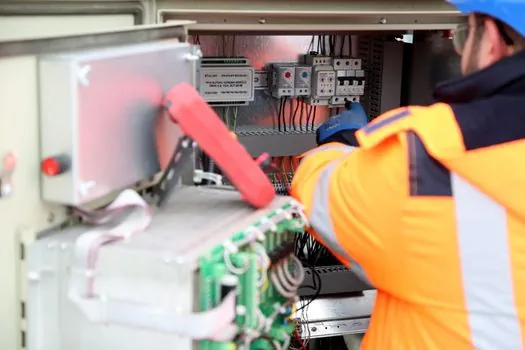
Panel cutout is the single physical parameter that decides whether the counter drops in or requires a bezel adapter. The two industry-standard cutouts are 22.5 mm (the same as a standard signal lamp or pushbutton) and 45 x 45 mm (the classic 72 x 72 mm bezel footprint). Some Asian-market DIN-rail-mount counters use a 35 mm rail clip instead of a panel cutout, and these need to be listed as a separate RFQ line because the cabinet door punching changes. For a control cabinet door built to IEC 61439, the control cabinet builder usually has a standard 22.5 mm knockout pattern, so 22.5 mm round counters are the path of least resistance. [S1]
Front-panel sealing is rated under IEC 60529. IP65 is the realistic minimum for any cabinet door that may be wiped down or hosed; IP66 is needed for food and beverage and outdoor cabinets; IP67 and above are reserved for cabinets submerged or buried. Operating temperature is the other environmental line: 0-50 °C is the default commercial range, -10 to +55 °C covers most factory floors, and -25 to +70 °C is needed for unheated outdoor cabinets or cabinets near furnaces. Specifying a wider temperature range than the cabinet actually sits in is one of the easiest ways to inflate a counter line by 30-50 percent without functional benefit.
Certifications, Standards, and What to Write on the Line
For European OEM panels, the minimum certification stack on a counter line is CE marking, a RoHS and REACH compliance statement, and EMC conformity to EN 61000-6-2 (industrial immunity) and EN 61000-6-4 (industrial emissions). For cabinets going into explosive atmospheres, ATEX category 3 (zone 2) certification on the counter itself is enough when the counter is mounted outside the hazardous area; ATEX category 2 (zone 1) is required when the counter sits inside, and the line item must then reference ATEX 2014/34/EU explicitly. UL 508 listing is the parallel North American requirement for industrial control panels built to UL 508A. Pushing the certifications list into a separate line on the RFQ, rather than burying it in a vendor notes field, removes the most expensive source of requote cycles on export builds. [S1]
The minimum effective RFQ line, written as a single string the vendor can quote from, reads: "Panel-mount electronic counter, 6-digit LCD, 24 V DC supply, PNP input 1 kHz, PNP transistor output, front-panel key reset, panel cutout 22.5 mm, IP65 front, 0-50 °C, CE/RoHS, 50 pieces." Adding the quantity unlocks a tier-2 price break from most vendors; omitting it forces a 1-piece quote that the vendor will manually re-price at 5-10 pieces. Related process-spec writing, such as the timing-pulley line in a motion-stage RFQ, follows the same "four non-negotiable fields plus quantity" pattern, and the same requote logic applies across both components.
Background reading: Satellite OEM vs ODM: How To Pick The Right Manufacturing Model For Space-Grade Hardware.