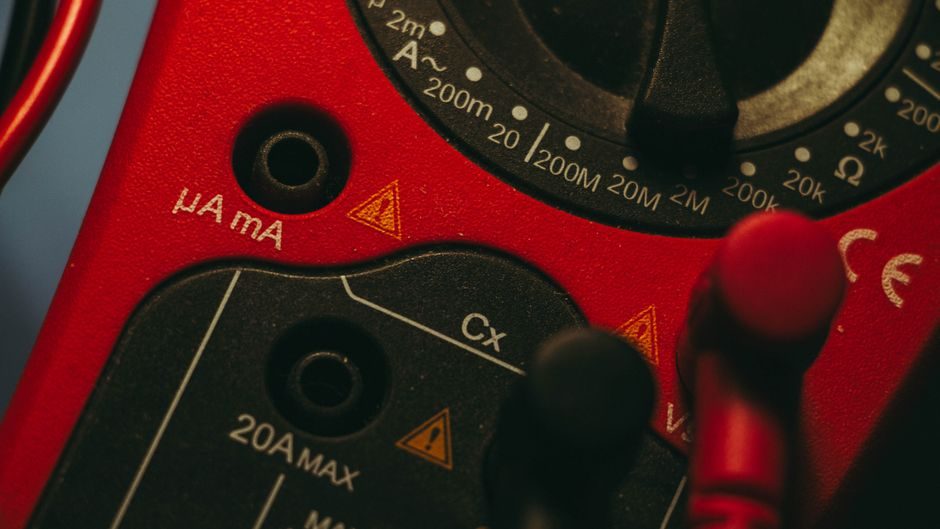
For a 2026 industrial retrofit, the minimum-viable spec is a Class 1 active-energy, three-phase, 96×96 mm flush-mount meter with true-RMS measurement, 0.5% voltage/current accuracy, RS485 Modbus, an IP50 front face and an aux supply of 85–264 VAC [S1].
The Contrel EMM-4L-96 illustrates that baseline exactly: 40–400 V phase-to-neutral, 50–600 V phase-to-phase, 45–65 Hz, 5 A nominal on a /5 A CT, 0.010–10 A measurement range, 0.5% voltage/current accuracy, 1 pulse output, IP50 front / IP20 terminals, 0…+60 °C operating, EN 61326:2006 and EN 61010-1:2010 declared, and around 400 g [S1]. Buyers who only need an energy sub-meter can drop the harmonic and Modbus options; buyers who need load-profile telemetry should not.
Scope: What an MFPM Actually Does in 2026
An MFPM consolidates four functions on one 96×96 mm panel face: energy meter, multimeter, frequency meter and power-quality meter [S1]. The 2026 product stream on Made-in-China groups it under "Instruments & Meters / Meter for Electricity / Energy Meter & Power Meter" [S3], and Chinese OEM listings routinely use the term to cover both three-phase panel meters and portable harmonic analyzers with on-board data logging.
Typical measurements listed across 2026 OEM catalogues: active power, reactive power, apparent power, power factor, frequency, voltage, current, active/reactive energy, THD-I and THD-V, with a 45–65 Hz network band for 50/60 Hz grids [S1]. The DC284Z-9SY / DC284Z-2SY platform from Changzhou Dacan is one of the production lines (10,000 PCS/year capacity, ISO 9001 site) that ships into this category at roughly US$256 per piece MOQ 1 [S9].
Selection Criteria: The Seven Gates That Decide the Shortlist
Filter any MFPM candidate through these seven gates in order, and the field narrows fast. The 2026 catalogue spread on Made-in-China runs from a Jiangsu Sfere LED three-phase unit at US$32–45 per piece (1 PC MOQ) [S5] to a portable Me440 32 GB harmonics analyzer at US$200–300 per piece [S3] and a Changzhou Dacan DC284Z platform at US$256 per piece [S9]. The Contrel EMM-4L-96 sits at the European mid-premium end [S1].
1) Accuracy class. For billing-grade energy, demand Class 1 active energy or better; for tenant sub-metering Class 2 is common. The EMM-4L-96 is published as 0.5% on V and I with Class 1 active energy [S1]. 2) Wiring. Confirm 1P / 2P / 3P / 3P+N / 3P balanced compatibility on the same unit, otherwise a 3P+N site will misread [S1]. 3) Aux supply. 85–264 VAC, 100–300 VDC covers global control-cabinet rails; below that, the meter will not start on weak UPS. 4) CT or direct connect. /5 A CT is the 2026 norm for >63 A circuits; 0.010–10 A measurement range is the safe working window [S1]. 5) Comm port. RS485 Modbus RTU at 1.2–38.4 kbaud is the lowest-risk default; TCP gateways like the ATZ2000 (US$30–50, 5 PC MOQ) exist for direct Ethernet [S5]. 6) IP and climate. IP50 front / IP20 terminals and 0…+60 °C operating / -10…+70 °C storage are typical indoor control-room limits; IP54 or a heater is needed for outdoor kiosks [S1]. 7) Standards. Look for EN 61010-1 (safety) and EN 61326 (EMC) declarations on the datasheet [S1].
Variant Comparison: Panel vs DIN-Rail vs Portable Harmonics Analyzer
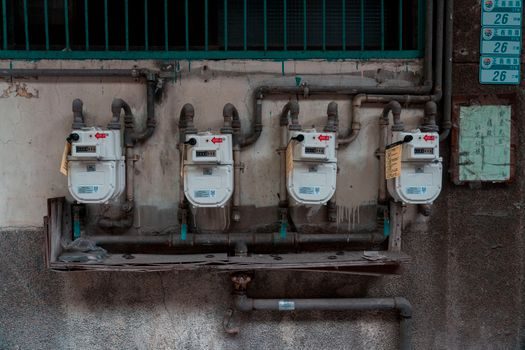
Three real form-factors appear in 2026 sourcing feeds and they are not interchangeable. The Contrel EMM-4L-96 is a flush-mount 96×96 mm panel meter (IP50 front) with Modbus and one pulse output, designed for permanent switchgear doors [S1]. The Jiangsu Sfere LED three-phase panel meter and the ATZ2000 LCD energy meter are smaller, lower-cost panel units at US$32–50 per piece aimed at high-volume OEM skid builders [S5]. The Me440 portable harmonics analyzer with 32 GB data recorder at US$200–300 is a survey instrument, not a permanent meter, used for week-long power-quality logging rather than SCADA tie-in [S3].
Decision logic in one line: pick a 96×96 mm panel MFPM (Contrel-class) for fixed switchgear with Class 1 billing energy; pick a 72×72 mm or 96×96 mm economy LED panel meter (Sfere/ATZ-class) for OEM skid builders where cost per node matters more than comms depth; pick a portable harmonic analyzer only for power-quality surveys, not for permanent revenue metering. For an MRO-style retrofit where the existing cut-out is 96×96 mm, the Contrel form-factor drops straight in with no panel rework [S1].
Who It Is For vs Who It Is Not For
It is for: panel builders wiring three-phase LV switchgear who need V, I, kW, kVAr, kVA, PF, Hz, kWh, kVArh and THD on one display; SCADA integrators pulling Modbus registers over RS485; energy-sub-metering tenants where Class 1 active energy is the contractual number; and process plants (steam-turbine auxiliaries, motors, boilers) that want one faceplate instead of three analog meters, which is exactly the duty the PD194E-9F2 is sold into for power-generation auxiliaries [S7].
It is not for: utility-grade revenue billing at the MV side (use a revenue-class three-phase meter certified to the local utility code, not an MFPM); hazardous-area Zone 1/Zone 2 without a specific Ex certification, since EN 61010-1 covers safety but not explosion protection [S1]; DC traction or DC-only drives where an AC true-RMS engine misreads; and solar PV string monitoring, where DC-specific energy meters with Hall-effect CTs are the correct tool. As a sizing rule, an MFPM on a /5 A CT is right up to roughly 630 A at the primary; above that, route through a 1 A or 0.1 A CT and confirm the meter's 0.010–10 A working range is not exceeded at full load [S1].
Limitations and Field Failure Modes

The recurring 2026 failure modes are wiring, not electronics. The EMM-4L-96 datasheet explicitly lists 1P / 2P / 3P / 3P+N / 3P balanced as selectable wiring modes, because fitting a 3P+N meter on a 3P-only circuit (or vice versa) is the single biggest source of "energy counts but PF reads zero" tickets [S1]. Below 0.010 A on the secondary side of a /5 A CT, accuracy is no longer guaranteed; do not size CTs for short-time peak loads only, because the night-load reading is what the Class 1 energy number is built on.
Temperature is the second limiter: 0…+60 °C operating and -10…+70 °C storage are the published limits [S1]; outside that, the LCD contrast drifts and the aux-supply capacitor ages fast. EMC immunity is declared under EN 61326:2006, which covers industrial EM fields, but the meter still needs to be mounted away from VFD output cables — typically 200 mm or more, with the CT secondary leads twisted. Modbus RTU at 38.4 kbaud on a long daisy chain will reflect; a 120 Ω termination at both ends and 1.2 kbaud on runs over 500 m is the conservative setting [S1].
Sourcing, Standards, and a Sanity-Check Shortlist
Cross-check the datasheet for these four items before signing a PO. First, EN 61010-1:2010 for electrical safety and EN 61326:2006 for EMC on the declaration of conformity, as published on the EMM-4L-96 datasheet [S1]. Second, a Class 1 active-energy accuracy statement, not a "Class 2 typical" footnote. Third, an aux-supply range that covers 85–264 VAC and 100–300 VDC, so the same SKU ships globally [S1]. Fourth, a confirmed Modbus register map and at least one pulse output for legacy EMS tie-in [S1].
On 2026 sourcing channels, Chinese OEM listings cluster around US$30–50 per piece for economy panel meters (Jiangsu Sfere, ATZ2000) [S5] and US$200–300 for portable harmonic analyzers like the Me440 with 32 GB logging [S3], while European-branded mid-premium units like the Contrel EMM-4L-96 sit higher per unit but include the full EN 61010-1 / EN 61326 declaration [S1]. For a deeper comparison of MFPMs against smart meters, the Smart Meter vs Multifunction Power Meter decision map lines the two classes up gate-by-gate, and the Smart Meter selection five-gate spec map carries the same logic into the upstream utility-grade segment. For a foundational read on what an MFPM actually measures, the multifunction power meter encyclopedia entry lays out the measurement chain, and a power meter side-by-side reference separates fixed-panel from portable-form-factor units.
Two trackable signals to watch through the rest of 2026: the first is Modbus TCP/Modbus-TCP gateway pricing on ATZ2000-class units (US$30–50 per piece in 2026 [S5]) — if that floor drops below US$25, expect Ethernet to displace RS485 daisy-chains on small skid builds; the second is the next revision of EN 61010-1 safety limits for measurement circuits, which historically tightens creepage on 600 V CAT III terminal blocks and would force a panel-cut redesign on legacy 96×96 mm products. Buyers writing 2026 RFQs should pin the EN 61010-1:2010 and EN 61326:2006 declarations explicitly [S1], request a measured THD-V at the named operating point, and confirm a /5 A CT secondary range of at least 0.010–10 A before releasing the order.
Spec-level background on the components involved: linear guide.