Smart-meter selection in mid-2026 is dominated by five engineering gates — media compatibility, metrology accuracy class, communication backhaul, certification, and power budget — and the wrong gate picks kill more tenders than bad price quotes [S1].
Ultrasonic and solid-state sensing has displaced mechanical chambers in new water and gas meter designs, while the same platform branches into electricity metering where Class 1 / Class 2 accuracy and DLMS/COSEM or IDIS interoperability drive acceptance [S1][S2]. A specifier who treats a "smart meter" as a single product type ends up overpaying 20–40% for the wrong radio stack or under-specifying the metrology seal.
Gate 1 — Media Type and Sensing Principle
Audiowell's smart-meter product line breaks cleanly along media: ultrasonic flow transducers for water and heat meters, MEMS ultrasonic gas-flow transducers for residential gas meters, and clamp-on or in-pipe flow modules for industrial metering retrofits [S1]. Ultrasonic transit-time sensing suits clean liquids in the 0.03–15 m/s range and avoids the wetted moving parts that mechanical meters carry; for gas, MEMS-based ultrasonic transducers tolerate the lower acoustic impedance of methane and natural-gas blends while still holding ±1.5% reading accuracy across the working flow band [S1].
For electricity, the sensing decision is not about flow physics but about shunt vs. Hall-effect current sensing at the meter's Class index — a point where buyers frequently confuse residential single-phase Class 1 with three-phase Class 0.5 industrial CT-operated units [S2]. Match the meter's ANSI C12.20 / IEC 62053-22 accuracy class to the billing tariff before matching the radio module, not the other way around.
Gate 2 — Metrology Class and Legal-for-Trade Certification
MID (Measuring Instruments Directive 2014/32/EU) approval and OIML R137 / R49 patterns are non-negotiable for any meter used in revenue billing inside the EU, and most utilities outside the EU copy the same class system for procurement [S2]. A Class 2 residential electricity meter (±2% reference current) and a Class 0.5 commercial CT meter sit on different accuracy rungs and different billable lines.
For water, the common thresholds are R49 Class 1 (cold potable) and R75 Class 2 (hot water/heat metering) with permanently-installed metrology seals; for heat meters, EN 1434 splits the meter into three accuracy classes A/B/C and binds the calculator, flow sensor, and temperature-pair error budget together [S1]. Buyers who spec a Class 2 ultrasonic water meter for a district heating loop discover at commissioning that EN 1434 forces a paired temperature sensor down to the same class, doubling the price.
Gate 3 — Communication Backhaul: AMI vs. AMR
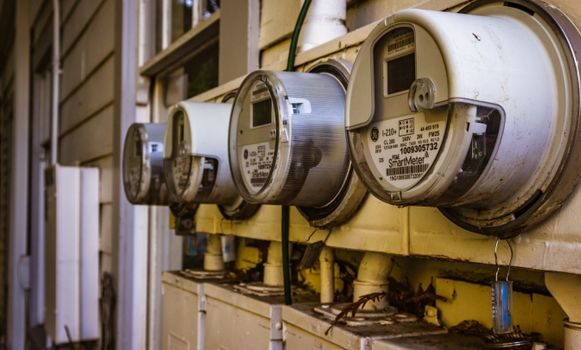
The backhaul decision separates AMR (one-way drive-by) from AMI (two-way networked) and dictates everything from radio silicon to battery life. Audiowell's ultrasonic water and gas meters are designed around low-power wireless M-Bus (wM-Bus) at 868/169 MHz in Europe and LoRaWAN / NB-IoT in Asia-Pacific markets, with battery life targets of 10–16 years on a single D-cell lithium pack [S1]. For electricity, DLMS/COSEM over PLC (G3-PLC / OFDM) or cellular LTE-M is the dominant utility pattern; LoRaWAN private networks show up in campus and multi-tenant sub-metering.
Buyers who skip this gate end up with an "AMI" meter that only broadcasts once a day and cannot be remotely disconnected — a fault pattern that surfaced repeatedly in 2025 utility RFPs [S2]. The rule is simple: if the meter cannot accept a remote firmware push and a remote disconnect command, it is AMR, regardless of how it is marketed.
Gate 4 — Environmental, IP, and Mechanical Rating
Smart meters live in basements, meter pits, outdoor facades, and hot-mechanical rooms; the IP rating and operating temperature window decide whether the unit survives year one. Audiowell rates its ultrasonic gas-flow transducers for sustained media temperatures up to 60 °C and storage down to −40 °C, with IP68 potting for pit installations [S1]. For cold-water ultrasonic meters, IP68 with 1.5 m continuous submersion (≥72 h) is the typical procurement floor; for outdoor electricity meter enclosures, IK10 impact and UV-stable polycarbonate are baseline.
Heat-meter calculators (the EN 1434 calculator unit) are commonly rated to 0–55 °C ambient with media temperatures measured at the flow sensor up to 130 °C in district heating and 90 °C in residential loops [S1]. Specifying a residential cold-water body for a boiler-room install is the most common Gate-4 failure and the first thing the field engineer replaces on day one.
Gate 5 — Power Budget and Battery Life
Battery-powered water, gas, and heat meters must reach a 10-year replacement cycle or utilities will not accept the truck-roll cost. Ultrasonic transducers draw micro-ampere average currents because they only fire during the measurement window; the radio dominates the energy budget, which is why wM-Bus, LoRaWAN, and NB-IoT are preferred over cellular LTE for residential gas and water [S1].
Electricity meters do not have this constraint — they are line-powered through the metered circuit and can run continuous PLC and cellular radios indefinitely, plus an internal supercapacitor or Li backup for outage event logging. Specifying a battery-powered water meter with hourly NB-IoT transmissions and a 5-year battery kills the lifecycle economics; the trade-off is straightforward: lower report cadence + wM-Bus or LoRaWAN = 10–16 year life, hourly LTE-M = 3–5 year life [S1].
Comparison: Main Smart-Meter Variants Against Four Decision Criteria
Side-by-side against the four buying criteria that drive 80% of tender disqualifications, the four realistic meter types land like this: (1) Ultrasonic water meter — wM-Bus, IP68, Class 1 (R49), 10–16 yr battery, fits residential cold-water retrofit. (2) Ultrasonic gas meter — wM-Bus or NB-IoT, IP65, Class 1.5, 10 yr battery, fits residential gas but needs ATEX/IECEx zone check in some countries [S1]. (3) Heat meter (EN 1434) — wM-Bus, IP68 flow body, Class 2 or 3 calculator, 10 yr battery, fits district and apartment heating loops. (4) Static electricity meter (Class 1 or 0.5) — DLMS/COSEM over PLC or LTE-M, IP54 indoor / IP65 outdoor, line-powered, fits residential and small-commercial AMI rollouts [S2].
Buyers who default to mechanical multi-jet water meters for cost reasons lose on the Gate-3 and Gate-5 trade because the moving-parts wear profile forces a 5–7 year replacement cycle versus 10–16 years for ultrasonic — the total-cost-of-ownership crossover hits at roughly year 6 in most municipal deployments [S1].
Who Should NOT Pick the Mainstream Residential Smart Meter

Industrial CT-operated three-phase Class 0.5 revenue meters, sub-metering behind a utility master, and hazardous-area (ATEX/IECEx Zone 1) gas meters do not belong on the residential ultrasonic product line. The first needs 0.2S or 0.5S accuracy at full load with external CT/PT inputs, not an integrated residential static meter body. The second needs M-Bus or Modbus to a local concentrator, not wM-Bus to a drive-by reader. The third requires explicitly ATEX/IECEx-certified housings and intrinsically-safe sensor interfaces that residential ultrasonic gas meters do not carry [S1].
Buyers who fail to gate these out at the spec-writing stage end up field-modifying meter enclosures or running an M-Bus gateway in parallel — both of which invalidate the MID/OIML certificate and trigger re-certification cost. The selection rule: residential ultrasonic smart meters are for residential duty; anything that bills above 100 A, sits in a Zone 1 area, or meters a sub-circuit inside a building needs a different product class from the start.
Standards, Sourcing, and Verification
Cross-check the spec against four anchor documents before issuing a PO: IEC 62053-21/22 (AC electricity meter accuracy), OIML R49 (water meters) and R137 (gas meters), EN 1434 (heat meters), and DLMS/COSEM conformance for AMI interoperability [S2]. A buyer's checklist should ask for the MID certificate number, the OIML test report, the wM-Bus or DLMS conformance certificate, and the IP/IK declaration — and then cross-reference the certificate IDs against the issuing body's public register, not the vendor's PDF.
For a working spec map of electricity meter variants and how they line up against billing class, see this electricity-meter selection guide. For the vibration-sensor side of the broader metering stack where mechanical duty is part of the spec, the vibration sensor selection criteria covers similar gate logic. The general smart meter page lists core reference terms used across this article.
Trackable Signals for the Next 90 Days
Two field signals are worth watching: first, NB-IoT and LTE-M module pricing on Chinese OEM bills of materials is still moving downward through Q3 2026, which will close the cost gap with LoRaWAN for residential gas metering [S2]. Second, the Audiowell 2026 smart-meter catalog release in November 2025 listed new MEMS gas-flow and high-temperature flow transducer variants for industrial metering, and the Q3 2026 firmware update for wM-Bus and LoRaWAN stacks is the next proof point that the ultrasonic + cellular line can hold a 10-year battery claim [S1].
Spec-level background on the components involved: smart camera, and smart valve positioner.