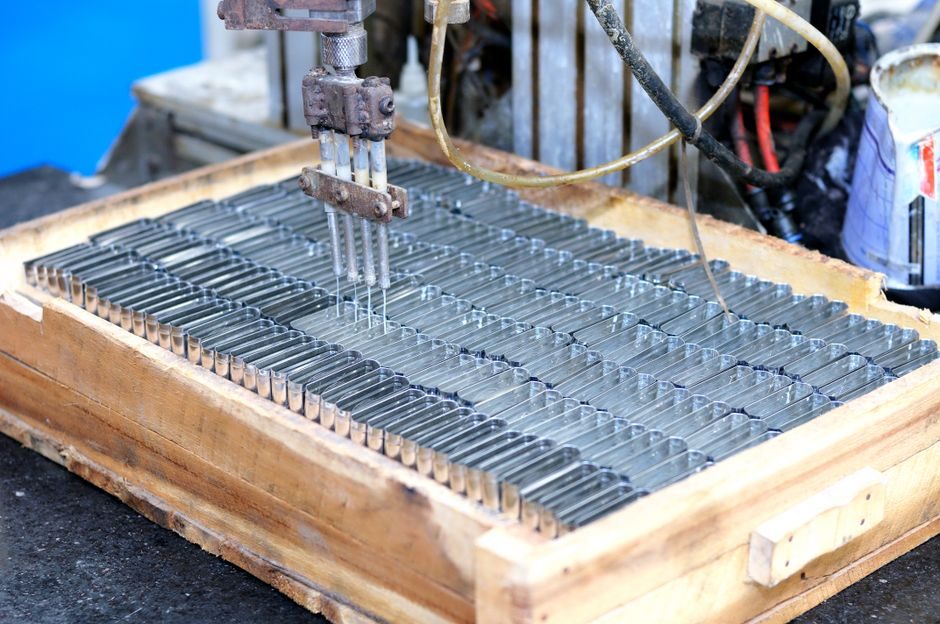
Industrial laser manufacturing is dominated by four process families — laser welding, laser cutting, laser additive manufacturing (L-PBF, L-DED) and laser micro-processing — each matched to a specific laser source class (fiber, CO₂, solid-state, diode, ultrafast) by wavelength, continuous-wave power and pulse regime [S1][S2].
Beam-shaping optics (e.g. Cailabs Canunda) and high-precision 5-axis motion frames are the two subsystems that most often determine whether a given laser process is production-viable, with claimed throughput gains of up to 200× in micro-processing applications when top-hat beam shaping is applied [S1][S5].
Process Taxonomy and Governing Physics
Laser additive manufacturing (LAM) is a layer-wise process that uses a focused laser beam to melt and solidify material — typically metal powder — according to 2D slices of a 3D CAD model, reducing complex 3D geometries into a stack of simpler 2D steps without hard tooling [S4]. Two macro-scale variants dominate metallic AM: laser powder bed fusion (L-PBF, also called selective laser melting or SLM) and laser-based directed energy deposition (L-DED, including direct laser deposition) [S2][S3]. L-PBF selectively melts a thin powder bed layer by layer, while L-DED feeds powder or wire coaxially or laterally into a melt pool created by the laser [S2][S3].
Micro- and nano-scale laser AM extends the same physics to feature sizes below 100 µm, with techniques such as laser micro-cladding, micro-stereolithography, two-photon polymerization, laser direct writing (LDW), pulsed laser deposition (PLD) and laser-induced forward transfer (LIFT) [S2]. The unifying physical advantage of laser sources is that the beam can be focused to a small spot, producing a small molten pool and heat-affected zone, with high and accurately controllable energy density — which is why lasers are preferred for metallic AM of high-melting-point alloys [S2].
Laser Welding and Cutting: Power, Source and Thickness Map
Fiber lasers (≈ 1.07 µm) dominate metal welding and cutting because of their high electrical-to-optical efficiency and strong absorption in steel, stainless steel, aluminium and copper; CO₂ lasers (10.6 µm) remain common for non-metals and for some thick-section cutting where beam delivery via mirrors is acceptable [S1]. For a deeper spec map, the laser welding machine selection guide walks through source type, power range, and thickness mapping, and the fiber laser welder 2026 price map brackets the cost envelope from ≈ $3 k handheld units up to ≈ $1.5 M battery-pack cell-to-pack systems.
Cailabs' Canunda beam-shaping product line is explicitly engineered to improve laser welding and laser additive manufacturing by reshaping standard Gaussian or multimode beams into top-hat or donut profiles, with stated throughput improvements "up to ×200" for micro-processes and improved quality/efficiency claims for copper, aluminium and steel welding [S1]. Beam-shaping matters because the intensity profile directly controls the melt-pool aspect ratio, the keyhole threshold and the spatter behaviour that drive defect rates in L-PBF and L-DED [S1][S2].
Multi-Material Laser Additive Manufacturing (MMAM)
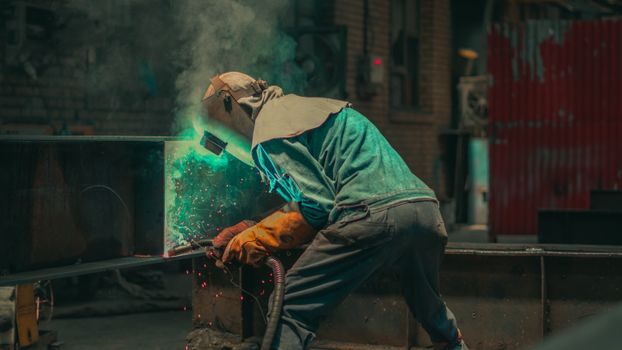
Multi-material laser AM (MMAM) — the deposition of two or more material compositions inside a single build — is positioned as a way to integrate structure and function, achieving locally tailored wear resistance, thermal conductivity, insulation or corrosion resistance inside one part [S2]. Early MMAM work concentrated on polymers, but polymeric systems cannot meet the demands of high-temperature, high-load, high-vibration environments and lack the electrical/thermal properties needed for functional devices, so the field is migrating toward metallic MMAM, especially for aerospace, defence, medical and nuclear-energy applications [S2].
Functional-graded-material (FGM) work on Ti-based and Fe-based systems via DED, and FGM porous scaffolds via L-PBF, are the most cited demonstrations; functionally graded porous structures are particularly relevant for orthopedic implants, while L-DED FGMs target thermal-barrier and wear-resistant structural components [S2]. A practical constraint: the review literature concludes that comprehensive coverage of metallic MMAM from macro to micro scales — and especially of L-PBF-based and LIFT-based MMAM — is still incomplete, so this remains an active R&D field rather than a mature production route [S2].
Comparison of the Main Laser Process Routes
Four process routes are typically weighed against each other: (1) L-PBF, (2) L-DED, (3) laser welding, and (4) laser micro-processing [S2]. On dimensional accuracy, L-PBF delivers the tightest part-feature tolerances because of the fine powder layer (typically 20–100 µm) and small spot size; L-DED trades accuracy for higher deposition rates and the ability to build on existing substrates for repair or feature addition [S2][S3]. On build volume, L-DED is essentially unbounded in XY (robot- or gantry-mounted) while L-PBF is constrained by the powder-chamber size — typically a few hundred mm on a side for production machines [S2][S3].
On material compatibility, L-PBF and L-DED are both used for steels, titanium, aluminium, nickel superalloys and refractory metals, with L-DED more tolerant of mixed powder/wire feedstocks and dissimilar-material combinations needed for MMAM [S2]. On capital and per-part cost, laser welding and cutting are an order of magnitude cheaper per system than L-PBF and two orders of magnitude cheaper than multi-laser L-PBF production cells, which is why the fiber-laser welder market spans from low-$1,000 kW-class handhelds to multi-axis robotic cells [S1]. The additive manufacturing material encyclopedia entry covers the powder-property side of the same decision; the laser marker and laser profiler pages cover the lower-power marking/measurement cousins of the same beam-delivery stack.
Integrated Laser Manufacturing Cells and Control
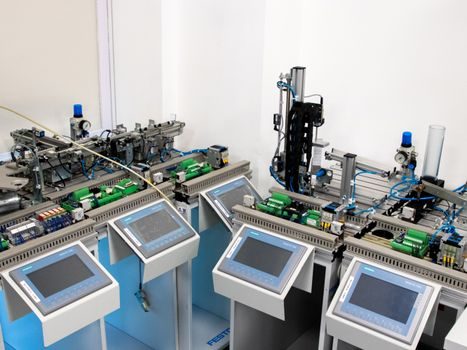
A modern integrated laser manufacturing cell — such as the integrated laser intelligent manufacturing and flexible processing system fielded by the Institute of Mechanics, Chinese Academy of Sciences — combines a high-power solid-state laser, a high-precision 5-axis robot frame, a full closed-loop feedback control system, a flexible beam-transmission and transformation system, a CAx database and supporting subsystems into one tool-less production platform [S5]. Beam-shaping modules such as the Canunda family slot directly into the flexible beam-transmission block, converting the same laser source into welding, AM or micro-processing modes by software rather than by retooling [S1][S5].
For process control, the laser level and laser-marker entries cover how beam alignment, focus offset and marking verification are specified in shop-floor acceptance tests. The v-process-line entry is the closest analog on the casting side, illustrating how a single tooling investment is reconfigured across part families — the same economics that drive flexible laser cells.
Limitations, Failure Modes and Selection Boundaries
Laser processes are not interchangeable. L-PBF suffers from residual stress, porosity, and anisotropy driven by the very small melt pool and rapid solidification that are also its strengths; L-DED inherits the same defects at coarser resolution plus dilution-zone control issues at the substrate interface [S2][S3]. Multi-material L-PBF and LIFT are described in the literature as "still in an embryonic stage" for metallic systems, with no comprehensive review yet published covering both macro and micro scales together [S2]. Beam-shaping alone does not fix these — it improves the intensity profile, but powder quality, atmosphere (argon/nitrogen for reactive metals) and thermal management remain binding constraints [S1][S2].
Selection boundary in practice: for thin-sheet metal joining under 3 mm with high productivity, fiber-laser welding is the default; for complex 3D metal parts with fine features and no existing substrate, L-PBF is the default; for large parts, repairs, or feature additions onto an existing component, L-DED is the default; for sub-100 µm features in metals, glass, or polymers, ultrafast (fs/ps) laser micro-processing with beam-shaping is the default [S1][S2][S3]. A useful rule of thumb from the DED transport-phenomena literature: L-DED part quality is governed primarily by powder catchment efficiency and melt-pool stability, which is why closed-loop melt-pool monitoring (pyrometer or coaxial camera) is now standard on production L-DED cells [S3].
Standards, Sourcing and Trackable Signals
Industry standards for laser manufacturing processes are not unified under a single ISO or ASTM number; instead, AM parts are qualified part-by-part under ISO/ASTM 52900-series terminology (which defines L-PBF and DED as process categories) and under application-specific standards such as ASTM F3301 for additive-manufacturing part qualification, while laser welding in pressure-equipment and pipeline contexts is qualified under ASME Section IX and ISO 15614-11 [S2]. For laser safety, the governing reference is IEC 60825-1 for laser-product classification and the regional implementations (e.g. CDRH 21 CFR 1040 in the US, GB 7247.1 in China) — these are the requirements a system integrator must satisfy before a cell is shipped [S5].
Trackable signals for the next 6–12 months: (1) commercial release of higher-power (≥ 6 kW) blue diode lasers (≈ 450 nm) for copper additive and welding — a stated focus of the Cailabs Canunda product line [S1]; (2) progress on metallic MMAM pilot cells, especially Ti/Al and Fe/Cu combinations for aerospace thermal-management parts [S2]; (3) qualification of L-DED repair workflows under NADCAP and AS9100 for aerospace MRO, gated on the melt-pool monitoring data above [S3].