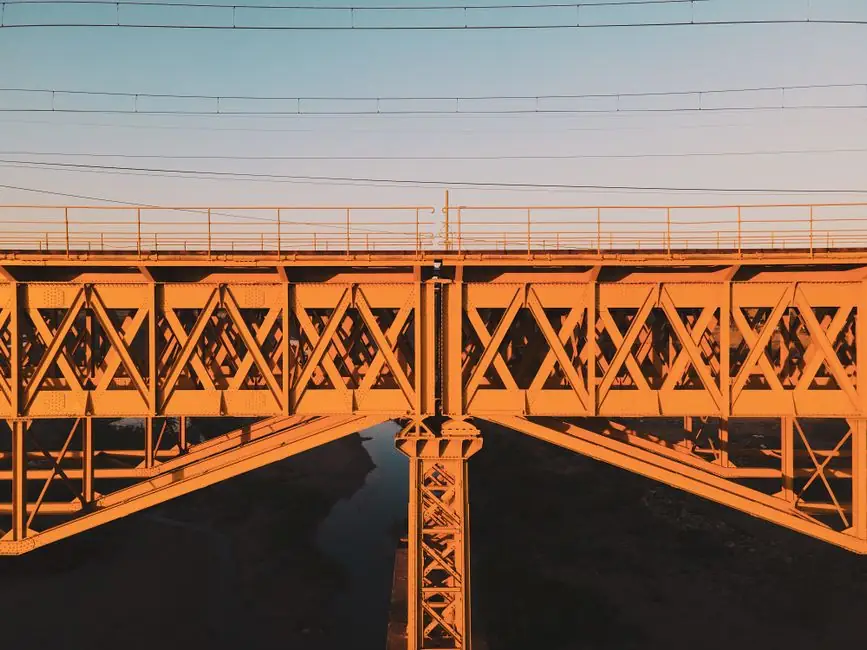
For bridge construction layout, a Class II 635-650 nm self-leveling line laser with ±1.5 mm accuracy, 15-30 m working range, IP54+ housing, and a matched pulse detector covers roughly 80% of deck, pier-cap, and rebar positioning tasks, and costs 60-85% less than a rotary green-beam kit [S4].
Bridge sites combine the worst of both worlds for a layout tool: long throws (15-40 m between abutment and pier), bright unshaded daylight (typically 30,000-100,000 lux), reflective wet steel, and uneven substrate; this rules out indoor-only units and forces an outdoor-rated, detector-paired specification [S2][S4].
Operating Principle and Wavelength Choices for Bridge Sites
Consumer-grade line lasers emit at 635-650 nm, near the lower edge of human photopic response, which the eye reads as a dim red line; higher-tier 670 nm and 780-905 nm variants shift output deeper into the near-infrared, where a dedicated detector is required to render the beam visible, and the IEC 60825-1 framework labels the visible and IR classes separately because the IR channel's invisible output carries a tighter legal exposure limit at the same optical power [S2][S4]. Diode output is capped at ≤1 mW for Class II and ≤5 mW for Class 3R under the IEC 60825-1 family, which is the hard ceiling that prevents any line laser from out-throwing a rotating green-beam past 50 m without crossing into Class 3B [S4].
Self-leveling is mechanical: a pendulum-mounted platform with a magnetic damper settles within ±3-4° of true horizontal in 2-4 seconds, then locks the line position to within the published accuracy figure; outside that envelope the unit beeps and refuses to project, which is correct safety behaviour and eliminates the tool for grade or drainage work but is fine for horizontal deck layout where the base sits on a surveyed pier cap [S4]. Beam color and wavelength set visibility, not accuracy, and a 940 nm source is a safer choice around reflective wet steel or polished form-face than an 850 nm source at equal optical power, though neither replaces the labelled laser class on the housing [S6][S7].
Spec Bands and What They Mean on a Bridge Deck
Three accuracy bands dominate 2026 SKUs and map cleanly onto bridge tasks: a ±0.5-1.0 mm at 10 m band reserved for pier-cap formwork and bearing-pad alignment, a ±1.5-2.0 mm at 10 m band covering rebar mat elevation and deck-screed setup, and a ±2.5-3.0 mm at 10 m band that is acceptable only for non-structural curb, rail, and deck-drain layout [S4][S7].
Working range tracks diode power and detector pairing: pulsed red cross-line units deliver 10-15 m visible and 40-50 m with a matched detector, while rotary green-beam units reach 30-40 m visible and 300-600 m with detector, but the green unit crosses into Class 3R above 5 mW and costs 1.5-2.5× more at retail than a red cross-line with detector [S4]. For deck pours the relevant spec is line width at working distance, and a line width of ≤3 mm at 5 m is the typical threshold below which an operator can mark a clean chalk reference on rebar chairs [S1]. A typical 2026 dual-module unit weighs 0.263-0.7 kg including 4× AA cells, runs 8-20 hours on alkaline, and operates across -10 to +50 °C, which covers the bulk of temperate-zone bridge work without a heated enclosure [S1].
Wavelength Trade-Off for Outdoor Bridge Visibility
Green at 510-532 nm appears roughly four times brighter to the human eye at equal power than red at 635-660 nm, because the eye is 4-6× more sensitive at 532 nm than at 650 nm, which is why green is preferred for bright or long indoor runs at the cost of price and runtime; for bridge work, however, the higher photopic sensitivity of green is partly cancelled by Class 3R power limits and the requirement to pair the diode with a matched green detector outdoors [S2][S4].
Red at 635-650 nm remains the workhorse because every detector brand supports it, the diodes draw less current (extending a 4× AA pack to the 15-20 hour mark versus 6-10 hours for an equivalent green unit), and the eye's lower sensitivity is offset on bridge sites by a higher-output pulse that the detector can resolve at 40-50 m when the visible line fades past 4-6 m in 500+ lux ambient [S4]. A 532 nm module is justifiable on a bridge project when the deck is wider than 30 m, the pour sequence demands a continuous visible reference past 15 m without a tripod shuffle, or the team routinely works in mixed indoor-pier-box and outdoor-deck conditions where a single tool covers both. The wavelength is printed on the laser-warning label of any compliant tool, and any spec sheet that lists only "laser line" with no wavelength data, no separate IR class, and no detector-matching spec should be rejected [S2][S7].
Selection Criteria: Who It Is For and Who It Is Not
A self-leveling 635-650 nm cross-line with detector is the right tool for: bridge inspectors transferring bearing-pad elevations, rebar crews marking chair heights on deck mat, surveyors setting pier-cap formwork, and electrical contractors positioning deck-drain and lighting boxes across spans up to 30 m. The same tool is wrong for: highway-grade slope work outside the ±3-4° self-leveling envelope, tunnel-heading alignment where a rotary green beam with a 300-600 m detector range is the working reference, and underwater pile-cap work where the IP rating must be IP68 rather than the IP54-65 typical of bridge-spec units [S1][S4].
For a typical 60-120 m span with 4-8 pier caps, the right kit is two Class II 635-660 nm self-leveling cross-line units plus a matched pulse detector and a 1.5 m surveying-grade tripod, total weight under 6 kg, total cost 300-600 USD at 2026 retail, versus 900-2,500 USD for an equivalent green rotary kit that buys longer range the bridge site does not need [S2][S4]. Battery logistics favor red: a 4× AA alkaline pack keeps a 635 nm unit running 15-20 hours, which covers a 10-hour pour day plus 4-6 hours of pre-pour setup on a single set of cells, whereas a green Class 3R unit typically drops to 6-10 hours on the same pack [S1][S4].
Comparison: Red Cross-Line vs Green Cross-Line vs Rotary Green for Bridges
Three tool classes compete on bridge sites, and the decision turns on four criteria: visible range under 30,000-100,000 lux ambient daylight, accuracy at 10 m, receiver-supported outdoor range, and unit cost in USD retail. Pulsed red cross-line (Class II 635 nm) delivers 10-15 m visible and 40-50 m with detector, 1-2 mm at 10 m, with a generic red-beam receiver at 180-450 USD; cross-line green (Class II 510-532 nm) delivers 20-30 m visible and 80-150 m with matched green detector, 1-2 mm at 10 m, at 350-700 USD; rotary green (Class II/3R 515-532 nm) delivers 30-40 m visible and 300-600 m with detector, 1-3 mm at 30 m, with a matched green detector at 500-1,500 USD [S4].
For a 60 m bridge span with pier caps every 15 m, the red cross-line with detector covers every working reference on the deck at one-third the cost of the rotary green; the green cross-line earns its premium only when ambient light exceeds 500 lux for the entire shift, which is most daylight pours between 09:00 and 16:00 in temperate zones, while the rotary green is the right answer for cable-stayed or suspension-deck work where a single reference must reach across 100+ m of unobstructed deck [S2][S4]. The reference infrared thermometer family shares the same emission-detection physics (invisible IR output converted to a working reference), which is why detector pairing and ambient-light rejection are the spec-sheet numbers that actually predict field performance rather than diode wattage. Detailed bridge-spec gating, including detector-pairing rules and the IP54-65 working envelope, is laid out in the construction tools reference and the construction machinery and equipment category pages [S2].
Limitations, Failure Modes, and Standards Discipline
Three constraints define where a line laser fails on a bridge site: ambient light, line geometry, and floor-flatness drift. Above roughly 500 lux (a typical overcast deck or shaded pier cap), the dim red line fades to invisibility past 4-6 m without a detector, and full direct sun at 30,000-100,000 lux pushes that limit down to 1-2 m, which is a hard physical limit tied to retinal sensitivity, not diode power [S4]. The line is fixed, so there is no rotary sweep, no plumb-up and plumb-down dual reference, and no slope-match mode, which rules the tool out of grade work and drainage slope but is correct behaviour for horizontal deck reference. Over 15 m on uneven substrate, accuracy drift widens to 2-4 mm because the line is a single plane rather than a swept cone, so a dip or crown in the deck form translates directly into vertical offset at the far end, and a rebar crew working a 20 m pour should re-check the receiver at the midpoint, not only at the abutment and the far pier.
Temperature drift of the diode housing shifts line position by roughly 0.1-0.3 mm per °C once the unit has been moved from a cold vehicle into a heated pier-box, and on a winter deck pour where the tool starts at -5 °C and equilibrates to +15 °C inside an hour, the cumulative offset at 20 m is 2-6 mm, which can exceed the accuracy band of a ±0.5-1.0 mm pier-cap unit and is the reason the spec band and the working environment must be matched, not assumed [S4]. Standards discipline matters here: credible datasheets cite the visible Class 2 and the IR Class 1 separately, the housing carries the IEC 60825-1 laser class label, and the IP rating is per IEC 60529, with IP54 as the practical bridge-deck minimum and IP65 the preferred rating for any tool that will see driving rain or concrete slurry wash-down [S2][S6].
For deck-form and rebar projects that share the same site realities (reflective steel, weather exposure, long throws), the overhead bridge crane spec gate covers a related heavy-lift selection problem and the infrared level encyclopedia page is the working reference for cross-line wavelength and accuracy decisions [S2].
Trackable signals for the next planning cycle: (1) confirm whether the project specification calls out IEC 60825-1 Class II explicitly, since 2026 procurement documents in some jurisdictions are tightening to require matched detector pairing in writing, not just a "laser level" line item; (2) verify IP65 versus IP54 on any unit spec'd for a deck pour between November and March in temperate climates, because the difference between IP54 and IP65 is the difference between a tool that survives a shower and a tool that survives a pour-day wash-down.
See also our earlier report, Polyurethane Insulation Selection for High-Rise Buildings: 2026 Spec Gate.