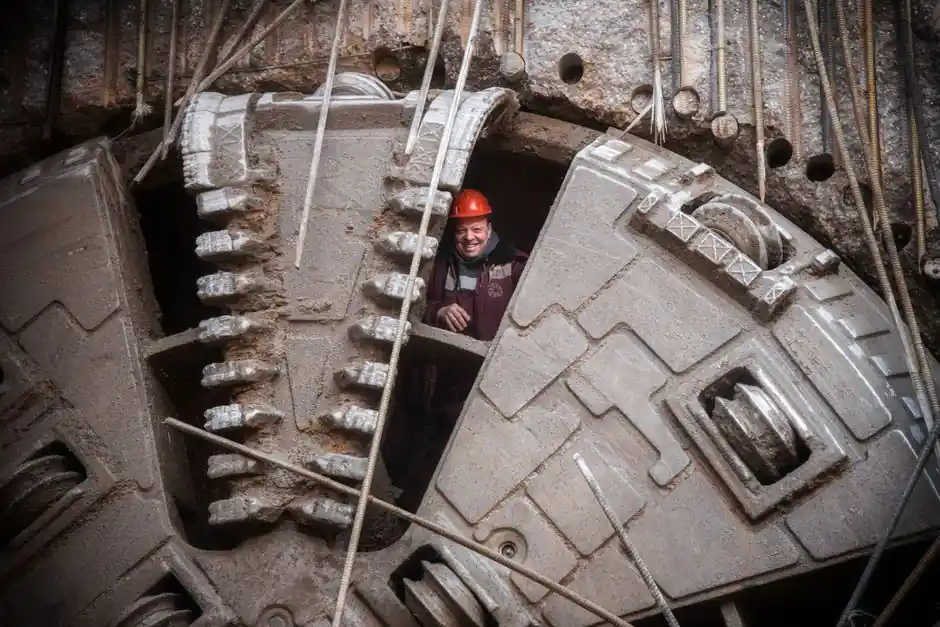
Tunnel heading and invert work demands a laser level with at least 1,000 ft (305 m) working range, IP66 or higher sealing against dust and shotcrete mist, and dual-axis self-leveling rated to ±5°, because the instrument has to stay live across long sight lines where re-setup adds hours per advance ring [S5].
For shield-driven tunnels the dominant failure mode is segment uplift caused by buoyant grout pressure exceeding engineering-code limits, so a laser-target guidance system surveyed at 10-20 m intervals along the lining is the practical mitigation that surveying crews actually run [S5]. Inside this envelope the term "infrared line level" covers two distinct hardware classes: a co-aligned visible 635-650 nm line plus a near-IR 850-940 nm channel used by machine-vision and photoelectric line receivers [S4].
Why a Tunnel Heading Punishes a Line Level Differently
A tunnel heading is a confined, humid, dust-laden, dim space that punishes instruments on three axes at once: visibility, sealing, and stability. Green-beam diodes (515-532 nm) are perceived up to four times brighter than red (635-660 nm) under the low-light conditions typical of a heading face, which is why green rotary lasers dominate TBM and NATM guidance packages even though they cost more and drain batteries faster [S5][S3].
Vibration from blasting, muck cars, and shotcrete robots makes a stable mount non-optional, and the same FHWA tunnel-investigation guidance that documents infrared thermography for lining-condition surveys notes that hand-pushed scans every 1 ft (0.3 m) are the standard practice, so any reference beam must stay flat across that scan interval [S1]. On a 10 m run inside a confined heading, an infrared line level operating at ±0.3 mm/m drifts roughly 3 mm, while a ±0.5 mm/m unit drifts 5 mm; the delta is what separates a tile reveal that closes from one that daylights along the curved invert [S4].
Specification Criteria for a Tunnel-Grade Laser Level
The four common beam formats line up against the criteria that actually drive a tunnel engineer's purchase decision: visible range in a heading, detector range, IP rating, and self-leveling envelope. Dot lasers deliver under 100 ft and are best for plumb-down shaft transfer, line lasers give 50-100 ft for formwork and segment alignment at the immediate face, red rotary (635 nm) hits 1,500-2,000 ft with a detector, and green rotary (515-532 nm) matches that 1,500-2,000 ft range but is perceived 4× brighter in low light at a higher battery cost [S5].
For tunnel cross-section control and invert grade setting, a rotary laser with an IP66-rated housing, a 5/8-11 thread mount, and a detector package is the workhorse choice [S5]. Accuracy bands follow the same three-tier ladder used in interior work: ±0.2 mm/m for precision cabinetry and reveals, ±0.3 mm/m for general interior layout, and ±0.5 mm/m for rough plumbing, mechanical rough-in, and exterior formwork where form tolerance is already ±10 mm [S4].
Wavelength Package and IR Channel Behavior
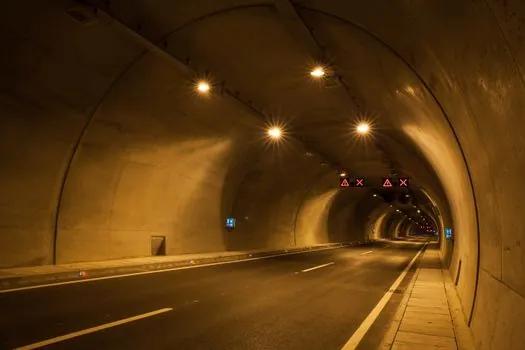
Visible 635 nm and 660 nm lines remain the operator channel because the human eye peaks near 555 nm and falls off sharply past 700 nm, so the visible line is what people see on the floor or wall [S4]. The IR channel at 850 nm or 940 nm exists so that machine-vision systems, line-receiver photoelectric sensors, and ceiling-mounted reference detectors can lock onto a beam the operator's eye ignores, which is critical for automated TBM guidance and conveyor alignment inside the segment yard [S4].
Credible 2026 datasheets cite the visible class (commonly Class 2) and the IR class (often Class 1) separately, because the IR channel is invisible and the legal exposure limit is tighter per the IEC 60825-1 family of laser safety rules. A 940 nm source at the same optical power is a safer bet around reflective metal than an 850 nm source, but neither is a substitute for the rated laser class on the housing [S4].
Tripod and Mount Pairing for Tunnel Geometry
Tripod choice sets the working height and the vibration floor of the whole reference plane. Adjustable-leg aluminum or fiberglass tripods dominate because they can be leveled on rail ties, muck, and uneven invert without blocking, and elevating tripods with a crank allow fine height setting without re-shimming [S5]. Common tripod extension spans 3-6 ft, with elevating models reaching 6-8 ft or more for invert-to-crown control.
Thread pattern matters in the field: most professional rotary lasers and automatic levels use a 5/8-11 thread, while smaller line and dot lasers use 1/4-20; mixing them without an adapter stops a job at midnight [S5]. For long tunnel drives, a heavy-duty elevating tripod with steel spike shoes and fiberglass legs is the pairing that holds calibration across a 10-hour shift, especially because the same temperature-drift rule of roughly 0.1-0.3 mm per °C that affects a handheld line level also applies to the tripod-mounted reference after a cold vehicle pre-load [S3][S5].
Shield Tunnel Monitoring: Where the Reference Beam Meets the Lining
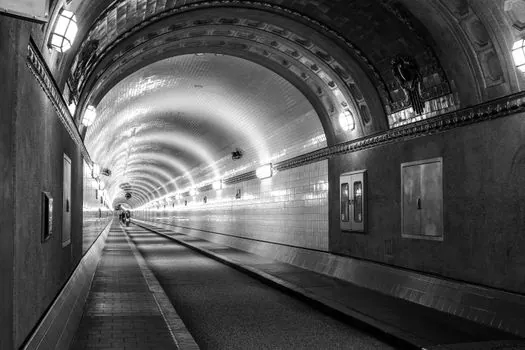
Segment uplift during shield excavation is the deformation mode that laser monitoring is specifically tasked to catch. Grout injected into the tail void exerts a persistent upward buoyant force on the segment ring, and when grout setting is delayed the ring rises; a laser reference set on a stable invert monument plus targets at 10-20 m intervals is the practical survey pattern, while infrared thermography of the same lining surfaces maps moisture intrusion and shallow voids up to 3 inches (76.2 mm) deep on a 1 ft (0.3 m) scan grid [S1][S5].
For sourcing, watch for two signals through 2026: vendors that publish ISO 17123-2 / DIN 18723 test certificates with their automatic level shipments, and line-level vendors that publish a wavelength band, an output power in mW, and a detector-matching spec on the same datasheet [S2]. Buyers who overspec accuracy to chase a number on paper usually end up with a fragile tool that needs recalibration after a 2 m drop, with calibration intervals of 6-12 months typical and factory flat-rate fees in the 30-80 USD band for most 2026 brands [S4]. The same line-level hardware also has a structural-measurement sibling used in lining scanning and moisture mapping, with a relevant infrared thermometer procurement track running alongside for QA crews who verify grout exotherm and segment temperature deltas during the same shift [S1][S3].
Comparison: Dot vs Line vs Red Rotary vs Green Rotary in a Tunnel
Four beam formats, four tunnel-engineering criteria: visible range in the heading, detector range, IP66+ availability, and self-leveling envelope. Dot laser delivers under 100 ft visible, no detector range, IP54 common, single-axis, best for plumb-down shaft transfer. Line laser gives 50-100 ft visible, 20-30 m detector range on the IR channel, IP65 typical, ±3-4° self-leveling, best for formwork and segment alignment at the face [S3][S4][S5]. Red rotary (635 nm) reaches 1,500-2,000 ft with detector, IP66 available, ±5° dual-axis, mature battery ecosystem but harder to see in dim headings without a target plate. Green rotary (515-532 nm) matches 1,500-2,000 ft with detector, IP66 available, ±5° dual-axis, perceived 4× brighter in low light, dominant in modern TBM guidance at a premium price tier [S5].
The right tool is decided by distance, surface area, ambient light, and the type of accuracy the contract demands, with the most common wrong picks being a consumer cross-line at 10-30 m pushed onto a 200 m heading survey, and a green rotary pulled into tight shaft work where a 1/4-20 line laser would have sufficed [S2][S3]. For road maintenance crews who also stage at the portal, the road-maintenance IR line level spec gate carries the same IP65, ±0.3 mm/m, and receiver-matching logic, while the infrared thermometer sizing gate covers the lining-temperature QA track that runs in parallel with the geometry survey.
Trackable next nodes through 2026: vendor publication of ISO 17123-2 / DIN 18723 certificates on rotary shipments, detector-matching data sheets for IR-channel line receivers at 850 nm and 940 nm, and revised IP66+ ratings on green rotary housings rated to IP65 today. Buyers should treat any line-level datasheet that omits wavelength band, output power in mW, and detector part number as indicative only, because most manufacturers quote a single deviation-at-distance number with no test procedure attached [S2][S4].
Component reference pages worth checking: construction tools.