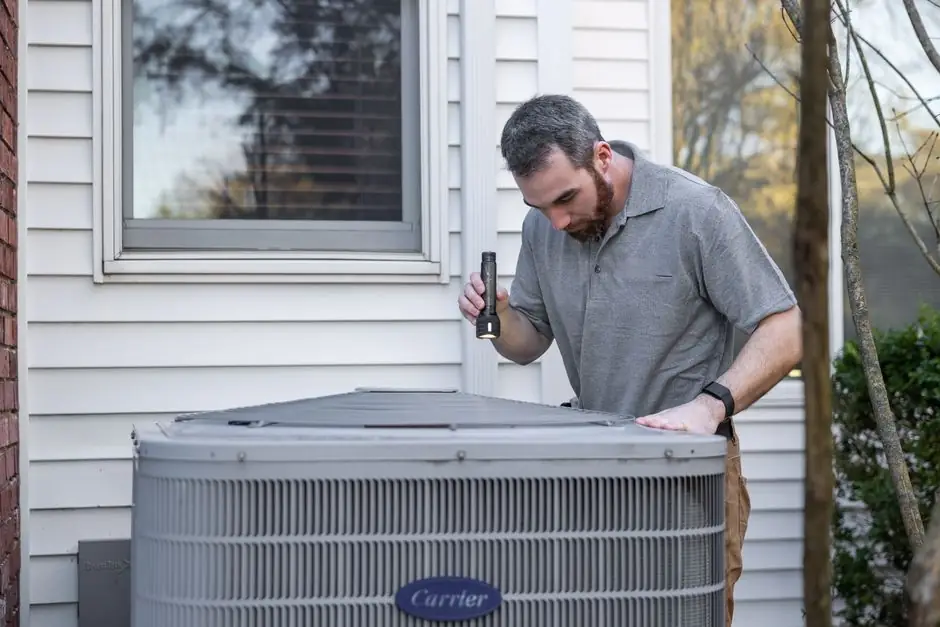
On a 2026 HVAC fit-out, an infrared line level is best specified as a dual-emission layout tool: a visible 635 nm or 660 nm reference line for the installer, plus a co-aligned 850 nm or 940 nm near-infrared channel that machine-vision cameras, ceiling-mounted line detectors, and photoelectric receivers can lock onto when ambient light kills the visible beam [S3][S4].
Spec sheet must cite wavelength, accuracy in mm/m, working range with and without receiver, IP rating per IEC 60529, and laser class per IEC 60825-1, since a "laser line" data row without wavelength data is a red flag on 2026 stock [S2][S3]. For a primer on how this instrument family differs from optical-automatic levels, the infrared line level selection map sets the baseline vocabulary before the HVAC-specific decision.
Why an IR Channel Matters on HVAC Duct and Ceiling-Grid Layout
The human eye peaks near 555 nm and falls off sharply past 700 nm, so on a typical 500-1000 lux fluorescent-lit mechanical room or above-ceiling plenum, a 635 nm or 660 nm visible line fades past 4-6 m without a target plate, and a dim red line is functionally invisible above 500 lux ambient [S3][S4]. The IR channel at 850 nm or 940 nm is what makes a line receiver possible: receivers integrate a photodiode plus a narrow optical bandpass filter centred on the laser wavelength, so an HVAC fitter can extend working range to 50-80 m on a long return-air run or a warehouse rooftop unit layout [S3].
For duct-alignment and condensate-pipe slope work, the IR channel also drives AGV docking stations and ceiling-installed reference detectors used in modular HVAC skid assembly, where a camera, not a human, is the consumer of the line [S3]. On a 10 m duct run, the visible line alone is the right pick; past 15 m on a long mechanical corridor or large-format retail ceiling, a receiver-matched IR line is the only practical tool, and an automatic leveling instrument or rotary laser becomes the better fit only when the run exceeds 30 m with a 1-3 mm at 30 m envelope [S4].
Spec Bands and What They Mean on an HVAC Site
Three accuracy bands dominate 2026 SKUs that actually show up on HVAC tender sheets: ±0.2 mm/m for precision work such as cleanroom duct reveals and raised-access floor grid, ±0.3 mm/m for general interior layout (partition walls, ceiling grid, socket heights, supply-diffuser heights), and ±0.5 mm/m for rough plumbing, mechanical-rough-in, and exterior condenser-pad formwork [S3]. On a 10 m duct run the deltas are 2 mm, 3 mm, and 5 mm, small in absolute terms, but the difference between a linear-slot diffuser reveal that closes flush and one that daylights along a corridor [S3].
Working range is the second gate: 2026 stock typically quotes 20-30 m visible line, sometimes 50 m in bright interior conditions with a target plate, and 50-80 m with a matched line receiver [S3]. IP54 is the de-facto floor for indoor jobsite use (dust-protected and splash-resistant from any direction per IEC 60529), and IP65 is the right pick for trades that cycle tools in and out of unconditioned vans or rooftop service areas [S2][S3]. Operating temperature usually lands in the −10 °C to +45 °C window, with some pro SKUs extended to −20 °C for cold-storage HVAC work [S3].
IR vs Visible vs Rotary: Decision Grid for HVAC Layout
Three tool classes dominate interior HVAC layout, and the decision turns on four criteria: visibility range under 1000 lux ambient, accuracy at 10 m, receiver compatibility for ceiling-plenum or rooftop work, and unit cost in USD retail [S4]. A 635 nm cross-line unit (Class II) delivers 10-15 m visible and 40-50 m with a generic red-beam receiver, at 1-2 mm at 10 m, and lands in the 180-450 USD band [S4]. A 515-532 nm rotary green beam (Class II / 3R) delivers 30-40 m visible and 300-600 m with a matched green detector, at 1-3 mm at 30 m, and lands in the 500-1500 USD band [S4].
Green wins outdoor visibility roughly 4-6x because the eye is more sensitive at 532 nm than at 650 nm; infrared-only models sit at the lower end of the 23-54 USD FOB-Ningbo band, while 3-line 360° variants with rechargeable Li-ion packs and IP54 housings cluster at the upper end [S2][S4]. For HVAC work in finished interiors, a 635 nm or 660 nm red-beam cross-line with a matched 850 nm IR channel and IP54 housing is the default; for rooftop condenser layouts and long return-air runs, a 515-532 nm green rotary with detector is the right tool despite the 3-5x unit cost premium [S4].
When an Infrared Line Level is the Wrong Tool
Three constraints define where an IR line level fails on HVAC work: ambient light, line geometry, and floor-flatness drift [S4]. Above roughly 500 lux (a typical fluorescent-lit interior or shaded outdoor site), the dim red line fades past 4-6 m without a detector, a hard physical limit tied to retinal sensitivity rather than diode power, and direct sunlight at the receiver window halves effective range even on Class 1 IR units [S4][S5].
The line is fixed: there is no rotary sweep, no plumb-up / plumb-down dual reference, and no slope-match mode. On floors outside a ±3-4° self-leveling envelope the unit beeps and blanks the beam, which is the correct safety behaviour but eliminates it for condensate-pipe drainage slope, outdoor chiller-pad grade work, and rooftop duct-trench fall [S4]. Over 15 m on uneven substrate, accuracy drift widens to 2-4 mm because the line is a single plane rather than a swept cone, and diode-housing temperature drift shifts line position by roughly 0.1-0.3 mm per °C once the unit is moved from a cold vehicle into a heated mechanical room [S4]. For comparison data on a related HVAC sensor family, the infrared thermometer range and D:S spec gate tracks the same emission-detection physics for thermal scanning of supply-air registers.
Acceptance Criteria, Calibration, and When to Replace
Acceptance test on site: with a target plate at 10 m, the visible line should fall within ±2 mm of a reference chalk-snap on a clean concrete floor; with a matched receiver, the IR channel should hold lock at the rated maximum range with the receiver held steady for 5 seconds [S3][S4]. If the unit beeps and blanks outside the ±3-4° self-leveling envelope, the unit is not faulty, it is correctly refusing to project, and the fix is to re-level the tripod, not to force the pendulum [S4].
Calibration intervals of 6-12 months are typical for 2026 stock, with factory flat-rate fees in the 30-80 USD band for most brands; a 12-month factory recalibration costs 80-220 USD per unit once shipping, cert documents, and line-downtime are included [S3][S5]. Quarterly field verification with a target plate adds 15-30 USD per visit but catches drift before it triggers a false reject on a conveyor sorting line or a mis-aligned duct flange on a molding line workcell [S5]. Replace, do not repair, when the pendulum housing shows physical damage after a 2 m drop, when the optical window is pitted from chemical exposure, or when the unit fails the 5-second lock test at rated maximum range twice in a row [S4][S5].
Sourcing, MOQ, and Lead Time for 2026 Procurement
2026 price bands on 500-piece MOQ from Ningbo and Shenzhen OEM lines: entry 2-line IR with plastic body and AA batteries at 23-32 USD/pc, mid 3-line 360° self-leveling with IP54 housing and Li-ion pack at 33-45 USD/pc, and pro multi-line green-beam with magnetic mount and hard case at 45-54 USD/pc FOB-Ningbo [S2]. Standard MOQ is 500 pieces with 1,000,000-piece-per-month supply capability, payment terms TT or LC at sight, and FOB Ningbo as the default incoterm [S2].
Lead time on a 500-piece OEM order runs 15-25 days for stocked SKUs and 30-45 days for custom-color, custom-logo, or private-mold runs; sample policy is typically 3-5 sample units at cost, refundable against a PO above 1,000 pieces [S2]. End-of-life disposal of laser/LED-class emitters falls under WEEE Directive 2012/19/EU for European HVAC sites, and buyers specifying into EU commercial-building projects should confirm the OEM has a registered WEEE producer-of-record before issuing a PO [S5].
Trackable signals for the next procurement cycle: whether the OEM shifts from 808 nm to 850 nm IR diodes as the default channel, and whether IEC 60825-1 revision guidance tightens Class 1 IR exposure limits for ceiling-mounted receiver arrays on commercial HVAC projects [S3].