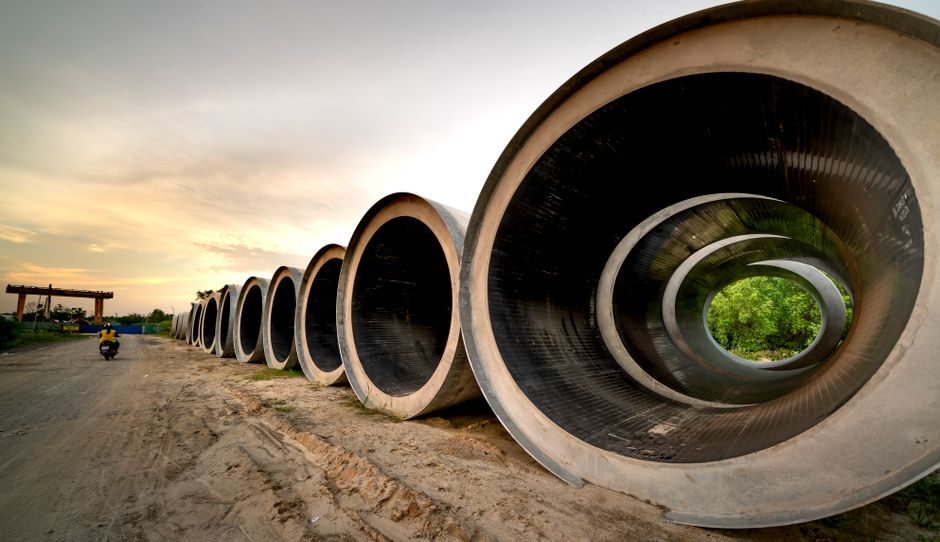
An inline pipeline pump mounts between pipe flanges with suction and discharge on the same centerline, so it eliminates the baseplate, the spacer coupling, and the laser alignment step that an end-suction centrifugal pump requires; this is why Chinese OEM listings now split "pipeline centrifugal pump" and "centrifugal pump" as two separate categories on the same product page [S1].
Selection collapses to three quantifiable decisions before the datasheet is opened: required TDH at the design flow, available NPSHa at the pump suction flange, and the fluid's temperature / cleanliness / corrosivity envelope, since casing, mechanical seal, and impeller material all derive from those numbers. Pentair's commercial product page frames the geometry: an in-line unit "slips right into the pipeline, delivering big performance without the bulk," which makes it the default for retrofit jobs where headroom and floor space are constrained [S8].
Gate 1 — TDH and Flow: Single-Stage vs Multistage Cutoff
Single-stage in-line units, including fire-fighting and HVAC circulator variants, are widely published at heads of 6 m up to roughly 50 m at small flows, which is the envelope where 50 Hz / 60 Hz end-suction frames already work [S2]. The 3-speed wet-rotor circulator on the public spec list runs max head 6 m at 65 L/min, max input 100 W, and PN10 / DN20 port-to-port 150 mm, numbers that anchor the lower end of the duty map [S2].
When the duty sheet demands >50 m head at moderate flow, the selection shifts to multistage in-line; Made-in-China's Multistage Pump Pipeline Pump category lists BB4 radial-split multistage booster units from Jiangsu Yingte at USD 2,000–50,000 per set, sized for "long distance transfers" [S5]. A separate 5.5–15 kW multistage pipeline centrifugal from Zhengzhou Shenlong spans USD 685–3,652 per set, which is the price band a process engineer should expect for the 30–80 m head window [S7]. For very high TDH at process flow, the more relevant reference architecture is a multistage centrifugal pump built around staged impellers in a barrel; the in-line form just packages that hydraulic into a flanged, foot-less envelope.
Gate 2 — Flange Class, Port-to-Port, and Suction NPSHa
Inline units live or die on flange compatibility, because the pump IS a piece of pipe; an incorrect ANSI / DIN / PN class match forces a spool-piece and erases the footprint advantage. The published bronze-body circulator lands at PN10 with DN20 port-to-port 150 mm, with max operating pressure 10 bar at liquid temperatures from -10 °C to 110 °C [S2]. A single-stage single-suction in-line fire pump carries its own flange standard set (typically PN16 / Class 125) and is paired with fire-system risers where NPSHa is generous [S3].
Inline geometry has a real hydraulic penalty: because suction and discharge share one straight shell, NPSHr is higher than an equivalent end-suction frame at the same flow, so cold-water designs (where margin to NPSHa is tight) deserve a net-positive suction check, not just a curve lookup. Pentair's framing of the in-line form is direct: "efficient fluid transfer — simplified," but it is silent on NPSH, so the buyer has to derive that number from the manufacturer's family curve rather than trust the marketing page [S8].
Gate 3 — Wetted Materials: Bronze, 304SS, Cast Iron, PP
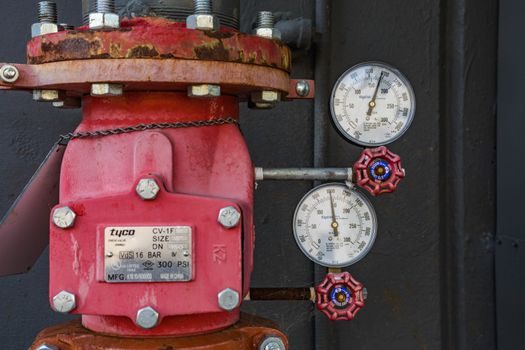
Material drives both price and the fluid compatibility list, and the public Chinese OEM listings show the four common tiers. The hot-water circulator uses a bronze body with 304 stainless steel wet-rotor construction, designed for heating systems [S2]. A bronze-body variant (same supplier) targets drinking-water circuits where dezincification resistance and lead-leach compliance matter, and the 304SS shaft / wet-rotor architecture runs under 45 dB(A) [S2].
For non-corrosive, non-flammable analytical service, Anton Paar's Inline Pump 520 is a magnetically coupled sample pump designed to install in-line without a bypass, with no mechanical seal to leak; this is the textbook choice for density-meter loops and clean-side sampling [S4]. Shanghai Pacific Pump's eight-series product list includes magnetic-drive and chemical pumps as separate lines from the standard in-line centrifugal, which signals that aggressive fluids (acids, solvents) deserve a mag-drive or lined in-line, not a cast-iron mechanical-seal unit [S1]. A direct contrast for sealed-metering or low-flow chemical feed is a diaphragm pump, which trades pulsation and flow for leak-tight dosing — see the calibration-interval decision map for a side-by-side on duty fit.
Gate 4 — Seal Architecture: Mechanical Seal vs Magnetic Coupling
Wet-rotor circulators eliminate the shaft seal entirely because the motor runs in the pumped fluid, which is why domestic heating circulators can publish "no leakage" as a hard spec [S2]. For sample loops, instrumentation-grade liquids, and any fluid where even a 1 ppm/day leak is unacceptable, magnetic-coupled in-line pumps (no dynamic seal) are the default; the Anton Paar Inline Pump 520 is built around exactly that architecture [S4].
Mechanical-seal in-line units still dominate fire, HVAC, and general water-service duty because they tolerate occasional dry-run on commissioning, which a magnetic-coupled can will not. The fire-service single-stage single-suction in-line pump on Okorder's listing, for example, accepts OEM build sheets and is the form most AHJs see on diesel-driven and electric fire risers [S3].
Gate 5 — Speed Control, Noise, and Energy
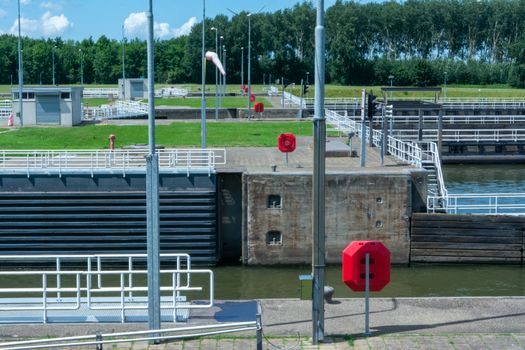
Wet-rotor domestic circulators are commonly 3-speed (e.g. 46 W / 67 W / 100 W input across speed 1 / 2 / max on the published bronze-body spec) because modulating demand is handled by stepping down, not by VFD [S2]. For commercial HVAC and process in-line pumps, the analog is a VFD on the motor; Chinese OEM datasheets for industrial in-line frames show 50/60 Hz mains and IP55-class insulation as the typical entry point, with IE3 / IE4 efficiency classes selectable at the order stage [S7].
Noise target <45 dB(A) at 1 m is achievable on small wet-rotor circulators with PP impeller and 304SS rotor can, which is why these units are specified for apartments and hotel plant rooms [S2]. On larger 5.5–15 kW in-line multistage boosters, acoustic treatment moves to the pipe side (flex connectors, hangers) because the pump itself dominates the 75–80 dB(A) band [S7].
Gate 6 — Duty Match: HVAC, Fire, Process, Sample
In-line pumps are not a universal substitute, and the duty lists are short and well-defined. The right picks, in order of fit: (a) HVAC hot-water heating circulators with PN10 flanges and wet-rotor motors, sized at max head 6 m and max flow 65 L/min in the smallest DN20 frame [S2]; (b) fire-service single-stage single-suction in-line, PN16, with matched Jockey / duty driver pairing and FM / UL listing pursued through the OEM [S3]; (c) process pipeline boosters in multistage in-line BB4 form, 5.5–15 kW, 30–80 m head, USD 685–3,652 per set on the Zhengzhou Shenlong tier [S7]; (d) sample and analyzer-loop in-line magnetic-coupled pumps, 0–500 mL/min class, where the Anton Paar Inline Pump 520 type unit sits [S4]. Shanghai Pacific Pump also lists a booster system as part of its eight-series portfolio, sold as a packaged skid rather than a bare pump [S1].
The duties where in-line is the wrong pick: high-viscosity (>400 cSt) slurries, strong oxidizers that demand Alloy 20 / Hastelloy wetted parts at elevated temperatures, and any service that needs a defined NPSHr margin tighter than about 1.5 m — for those, the spec should move to a gear pump for viscous or a hydraulic pump architecture for high-pressure, and the in-line centrifugal is simply deleted from the shortlist. For dosing / metering flow rates (mL/min to a few L/h) the correct comparison is a metering pump, not a pipeline pump at any speed.
Gate 7 — Manufacturer Tier, Lead Time, and Standards

Chinese OEM listings group in-line pipeline pump makers into three observable tiers on the public marketplaces: (1) integrated groups (e.g. Shanghai Pacific Pump, established 1998, 101–200 employees, 67,000 m² of plant area, ISO 9001:2000 era quality system, CE-marked, with eight product series from clean-water to vacuum pumps and fire-fighting approval) [S1]; (2) regional specialists (e.g. Anhui Tenglong Pump & Valve in Xuancheng, focused on chemical and process pumps) [S6]; and (3) trading-only or low-MOQ resellers on Okorder / Made-in-China that move standard SKUs at USD-set pricing with 1,000–10,000 sets/month supply capability [S2][S3]. The Jiangsu Yingte BB4 listing at USD 2,000–50,000 per set sits between tiers 1 and 2 because it specifies "high capacity large flow" radial-split barrel design, not commodity in-line [S5].
Standards discipline before PO: PN / ANSI flange class, ISO 5199 (or API 610 where the duty crosses into hydrocarbon service), hydraulic performance per ISO 9906, and ATEX 2014/34/EU for any unit in a Zone 1 boundary — the OEM page rarely resolves all four, so the engineer should request the certificate pack, not trust the catalog. Pricing for the small DN20 wet-rotor circulator is published at "Ref Price — Loading Port: Ningbo, Payment: TT or LC" with 5,000 sets/month supply capability [S2]; the fire-service in-line pump lists "Ref Price — Loading Port: Shanghai, 10,000 sets/month" [S3]; these are the lead-time and Incoterm signals to anchor a PO.
Closing signal: a buy on this class is decided in the datasheet review, not the catalog browse — confirm flange class, TDH at design flow, NPSHa margin, wetted material, and seal type before signing. Track three concrete items in the next 90 days: ISO 9906 hydraulic-performance retests on the BB4 radial-split booster tier (Jiangsu Yingte, USD 2,000–50,000 set band [S5]), ATEX/IECEx certificate expiry dates on the 5.5–15 kW in-line multistage units, and any Q3 inventory moves on the DN20 PN10 wet-rotor circulator (5,000 sets/month Ningbo supply) since that is the SKU most exposed to a duty mix-up with a centrifugal pump on a small HVAC retrofit [S2][S5][S7].