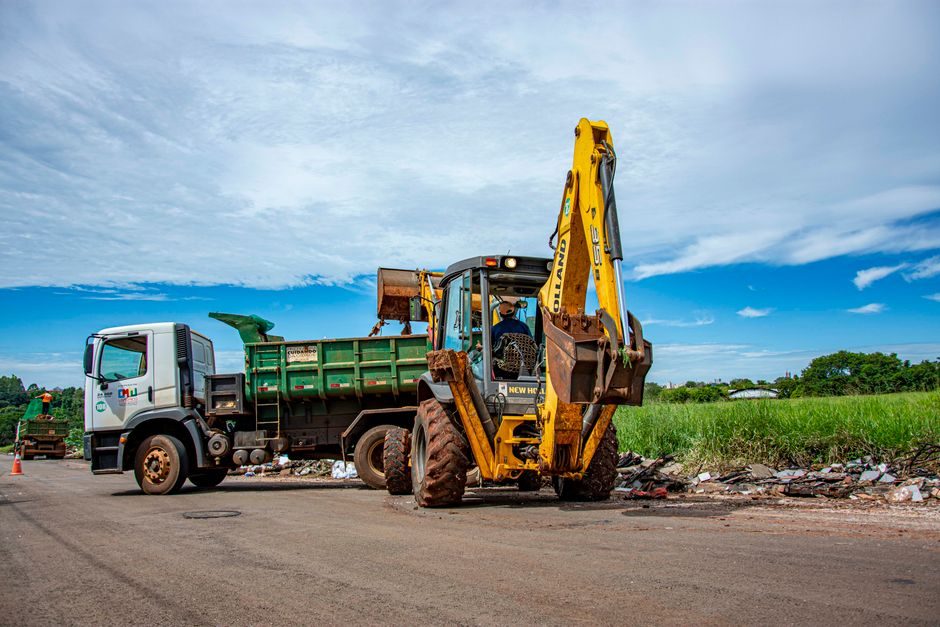
Landfill duty cycles punish conventional motor graders faster than highway maintenance work because the working face mixes demolition debris, wire, and reactive subgrade — a 12M-class machine with 136 kW (183 hp) base power and a 3.7 m (12 ft) moldboard handles daily cell cover at municipal solid waste sites, but only when paired with all-wheel-drive and sealed electrical systems [S3].
For multi-acre landfill cells, the operating envelope sits between the 140 hp compact class and the 300+ hp mining class: SANY's heavy-duty category begins above 300 hp with operating weights over 160,000 lb and 24 ft blade reach [S2], a size envelope that exceeds most landfill haul-road geometries and the legal transport envelope of U.S. state DOTs.
Landfill Duty Profile: What the Grader Actually Pushes
Daily cover placement, leachate-pad grading, and access-road maintenance drive the spec, not peak cut depth. Landfill operators must run wheel loaders, motor graders, backhoes, and water trucks on and off the active cell, and dust suppression is a written job task rather than an option [S8]. Material density varies cell-to-cell — wet sludge, alternative daily cover (ADC), and chipped green waste each shear the moldboard differently, so a 3.7 m blade on a Cat 12M, 140M, or 160M (gross vehicle weight 18,400-20,607 kg / 40,565-45,432 lb) is the typical sweet spot [S3].
Landfill blades see constant impact loading from rebar, concrete, and household debris; a 14M3 frame weighing in the same class with a 257 L/min (68 gal/min) load-sense hydraulic pump at 24,100 kPa (3,495 psi) gives the operator reserve flow for ripping compacted cover before grading [S4]. The 14M3's electro-hydraulic load-sensing closed-center circuit matches the rapid moldboard corrections a landfill slope needs when subgrade subsides under fresh lift.
Frame Type: Rigid vs Articulated for Decaying Subgrade
Rigid-frame graders deliver predictable cut angle and lower mechanical wear on long, straight haul-road passes, which matches most landfill cell geometry [S2]. Articulated frames swing the front frame and blade relative to the rear, shrinking the turning radius for tight cell-to-cell moves, and this is the better choice for working around gas wells, leachate manholes, and temporary access ramps.
The 14M3 with a 7.6 m (24 ft 10 in) outside-front-tire turning radius and 47.5° steering range can pivot inside a single gas-well cluster without the operator needing a three-point turn [S3][S4]. For a comparison baseline: the legacy 14H transmission offered eight forward and eight reverse gears, with four gears below 10.5 km/h (6.5 mph) reserved for precision earthmoving — speeds one through three on the M-series 12M (4.0-8.0 km/h / 2.5-5.0 mph forward) map directly onto slow cover-spread work [S3][S5].
All-Wheel-Drive: The Landfill Default
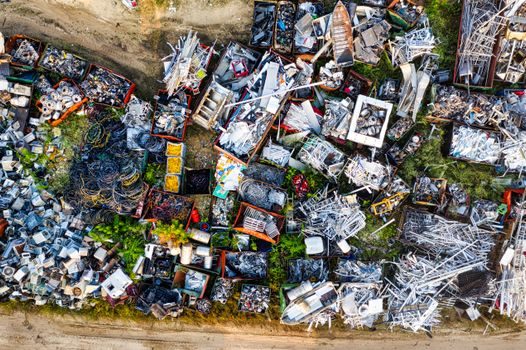
On a wet clay cap or a tire-deep track, a two-wheel-drive grader loses tractive effort before it loses hydraulic power; AWD closes that gap by powering the front axle on demand. The 140M AWD shares the 159 kW (213 hp) C9 ACERT base of the 140M, but VHP Plus stretches to 174 kW (233 hp) for the AWD model versus 159 kW (213 hp) for the 2WD — the extra power compensates for the parasitic loss of the front-axle drive [S3].
Landfill-side grading on ADC or tire shreds needs the 140M AWD configuration, while the 160M AWD at 20,607 kg (45,432 lb) gross and 159-200 kW (213-268 hp) VHP Plus range is the upper sensible limit before a mine-class 14/16-machine takes over. For a broader haul-road framing outside the landfill cell, the mining-haul-road spec map covers the larger frame sizes; for pavement-class work the road-construction spec match walks through drivetrain options that overlap landfill access-road work.
Grade Control and the 3D/2D Decision
Cat Grade with 3D for motor graders integrates GNSS positioning and digital terrain model files into the operator display, removing string-line setup and allowing the operator to grade to a design surface directly from the cab [S1]. On a landfill cap, where design surfaces change cell by cell and a survey crew stake would be destroyed daily, 3D grade control replaces the traditional slope-stake workflow with a model-driven one and the ROI is dominated by avoided survey cost, not fuel or labor.
Leachate-pad grading — typically a 1-2% slope to collection trenches — is a textbook 3D-machine-control job because the design surface is uniform but must be re-cut each time the clay liner is exposed. For pure maintenance grading on haul roads, 2D systems (cross-slope plus elevation reference) remain cost-effective and avoid the GNSS signal multipath that landfill perimeter berms can create.
Undercarriage, Tires, and the Debris Problem

Standard pneumatic tires on a 140M-class grader are not landfill tires; the cut-shoulder and sidewall damage from rebar and wire is a known high-cost item. Dual-seal rim flange protection, rubber tire chains, and foam-filled front tires are the three most common landfill modifications. Circle diameter on the 140M is 60.2 in (1,530 mm) with 27.4 in left / 28.7 in right shift, giving 70.5 in left and 77.9 in maximum reach outside the tires — reach that lets the operator cut a clean shoulder without dropping a wheel into the cell [S7].
Down pressure at base GVW on the 140M is 16,410 lb (7,444 kg) against a machine weight of 28,503 lb (12,929 kg), a ratio that matters when ripping a compacted cover with the optional rear ripper [S7]. Operators should spec moldboard wear strips and shim-adjustable DCM (drawbar-circle-moldboard) hardware up front — these are the components that take the abrasive wear of ADC and recycled aggregate daily cover [S3].
Selection Matrix: Cat 12M / 140M / 160M for Landfill Cells
For a 30-80 acre municipal landfill running 2,000-4,000 tons/day with daily cover, the Cat 140M AWD at 159 kW (213 hp) base with the 3.7 m moldboard is the default: gross weight 19,883 kg (43,834 lb), VHP Plus up to 174 kW (233 hp) [S3]. For smaller transfer stations and closure-cell work where the grader is shared with road maintenance, the 12M at 136 kW (183 hp) and 18,400 kg (40,565 lb) gross cuts capital cost without losing the 3.7 m moldboard width [S3].
For regional landfills above 5,000 tons/day, the 160M AWD at 159-200 kW (213-268 hp) and 20,607 kg (45,432 lb) adds hydraulic reserve for rippers and disc harrows without crossing into mining-class weight. The Cat 14H spec, with eight forward and eight reverse gears and four sub-10.5 km/h working speeds, is the legacy benchmark that the M-series electronic controls replaced — used 14H units remain in landfill fleets where the 24 ft 10 in outside turning radius and simpler powershift transmission are valued [S3][S5]. Frame weight, moldboard width, AWD availability, and grade-control readiness form a four-axis decision tree; exceed any of them by 20% and the spec has crossed into a different machine class.
A spec mismatch on the 12M-class 140 hp range is the most common landfill buying error — the buyer saves on acquisition but then over-allocates hours to cell maintenance and under-allocates to cover-soil spreading. A landfill fleet specifying three or more graders should standardize on a single M-series model so that moldboard edges, circle bearings, and ripper shanks share a common parts pool; for cross-equipment fleet decisions, the crawler dozer urban-default spec map covers the companion push-dozer that often works the same cell. Watch the AWD hydraulic-tank routing on the 140M AWD retrofit — early production routing runs hot under continuous landfill load and is a trackable service-bulletin item.
For the relevant spec sheets and selection criteria, see motor grader, ac motor, and hydraulic motor.