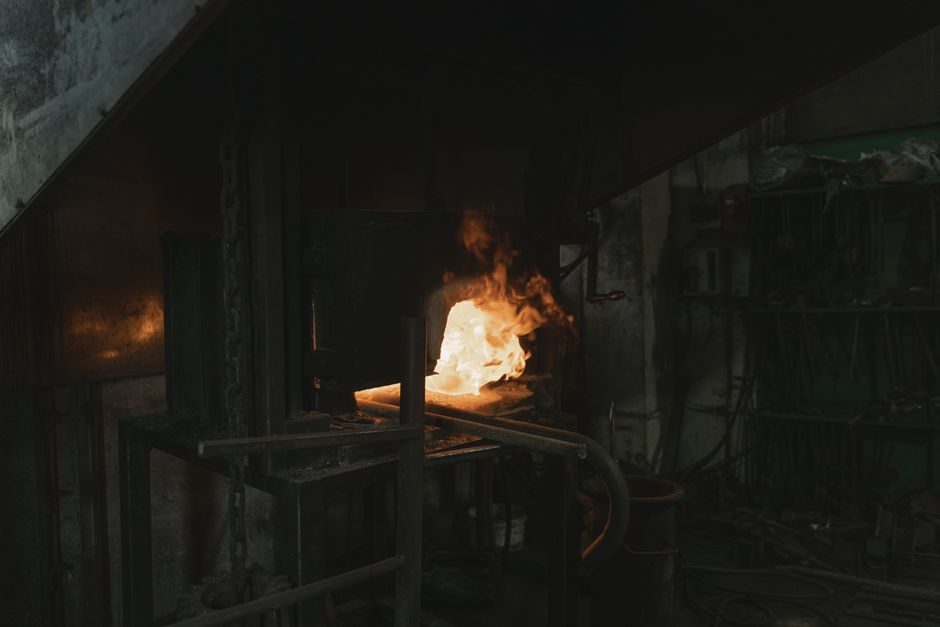
A 10-ton class line frequency (50/60 Hz) coreless induction furnace carries a 10-year total cost of ownership weighted toward refractory lining replacement, kWh-per-ton energy draw, and harmonic-mitigation capacitor banks, not the headline transformer-and-coil purchase price [S3][S5].
Line frequency units—still the default for large foundries because lower frequency yields deeper melt penetration—differ from medium-frequency (150-1000 Hz) coreless and channel furnaces on three cost axes: power supply topology, refractory wear rate, and plant-side electrical infrastructure [S3][S4].
Cost Driver 1: Power Supply Topology and Up-Front CAPEX
A line frequency coreless furnace uses the plant three-phase supply directly, stepped through a furnace transformer with switched capacitor banks for power-factor correction; the medium-frequency variant adds an AC-DC-AC solid-state converter to step line frequency up to the 150-1000 Hz range [S3][S7]. Line-frequency supply sections describe a main contactor, a switchable inrush resistor (surge current up to six times nominal), a balancing reactor with capacitors, and switched compensation capacitor banks tuned to operating load [S7]. The medium-frequency unit trades that switchgear for a thyristor or IGBT inverter, which shifts CAPEX into power electronics rather than into transformer copper and PF capacitor kVAr [S2][S7]. Channel-type line frequency furnaces from suppliers such as Otto Junker’s RWK range cover holding capacities from 10 t through 60+ t with a documented envelope and bath dimensions table that lets a buyer size the transformer and inductor pair to the melt rate target [S8].
Cost Driver 2: Energy Draw and Power Quality Penalty
Line frequency coreless furnaces are documented as poor power-quality loads: their rectifiers and switched capacitor banks inject harmonics back into the plant bus, and the inrush surge can hit six times nominal current at switch-on [S5][S7]. For a 10-ton class melt, the line-frequency option draws heavy reactive current at 50/60 Hz and requires switched PF capacitor banks; the medium-frequency option reduces the per-ton kWh by raising frequency, but the solid-state inverter itself generates harmonic distortion that must be filtered [S3][S4][S5]. Frequency choice sets heating rate versus penetration depth: 50/60 Hz penetrates deepest and suits large molten metal volumes, while 600-1000 Hz gives rapid temperature response for small batch coreless melts but needs thinner refractory and tighter coupling [S3][S4]. At the plant level this means a line-frequency install needs reactive-power compensation hardware sized in kVAr to the MVA rating, and may also force a utility-side harmonic study before the utility approves the connection [S5].
Cost Driver 3: Refractory Lining, the Hidden Multi-Year Spend
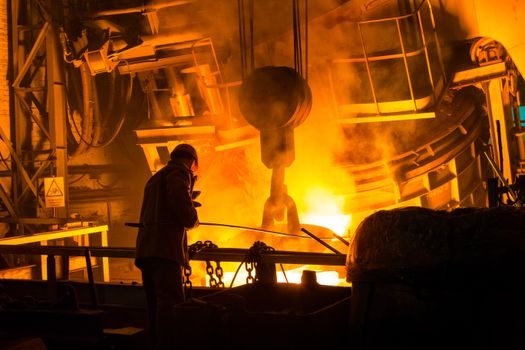
Refractory is the single largest recurring OPEX line in any coreless induction furnace regardless of frequency; coil-grout and ramming-mass selection drives campaign life more than any other wear part [S1][S9]. Commercial coil-clay products for medium- and line-frequency coreless coils are typically high-alumina mixes with Al2O3 ≥90%, SiO2 ≤4%, CaO ≤3%, refractoriness ≥1950 °C, installed by trowel and mixed with water; quoted trade prices in 2026 sit in the US $1,000-1,500 per metric ton band at one-ton minimums, with related ramming masses in the US $245-1,800 per ton band [S1]. The working lining between coil and melt typically fails first; high-alumina dry ramming mass with boric acid and neutral ramming mass grades are the standard campaign-life consumables, and the 10-year refractory bill commonly rivals the original furnace transformer cost over three to four full reline cycles [S1][S9]. For context on adjacent process equipment spend, see the spec-driven line frequency induction furnace overview and the induction furnace topology primer for how coil geometry and frequency choice tie to lining life.
Cost Driver 4: Cooling Water, Tilting Hydraulics, and Auxiliary Power
Every induction furnace—line or medium frequency—runs two separate electrical systems: a plant-supply branch for the cooling-water pumps, the hydraulic tilting cylinder, and the instrumentation loop, and a separate three-phase supply through a furnace transformer for the coil itself [S3]. The copper induction coil is hollow-bore water-cooled, and the cooling loop exchanges heat through a remote heat exchanger; pump, valve, and deionizer maintenance is a steady annual OPEX line that scales with furnace MVA, not with melt rate, so it disproportionately burdens small line-frequency units and large channel holders alike [S3][S8]. Channel furnaces in the RWK 10-60 t class show that holding duty is constant-energy, so water and hydraulic parasitic draw is amortized over a much longer idle-on time than a batch coreless furnace that powers down between melts [S8].
Comparison: Line-Frequency Coreless vs Medium-Frequency Coreless vs Channel
Three configurations compete for the same melt-rate slot, and the 10-year TCO ranking depends on duty cycle and melt weight. Line-frequency coreless (50/60 Hz) gives the deepest penetration and the simplest power supply but needs the largest PF-capacitor bank, draws the highest inrush surge (up to 6× nominal), and uses the most aggressive refractory grade [S3][S7]. Medium-frequency coreless (150-1000 Hz, solid-state inverter) cuts kWh-per-ton, slashes melt time, and is the preferred pick for small-batch automotive foundry work in the 150-300 Hz intermediate band, but adds inverter electronics and harmonic filtering to the bill [S2][S4]. Channel-type line frequency furnaces (RWK 10-60 t class) hold temperature with low energy draw between pours, but the channel inductor is a hard-to-repair consumable whose failure halts the entire furnace and dominates the 10-year OPEX for a holding-and-superheating duty profile [S8]. See the broader selection trade-off in Line-Frequency Induction Furnace Types and the adjacent capital-equipment maths in Casting Ladle TCO 2026.
10-Year TCO Math: How to Weight the Drivers
A defensible 10-year TCO model for a 10-ton class line frequency coreless furnace should sum four lines: (1) power-supply and switchgear CAPEX including PF capacitor bank and surge-limiting reactor; (2) transformer, coil, and cooling skid replacement at year 8-10; (3) refractory reline cycles, typically 3-4 campaigns at the per-ton coil-clay and ramming-mass rates; (4) annual energy at kWh-per-ton against local tariff plus harmonic-mitigation OPEX [S1][S3][S7]. Channel holders shift weight from (1) toward (3) plus an inductor rebuild line that is the dominant mid-life event [S8][S9]. Medium-frequency coreless shifts weight from (1) toward inverter electronics and harmonic filter CAPEX, while typically extending (3) lining life because the higher frequency allows a thinner, cooler hot face [S2][S9]. The trade-off between CAPEX and OPEX is the same logic a spec engineer uses on any process line—see the equivalent TCO model for materials handling in Pallet Stacker TCO.
Failure Modes and Operational Constraints
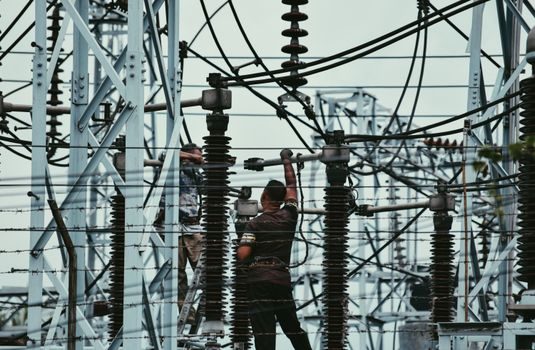
Line frequency coreless furnaces fail on three predictable paths: (a) refractory burn-through at the coil-grout interface when Al2O3-grade coil clay is substituted with lower refractoriness, typically below 1750 °C; (b) water-cooling circuit fouling that forces coil temperature to climb and accelerates copper-tube fatigue; (c) capacitor-bank contactor wear from frequent inrush surges, which in turn destabilizes PF correction and triggers utility penalty clauses [S1][S3][S7]. Channel furnaces add a fourth path—inductor channel refractory wash-out, which forces an emergency induction-channel rebuild and a 4-8 week outage, so a 10-year TCO must reserve a contingency line sized to one full channel rebuild event [S8].
Who Should Specify Line Frequency—and Who Should Not
Line frequency coreless is the right pick for foundries that melt 5-30 t per heat, run two or fewer heats per shift, and have an existing plant bus robust enough to handle 6× inrush; it is the wrong pick for high-mix job shops that need rapid alloy changeover, which favor medium-frequency coreless [S3][S4][S9]. Channel-type line frequency is the right pick for holding-and-superheating duty at 10-60 t scale, especially paired with a downstream continuous caster, but is the wrong pick for cold-melt-only operation where the channel inductor is never allowed to freeze without risk [S8][S9]. In all three cases the TCO verdict is the same: spec the lining grade and the PF-capacitor bank carefully, because those two lines decide whether the furnace earns or loses money over a decade [S1][S3][S7].
Next signals to track: 2026 refractory price movement for Al2O3 ≥90% coil clay and dry ramming mass, and any 2026 utility-side harmonic-limit revision affecting 50/60 Hz coreless installations above a defined MVA threshold.
The underlying component specifications are covered under total station.