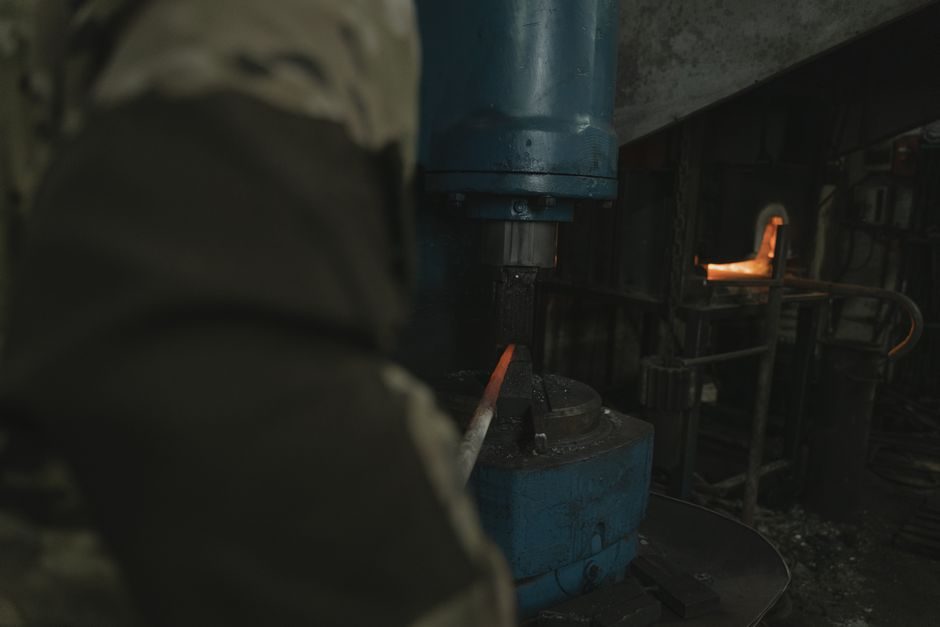
Line frequency induction furnaces (LFIF) operate on unrectified 50 Hz or 60 Hz mains through a step-down furnace transformer and a water-cooled copper coil, with the melt itself acting as a single-turn secondary [S2]. The defining spec is that the supply frequency is the grid frequency itself, so the skin depth in molten iron at 1500 °C stays around 70-80 mm and natural electromagnetic stirring stays gentle.
For context, the standard English-Chinese metallurgy glossary lists 工频感应炉 = "line frequency induction furnace" as a distinct class from 高频感应炉 (high frequency), and both sit alongside 直流电弧炉 (DC arc furnace) in the same metallurgical equipment family [S4]. Customs classifications for the control/instrumentation side of the package fall under HS 9032899099 with a 7 MFN tariff rate and 13 VAT rate in the Chinese import schedule [S1].
Where the Line Frequency Furnace Wins on Cost and Capacity
LFIF capital cost per ton of melt capacity runs materially below medium-frequency (MFIF, 150-1000 Hz) or thyristor-based medium-frequency units, mainly because the power supply is a conventional transformer rather than a solid-state inverter. For a 10 t iron-melting furnace, the transformer is sized in the 6-8 MVA range, and a single transformer can feed one or two furnace bodies through a changeover switch. Power factor is corrected with switched capacitor banks on the primary side to roughly 0.92-0.95 lagging, which keeps utility penalty charges low. [S2]
Heat efficiency for a well-stirred 10 t iron bath is commonly quoted in the 65-72% range at full power, and the furnace accepts a wide range of light and heavy scrap without the cold-start problems that plague smaller medium-frequency units. Because the melt volume is large relative to coil current, the bath surface stays relatively quiescent, which lowers magnesium or FeSi oxidation loss during ductile-iron treatment. Foundry buyers who run two or three shifts on cast iron, ductile iron, or basic carbon-steel scrap typically get the lowest per-ton melting cost from this configuration.
Where the Same Design Hurts: Stirring, Cold Start, and Refractory
The same skin depth that keeps cost down is also the furnace's biggest weakness. At 50/60 Hz the induced current hugs the bottom and side of the crucible, so electromagnetic stirring is weak, and a deep cold charge of light-gauge scrap tends to form a "bridge" that the arc from below cannot easily penetrate. Operators solve this by pre-loading fine scrap at the bottom and feeding bulky material last, but cold-start melt-down from a fully charged empty furnace is slow compared to a 250 Hz medium-frequency unit, which can be 20-30% faster on the first 30 minutes of a cold start. [S2]
Refractory life is the second concrete trade-off. The high circulating current in molten iron drives strong bottom erosion, and a typical acidic silica lining on a 10 t line frequency furnace lasts around 200-400 heats in severe service, versus 400-800 heats for a comparable medium-frequency coreless furnace. The stirring pattern also means dross and slag tend to migrate outward rather than self-desulfuring, so a separate desulfurizing ladle is often needed if low-S steel is the target. The encyclopedia reference on induction furnace and the related line-frequency furnace entry lay out the same trade-off in spec-sheet form.
Configuration Map: Coreless vs Channel-Type, and How to Pick
Two physical configurations dominate. The coreless (坩埚式) design is the workhorse for iron foundries: a water-cooled solenoid coil around a refractory crucible, melt capacities from 0.5 t to 30 t, and the entire body tilted for pour. The channel (有芯) design wraps a single-loop molten-metal channel around an iron core, achieves 90-95% electrical efficiency, and is used as a holding/duplicating furnace next to a primary melter, with typical channel unit sizes of 200-1500 kW feeding 5-200 t holding baths. Channel furnaces are not designed to melt from cold; they need a heel of liquid metal from another source. [S2]
A practical decision table for a process engineer:
- Material: cast iron / ductile iron / carbon steel scrap → line frequency coreless is usually the lowest cost per ton. Copper, aluminum, brass, or zinc → line frequency is the wrong tool; high-frequency or medium-frequency is mandatory because the higher resistivity and lower skin depth demand kHz-range drive.
- Batch size: above 3 t per heat, line frequency is competitive. Below 1 t, medium-frequency wins on flexibility, melt rate, and stirring.
- Operating pattern: 2-3 shift continuous operation favors line frequency because the power factor and the running efficiency improve with steady state. 1 shift with long cold soak favors medium-frequency because the cold-start penalty is much smaller.
- Utility: 50/60 Hz grid with a soft 10-20 MVA transformer budget → line frequency is the only practical fit. Sites with limited grid capacity or strict flicker limits should consider a medium-frequency VFD-driven supply because the inverter absorbs voltage disturbances.
Comparison Against Medium-Frequency and Arc Furnace Alternatives
On a like-for-like 10 t ferrous melt, line frequency coreless sits in the middle of three main options. Versus a 10-15 t AC EAF (electric arc furnace), the LFIF has much lower electrode and graphite cost, much lower flicker, and is silent enough to site inside an urban foundry; the EAF in turn wins on tap-to-tap time and on the ability to melt larger heavy scrap bundles. [S2]
Energy consumption benchmarks commonly cited for a well-run 10 t LFIF in continuous operation are 540-580 kWh/t of liquid iron, against 500-540 kWh/t for a 250 Hz medium-frequency unit and 420-470 kWh/t for a modern EAF. Those numbers shift with charge composition, slag practice, and power factor, but the LFIF is consistently on the higher-kWh side because the same 50/60 Hz supply that saves on capex also produces a deeper current penetration and more wall losses. For a process engineer sizing a new melt shop, the right question is rarely "is LFIF good?" but "is our duty cycle steady enough that line frequency's lower capex offsets its higher per-ton energy and refractory cost?"
Utility, Harmonics, and Grid Compliance
Because the LFIF draws through a transformer-rectifier-free path, it does not generate the high-order harmonics that a thyristor or IGBT medium-frequency inverter does, and harmonic compliance is much easier. The dominant grid issue is flicker from the cyclic load swings during meltdown, plus inrush on charge tipping. A 5-10 MVA line frequency furnace typically needs an in-plant capacitor bank sized at 30-50% of the transformer rating to keep displacement power factor above 0.90, and many utilities require a static VAR compensator (SVC) or synchronous condenser once total connected furnace load exceeds about 20 MVA at one site. [S2]
Cooling water is the other utility that often gets underestimated. A 10 t LFIF at full power needs roughly 35-50 m³/h of cooling water for the coil and the busbars, with a supply temperature below 30 °C to keep coil resistance losses and copper temperature within rating. Closed-loop cooling towers with plate heat exchangers are the usual solution, and the cooling skid is often the most expensive auxiliary after the transformer itself. For a practical auto-trolley feed and skim station buildout around the furnace, see the notes on automatic molding line and molding line integration on the spec site, since the conveyor and sorting downstream depend on a predictable tap-to-tap cadence.
Standards, Sourcing Reality, and What to Verify
Three reference families govern an LFIF build. Safety: IEC 60079 series applies where the charge includes magnesium or aluminum chips and the surrounding area is classified; grounding and protective bonding follow IEC 60364 and equivalent national wiring rules. Mechanical: the crane-lifted furnace body, the tilt hydraulic system, and the water-cooled coil are typically designed against national pressure-equipment and lifting codes. Efficiency and test: IEC 60076 covers the power transformer; the IEEE / national harmonic and flicker standards (e.g. IEEE 519) govern the point-of-common-coupling. Customs classification of the control instrument package landed in China falls under HS 9032899099 at 7% MFN with 13% VAT, as listed in the May 2026 schedule [S1].
For a sourced-from-China LFIF package going into an overseas foundry, the engineer should verify five items on the data sheet before signing: transformer MVA and impedance %, primary voltage and frequency (50 vs 60 Hz, both are real), coil cooling water flow and pressure drop, refractory lining material (silica, alumina, or magnesia-based), and tilt hydraulics pressure and stroke. A unit rated for 50 Hz will underperform or saturate the core on a 60 Hz grid, and vice versa, because the magnetizing current is frequency-dependent. For a melt-shop process engineer weighing a brownfield retrofit against greenfield, the underlying capex-vs-opex math is what decides it; if you are doing a one-shift job-shop with frequent alloy changes, a medium-frequency VFD-driven furnace will usually beat a line frequency unit on total cost of ownership. For a two- or three-shift ductile-iron or plain-carbon-steel operation with steady scrap input, line frequency remains the most economical electric melter on the market.
The next watch points to track: grid-side flicker limits tightening in some EU member states, which may push new builds toward SVC-equipped medium-frequency units even at 10 t scale; refractory-bond chemistry improvements that lengthen silica lining life on 50 Hz furnaces; and the gradual re-categorization of induction-furnace control electronics in customs codes as solid-state inverters displace more of the older transformer-fed installs. None of these change the fundamental answer, which is that line frequency induction furnaces are the right fit for high-tonnage ferrous melting on a steady duty cycle and the wrong fit for small batch, non-ferrous, or cold-start-heavy service. A look at how this melter slots into a wider production flow alongside automatic molding line and conveyor sorting line equipment rounds out the spec picture for a 2026 brownfield project.
Background reading: Food Processing Equipment Manufacturing: Process Map, Materials, and Selection Criteria.