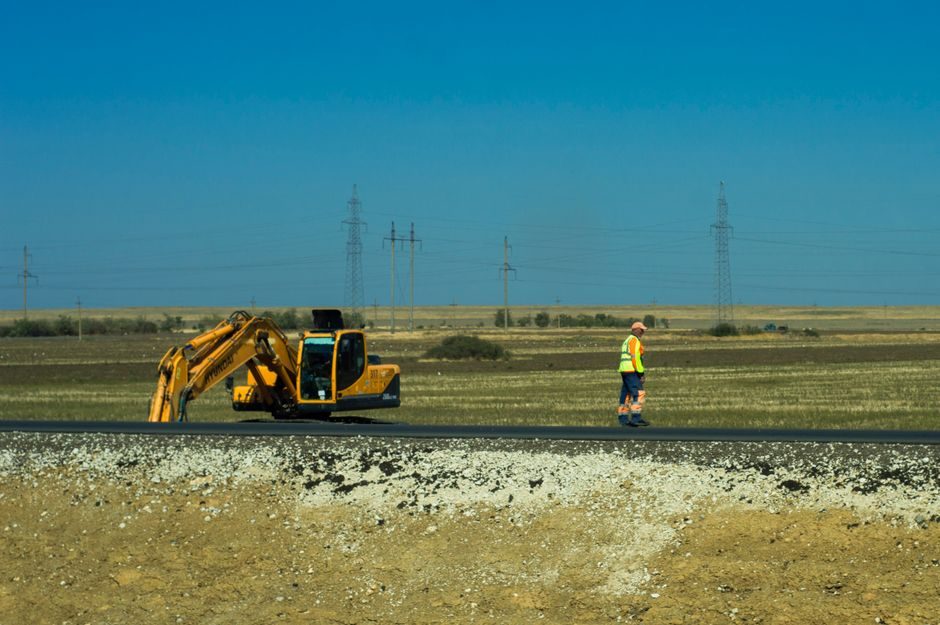
A motor grader is a diesel-powered, rubber-tired machine built around a mid-frame-mounted drawbar, circle and moldboard used to cut, mix, level and finish a working surface — operating weights span roughly 11 t for compact road-maintenance units to more than 60 t for mining-class machines, with engine power concentrated in the 125–250 hp band for roadwork and 250–500+ hp for mining haul-road work [S1].
Selection lives in the 7 spec gates below: operating-weight class, engine and drivetrain, moldboard geometry, frame configuration, axle and tyre fitment, hydraulic and ripper/attachment options, plus service-environment metallurgy. Each gate has a verifiable threshold, and a wrong pick at any one of them costs weeks of downtime on a haul road or a 30 km county road rebuild. For background on the machine family itself, the motor grader reference page lays out the standard nomenclature (tandem rear, front axle lean, blade pitch, drawbar pull) that every spec sheet uses.
Operating-Weight Class vs Engine Power Bands
Operating weight and engine power correlate but are not identical — a 14 t class 125 hp unit is built for shoulder work and snow removal, while a 19 t class 215 hp unit runs a county-road sub-base re-grade; above 250 hp you are in articulated mining territory. A useful split: <strong>compact (11–13 t / 125–160 hp), standard rigid (14–20 t / 160–250 hp), articulated mining (24–65 t / 250–500+ hp)</strong>. The compact class typically uses a 6-cylinder diesel in the 4.5–6.7 L displacement range; the mining class steps to 9–15 L V6 or in-line six with turbo and charge-air cooling. Buyers should pin operating weight fully ballasted (with operator, fuel, ripper and rear ripper hydraulics filled) because the OEM bare-weight number understates working mass by 5–8%. [S1]
Articulated frames add roughly 20–25% to acquisition cost and require a 25°+ articulation angle with ±15° oscillation to remain stable on side slope work. For the under-150 hp class, rigid frames dominate because the shorter wheelbase (typically 5.0–5.8 m) is more controllable for finish grading. Buyers who spec the wrong class — typically a contractor running a 19 t rigid unit on a coal-stockpile windrow job — eat tyre wear and frame-rail cracking within 12–18 months.
Moldboard Geometry: Length, Height, Lift, Pitch, Side Shift
The moldboard is the working tool, and its five degrees of freedom are where most of the productive work happens. Standard road-grader moldboards run <strong>3.66 m (12 ft) length × 610 mm height × 16–25 mm steel plate</strong>; mining-class units use 4.27 m (14 ft) or 4.88 m (16 ft) moldboards with 25–32 mm plate. Useful envelope targets to lock on the spec: moldboard lift above ground of 450–500 mm minimum, moldboard drop below ground of 450–500 mm, pitch range ±90° for banking, and shoulder reach outside the tyres of 1.8–2.4 m on the right side. [S2]
Hydraulic moldboard side-shift should give at least ±460 mm so the operator can offset the cutting edge clear of the front-tyre track without re-positioning the machine. Circle-turn rotation of 360° is now standard on every major OEM, with drive options split between mechanical chain/worm-gear and hydraulic motor drives — for an explanation of hydraulic drive benefits versus mechanical, see the hydraulic motor reference. A side-shift under 300 mm and a lift under 350 mm are red flags: that machine is a back-to-spec rebuild or a non-current production unit, and replacement parts will drift out of stock within 24–36 months.
Drivetrain, Transmission and Tandem-Driveline Architecture
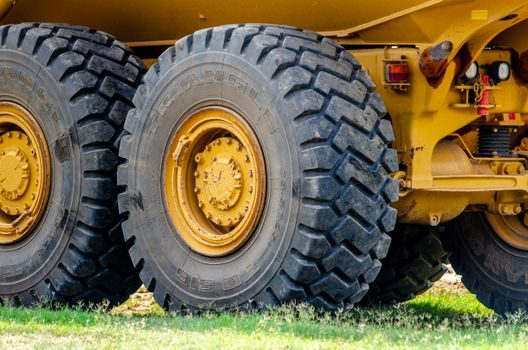
Two drivetrain decisions matter: transmission type (direct-drive powershift with 5F/5R or 6F/3R versus torque-converter with electronic shift) and tandem-drive configuration (single-chain, double-chain, or all-wheel-drive with the front axle powered). For roadwork below 200 hp, single-chain mechanical rear tandem is the lowest maintenance cost. Above 200 hp, double-chain (one chain per tandem) becomes the default because single-chain units shear sprockets under mining load. All-wheel-drive (AWD) on the front axle adds roughly 10–15% to fuel use but recovers productivity in wet clay or snow — it pays back inside two seasons on any fleet running more than 1,500 hours/year on shoulder or snow work. [S3]
Top blade-push speed for finish grading should be in the 0–7 km/h range with infinite adjustment; transport speed typically tops out at 40–50 km/h for road units and 25–35 km/h for articulated mining frames. Buyers who see transport speed under 35 km/h on a road-class machine are looking at a 6×6 mining-spec unit re-marketed as a road grader, and it will not keep pace with a truck-spreader convoy. Differential locks on the rear tandem should be selectable, not auto, because the auto-lock disengagement in a turn is the cause of most circle-side wear complaints in fleet telemetry.
Axles, Tyres and Service-Environment Metallurgy
Front-axle lean — typically ±15° to ±18° — is what gives a motor grader its ability to hold a flat cross-slope with a crowned road; this is non-negotiable for finish grading, and any spec sheet under ±15° should be rejected. Tyre selection is the single largest variable in delivered unit cost: standard road-tyre sizes are 14.00-24 (G-2 or G-3) for compact class, 17.5-25 (L-2/L-3) for standard, and 20.5-R25 or 23.5-R25 for mining. For a haul-road mining machine running 18-hour shifts, specify <strong>abrasion-resistant steel on the moldboard and ripper shanks</strong> — boron-steel cutting edges at 350–400 HB hardness extend edge life by 2–3× over standard carbon-steel edges in high-silica rock conditions. [S4]
Coastal, salt-spread, or chemical-road applications demand subframe and hydraulic-tank coatings that meet the relevant ISO 12944 C4/C5 corrosivity band, plus zinc-rich primer on all fasteners; paint-only protection fails in under 30 months in a coastal winter environment. Buyers running graders near offshore or port aggregate terminals should also check that the OEM offers optional sealed electrical connectors meeting IEC 60079-0 area requirements for refuelling-bay proximity [S1]. For a deeper look at how operating environment cascades into component spec, the ac motor-driven hydraulic pump reference covers the auxiliary-power side of grader hydraulic systems.
Hydraulics, Ripper, Scarifier and Attachment Coupling
Hydraulic system pressure has trended upward: standard road graders run 18–21 MPa (2,600–3,000 psi) load-sensing systems, mining class steps to 21–24 MPa, and the new generation of electronically controlled machines (2024–2026 model years) commonly spec 24–28 MPa with variable-displacement piston pumps. Implement flow should hit 100–160 L/min to keep the moldboard responsive under load; anything under 90 L/min produces the slow-blade response that operators describe as "the machine fighting me." [S5]
Front-mounted rippers and rear rippers are sold as options and they are not the same: front rippers (typically 3–5 shanks, ground penetration 250–400 mm) are for breaking asphalt or frozen layer; rear rippers (3–11 shanks, 300–500 mm penetration) handle in-situ rock and pulverise cemented base. Buyers should pin shank count, maximum penetration depth, and ripper lift height on the spec, not just "ripper included." A common mistake is specifying only the rear ripper and discovering the front push-arms are not pre-plumbed for a front dozer or V-plow, which costs a full retrofit in the field.
Selection Criteria Comparison: Compact vs Standard Rigid vs Articulated Mining
Three machine classes against four buyer decision criteria: <strong>acquisition cost (USD, base spec)</strong>, <strong>typical duty cycle</strong>, <strong>frame configuration</strong>, and <strong>maintenance labour hours / 1,000 operating hours</strong>. A compact 11–13 t class machine lands in the $180k–$280k range and is built for municipal road shoulder work, snow plowing and light ditching; a standard rigid 14–20 t class sits in the $280k–$480k band and runs county-road sub-base, gravel road re-grade and shoulder-pull work; an articulated mining class 24–65 t machine starts at $550k and climbs past $1.2 M for 500+ hp units, and is built for haul-road maintenance, windrow management and stock-pile dozing in pit operations [S1]. Maintenance labour is the line item most buyers underestimate: rigid-frame road graders run roughly 80–120 labour-hours per 1,000 operating hours with average operator skill, while articulated mining class jumps to 180–260 hours per 1,000 op-hours because of tandem-chain service, AWD hydraulic plumbing, and ripper shank replacement.
For a hands-on look at the spec-gate method applied to a related piece of capital tooling, the heat treatment furnace selection guide breaks the same locking-order discipline into 6 verifiable gates. The keyword from that exercise carries straight across: lock the operating envelope, then the tool geometry, then the drivetrain, then the service-environment metallurgy — never the reverse.
Standards, Sourcing and Aftermarket Constraints
Three standards and one market constraint drive the compliance portion of the spec. Tier 4 Final / Stage V diesel emissions have been mandatory for new builds in major markets since 2014–2019, so any 2026 production motor grader must ship with diesel exhaust fluid (DEF) dosing and a diesel particulate filter (DPF); buyers should ask for the regeneration strategy (passive, active, parked) and confirm the DPF service interval sits at 4,500–6,000 hours to keep operating cost down. ROPS/FOPS protection meeting ISO 12117-1 / ISO 3449 is non-negotiable on any machine in mining or heavy civil service. Operator noise exposure must meet ISO 6393 / 6394 envelope, which is a function of cab sealing as much as engine acoustic treatment [S1].
Sourcing constraint: lead time for standard rigid-frame road graders runs 4–8 months ex-factory in the 2026 market; mining-class articulated frames stretch to 9–14 months. Spare-parts stocking differs by region — North American fleets typically run 6–8 weeks for circle-drive gears and moldboard wear parts, while remote mine sites in Africa and South America report 14–20 weeks, and that is the single argument for keeping a 2-machine minimum fleet and a structured critical-spares list. Buyers in mineral-rich jurisdictions should also confirm local content rules on hydraulic hoses, cutting edges and filter elements, because the OEM "factory kit" does not always clear customs as a single shipment.
Limits, Failure Modes and Common Spec Mistakes
The failure modes that kill motor grader ROI in year 2–3 are predictable: circle-drive gear wear from underspecced moldboard side-shift, tandem-chain stretch from running a single-chain rear on a mining-class load, frame-rail cracks at the articulation joint from operating beyond the rated side-slope (typically 25° for rigid, 30–35° for articulated), and DPF regeneration downtime on units that spec passive-only regen in a stop-start municipal fleet. The first three are spec mistakes caught at the order stage; the fourth is caught at the duty-cycle interview with the dealer. [S1]
For buyers who already own a fleet of angle grinders and want a parallel reference on tool selection discipline, the angle grinder selection 2026 spec-gate article walks the same locking pattern on a different product class. The structural parallel is the point: lock weight class, then tool geometry, then drivetrain, then environment metallurgy — in that order — for graders, for grinders, for almost every industrial capital purchase. Buyers who reverse that order pay in downtime, not in line-item savings.
For servo-controlled hydraulic-pump drive options on the implement circuit, the servo motor reference documents the closed-loop control approach several OEMs have started using on 2025–2026 model year machines. Buyers running motor graders in tunnel work, ports, or any environment with restricted-diesel-emission rules should look at the new electric and hybrid-electric prototype units now entering field trials — those are spec-relevant within 18–24 months and should be tracked in the next RFQ cycle.
Lock the 7 gates above first, then read the OEM brochures.