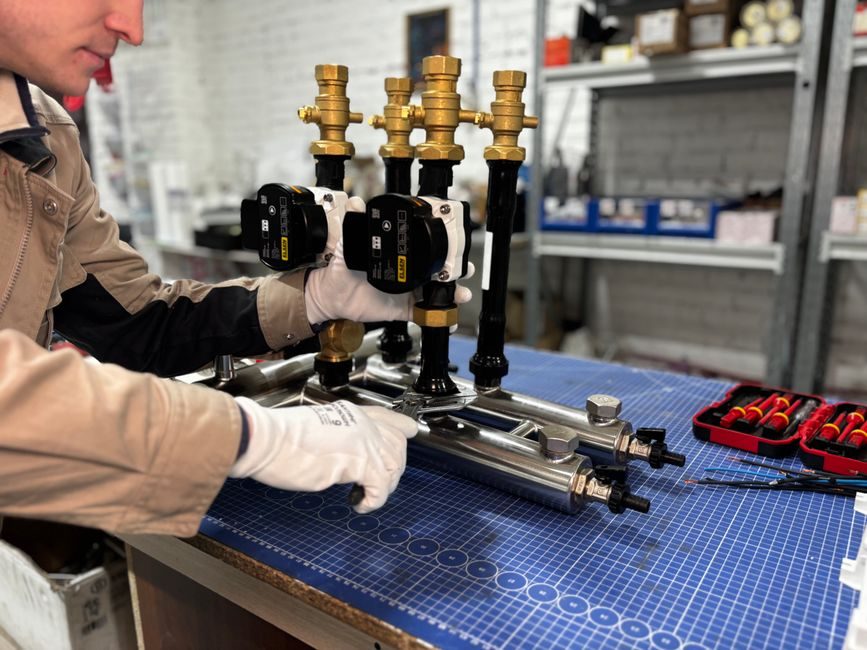
A plug valve is a quarter-turn isolation device whose closure element is a tapered or cylindrical plug with a bored passageway; a balancing valve is a throttling device engineered to set, measure, and lock a target flow rate in distribution loops, typically HVAC, chilled water, and district heating.
The functional gap matters at the BOQ stage: a plug valve is normally specified for line isolation, slurry service, or frequent cycling in oil, gas, and chemical lines, while a balancing valve is specified for hydronic balancing, fixed flow setting, and differential-pressure measurement. Specifying one in the other duty produces either poor flow control or unnecessary seat wear and seat leakage Class VI failure.
Functional Definition and Operating Principle
A plug valve closes by rotating a plug 90°, aligning the bore with the pipe for full open and perpendicular for full shut; the geometry gives a straight-through, low-turbulence flow path with minimal pressure drop when open [S2]. Typical published plug-valve ratings cover 0.15–0.25 in DN, 0–125 psi working pressure, and –29 °C to +71 °C media temperature for the pneumatic push-in A11 series catalog entry [S2]; industrial process plug valves from long-running Chinese makers reach ANSI Class 150–300 in carbon, alloy, and stainless bodies [S4].
A balancing valve combines a throttling element (often a piston or parabolic plug) with a handwheel, fixed-position memory stops, and usually a differential-pressure port pair for flow measurement; the SIMPLE VALVE D080-00500 ships as a piston balancing valve with handwheel, brass body, DN 0.5–2 in, and 16 bar (232.1 psi) maximum working pressure for water/oil/air distribution [S1]. The non-rising-stem Model 1710 uses a parabolic plug-shaped disc specifically to give a linear flow-versus-turn relationship for hydronic balancing [S3].
Closed-position bubble-tightness targets differ by design: plug valves are routinely specified to API 598 or FCI 70-2 seat-tightness classes; balancing valves are not required to provide zero-leakage shutoff and are usually installed in parallel with a ball valve or butterfly valve for isolation duty [S3].
Selection Criteria Mapped to the Two Products
Five decision levers separate a plug-valve spec from a balancing-valve spec: duty (isolation vs flow setting), Kv/Cv curve linearity, seat type, body pressure class, and measurement ports. A 90° plug gives an on/off characteristic with limited intermediate flow control; a balancing valve with a characterized plug or piston gives a near-linear Kv versus handwheel turns and locks at a fixed Kv after balancing [S1][S3].
Body pressure class anchors the comparison: the D080-00500 balancing valve is rated 16 bar (232.1 psi) in brass for HVAC distribution [S1]; the A11 pneumatic plug valve is rated 125 psi (8.6 bar) on a much smaller DN range [S2]; industrial ANSI 300 plug valves from NTGD extend to 740 psi (51 bar) WOG in carbon and stainless bodies for oil and chemical service [S4]. Matching the wrong product to line class either overspecifies the body cost or underspecifies the pressure containment.
Seat and lubrication drive a separate decision: lubricated plug valves use a sealant injection to reduce seat wear and tighten the shutoff in slurry or dirty service, while soft-seat plug valves (PTFE, RPTFE) target chemical and clean media at the cost of a lower temperature ceiling; balancing valves are typically metal-seat with EPDM or NBR O-rings on the measurement ports and a stainless stem [S1][S4].
Actuation: a plug valve is the natural fit for a quarter-turn actuator, pneumatic or electric, due to its 90° rotation [S2]; a balancing valve is almost always handwheel operated, with optional digital readout and a balancing computer interface, because the operator must read flow and lock the handwheel position [S1][S3].
Who Should Specify Each Valve

Specify a plug valve when the duty is on/off or infrequent throttling, the media contains solids, slurry, or two-phase flow, and the line is class 150–300 in a chemical, oil and gas, mining, or pulp-and-paper process [S4]. A11-type miniature plug valves fit instrumentation, pneumatic logic panels, and small actuator manifolds where the working pressure is below 125 psi and the temperature window is –29 °C to +71 °C [S2].
Specify a balancing valve when the duty is hydronic balancing across chillers, boilers, AHUs, fan-coil units, or district heating substations, the line is DN 15–50 (½–2 in), and the working pressure is below 16 bar [S1][S3]. They are also a common fit in low-temperature hot water (LTHW) and chilled-water (CHW) distribution where measuring and locking the design flow is the contractual requirement for commissioning.
For a comparable industrial isolation function on a clean process line, the same drawing usually calls for a ball valve or butterfly valve rather than a plug valve, and a separate check valve is added to prevent backflow; the balancing valve is then used in the distribution branch rather than the main loop [S5][S6].
Criteria-Based Comparison: Plug Valve vs Balancing Valve
Comparing on duty, body pressure, temperature, media, and measurement capability clarifies the BOQ line item: a plug valve is an isolation device with a 90° turn and a straight-through bore, while a balancing valve is a measurement-grade throttling device that requires a handwheel and a differential-pressure measurement port pair [S1][S2][S4].
Body pressure class: 16 bar brass (D080-00500) versus 125 psi miniature pneumatic (A11) versus 740 psi (51 bar) Class 300 industrial plug valves (NTGD) [S1][S2][S4]. Temperature: –29 °C to +71 °C for the A11 series; metal-seat balancing valves track the seal material, typically up to 120 °C for EPDM and 150 °C for FKM [S2].
Media fit: plug valves handle slurry, two-phase, and dirty process media when lubricated; balancing valves are designed for treated water, glycol mixtures, and low-viscosity oils in closed loops [S1][S4]. Measurement: a balancing valve includes ports for a differential-pressure meter and lockable memory stops; a plug valve is closed when the plug is perpendicular and gives no flow reading [S1][S3].
Standardisation: balancing valves for HVAC are commonly specified to EN 12267 (performance) and tested to EN 12266; industrial plug valves are specified to API 6D, API 599, or MSS SP-78 for the relevant body class [S1][S4].
Real Use Cases and 2026 Sourcing Snapshot

Process isolation, slurry line, and chemical dosing: an ISO 9001-certified Chinese plug-valve maker established 1999 supplies flange, threaded, three-way, lubricated, and jacketed plug valves in carbon steel, stainless steel, and alloy bodies to oil, gas, chemical, and mining customers [S4]. Buyers comparing industrial-grade plug valves, gate valves, and check valve lines from a single supplier frequently use Oubei Town (Zhejiang) manufacturers, one of which covers 20,000 m² with 150+ staff and is certified to ISO standards for ball, gate, globe, check, plug, and butterfly valves [S5].
Hydronic balancing in a 2026 commercial build: a DN 15–50 brass-body piston balancing valve at 16 bar covers fan-coil branch balancing, AHU coil balancing, and chiller/boiler primary-loop balancing, with handwheel adjustment and a memory stop to lock the commissioned Kv [S1]. For district heating and large chilled-water risers, the non-rising-stem parabolic-plug design (Model 1710-style) gives linear flow-versus-turn and a low handle profile to fit inside mechanical-room risers [S3].
For complementary cost/spec guidance on balancing-valve selection, the 2026 cost guide on Balancing Valve 2026 Price & Cost Guide: Body, DN, Kv and Cert Levers maps the body, DN, Kv, and certification levers that drive price. For isolation valves on the same hydronic and process lines, the Knife Gate Valve 2026 Price & Cost Guide: DN, Material, Seat and Actuator Levers gives a parallel spec cut for slurry and solids-handling isolation duty.
Limitations, Failure Modes, and Sourcing Standards
Plug-valve failure modes include seat scoring in unlubricated dirty service, stem packing wear in high-cycle duty, and cold-flow creep of PTFE seats above their rated temperature; the published A11 plug-valve envelope is restricted to –29 °C to +71 °C and 125 psi, so specifying it on a steam or high-pressure chemical line is a Class-A engineering error [S2]. Lubricated plug valves offset seat wear but require periodic sealant injection and a lubricant compatible with the media [S4].
Balancing-valve limitations centre on Kv drift, port leakage, and handle tampering: a balancing valve is not a shutoff valve, and an installer who closes it for branch isolation will see the design flow shift across the loop; a separate isolation valve, usually a ball or butterfly, is therefore installed upstream of every balancing valve [S1][S3][S6]. Differential-pressure port caps can leak if the EPDM or N seal is not replaced at recommissioning; factory default test pressure is typically 1.5× the PN rating [S1].
Cross-source standards: API 6D, API 599, and MSS SP-78 govern industrial plug-valve design and test; EN 12267 and EN 12266 govern HVAC balancing-valve performance and test; ISO 9001 is the baseline QMS requirement for both product lines, with the long-running Chinese valve manufacturers in the data set (NTGD, XHVAL since 1986, Number One Valve) holding ISO 9001 certification [S4][S5][S6].
For 2026 sourcing, the same Alibaba supplier pool listed for plug valves and balancing valves reports Western Europe at 50.0% and North America at 25.0% of revenue, with an 80.6% response rate, indicating a mature cross-border sourcing channel for both product categories [S6].