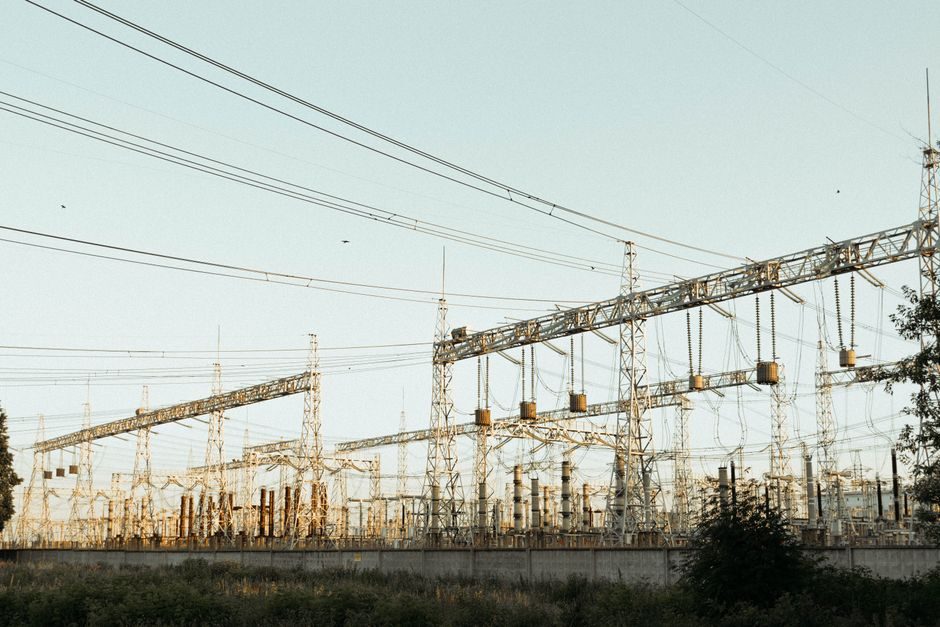
A low-voltage power distribution box is a coordinated assembly — enclosure, busbar, breaker compartment, and increasingly a metering/reactive-power node — and the wrong choice on any one of those sub-systems derates the whole panel. Treat enclosure class, Icw, busbar material, compensation topology, mounting format, and comms protocol as separate selection gates [S1].
For LV distribution-side specifiers, the unit typically sits downstream of a transformer (Dyn11 is the common vector group pairing for that upstream link, driven by line-to-ground fault isolation and harmonic behaviour [S2]) and upstream of final sub-circuits. The spec sheet has to defend itself at the procurement meeting against the installer's clamp-meter and the safety officer's megger, not the marketing brochure.
Enclosure Class and Mechanical Duty: IP, IK, and Sheet-Metal Gauge
IP rating is the first filter: indoor dry locations are typically IP44, wash-down food lines IP65, and outdoor pole-top or basement plant IP66 with a documented salt-fog or UV story [S1][S4]. IK10 (impact 20 J) is the typical mechanical-impact baseline for industrial floor installations, and is normally delivered through 1.5-2.0 mm cold-rolled steel fabrication with welded seams [S4].
Sheet-metal fabrication tolerances on stamped enclosures from mainstream Chinese suppliers cluster around the US$ 111-3,402 per-piece band for 1-piece MOQ runs of mid-format cabinets [S4]. Where stainless (304 / 316L) is required for corrosive atmospheres, expect a 30-60% premium versus mild-steel equivalents at the same gauge. The enclosure is also a heatsink: undersize it and the busbar thermal limit drops roughly linearly with available free-air volume around the conductors.
Short-Circuit Withstand (Icw) and Busbar Engineering
Most Asian-supplied LV distribution boxes are rated to Icw = 10-25 kA for 1 s at 400 V, with 35-50 kA options for the transformer secondary bus-tie case [S1]. Copper busbar at 10 mm × 60 mm handles roughly 630 A continuously in a typical IP44 wall-mount at 35 °C ambient; the aluminium equivalent needs a 1.5-1.7× cross-section increase for the same current.
Where the supply contains a VFD or large inverter cluster, the engineer should add a check for higher-order harmonic heating (typically 5th, 7th, 11th) and a neutral current derate — the same point that drives the Dyn11 vector-group preference upstream [S2]. A standard 1.0 service-factor busbar will run hot at 1.5× neutral current; K-rated transformers and 200%-rated neutrals are the upstream mitigations, not the distribution box itself.
Reactive Power Compensation and Power-Factor Targets
Integrated LV boxes such as the XPZW type bundle distribution and reactive compensation, sized by selecting the right capacity so the load-feed-point power factor settles at an "optimal level" rather than a fixed 0.95 [S1]. The practical default is cos φ ≥ 0.92 at the busbar to avoid utility penalty bands in most Asian and European tariffs; cos φ ≥ 0.95 unlocks bonus tariff tiers where offered.
Capacitor-bank staging matters more than total kVAr: 7-stage (6:2:1) banks are common, allowing the controller to step in <10% increments and avoid hunting. Detuned reactors (7% or 14% reactor p factor) are mandatory when the network has significant 5th or 3rd harmonic content — without them, capacitor + transformer inductance forms a near-resonant tank that amplifies harmonic voltage. The integrated vs separate-cabinet decision is partly about cable length between breaker and capacitor contactor; >3 m of cable requires line reactors or dv/dt filters on the capacitor bank.
Mounting Format: Pole, Wall, Floor, and Substation Integration
The XPZW-class integrated box is engineered for co-location with a distribution transformer on the same pole, on a separate pole, or wall-mounted, all with the same internal layout [S1]. Floor-standing cabinets generally start at 800 mm × 600 mm × 300 mm and scale up to 2000 mm × 1000 mm × 800 mm for 1600 A main-bus applications, with the distribution cabinet format used in indoor switchrooms.
Wall-mounts cap out around 250 A in most product lines; above that, weight and thermal mass push the specifier toward floor-standing or explosion-proof distribution formats for hazardous zones. Pole-mounts use stainless or hot-dip-galvanised enclosures with a minimum IP54 canopy; they should also be specified with a documented wind-load rating of 0.5-0.7 kN/m² for typhoon-prone regions.
Intelligent Monitoring, Communications, and Metering
The "intelligent" suffix on integrated boxes typically means a built-in multifunction meter plus a controller with MODBUS RTU (RS-485) or, on newer builds, MODBUS TCP / IEC 61850 over Ethernet [S1]. The minimum metering set the engineer should require: 3-phase voltage, 3-phase current, active/reactive power, power factor, frequency, and energy (kWh / kVArh) with at least Class 0.5S accuracy for revenue-grade applications.
Remote trip and load-shedding contact outputs are commonly used for utility demand-response programs; remote firmware upgrade and event logging with a 1-second time-stamp resolution are typical for grid-tied installations. Where a power distribution box is part of a wider plant, ensure the meter registers cleanly with the upstream SCADA gateway — most protocol-conversion pain is in the register map, not the physical layer.
Selection Comparison: Integrated vs Modular LV Distribution Boxes
Four options cover the bulk of LV specifier shortlists: (1) integrated pole-mount like XPZW, (2) modular floor-standing distribution cabinet, (3) explosion-proof distribution for Zone 1/2, and (4) packaged substation for outdoor 10/0.4 kV step-down. On installation footprint, the integrated pole-mount wins (≤1 m² ground area, no dedicated room) while the modular cabinet offers the best expandability. On Icw, modular cabinets reach 50-65 kA versus the integrated unit's typical 25 kA ceiling [S1]. On hazardous-area compliance, only the Ex-proof variant is acceptable for Zone 1/2 — the standard unit is implicitly NOT for those atmospheres. On lifecycle cost, integrated units save 15-25% on installed cost but lock the specifier into the OEM's capacitor and breaker families; modular cabinets accept third-party components throughout, with longer lead times as the trade-off.
Who Should NOT Pick the Standard Integrated Box
The pole-mount integrated design is wrong for any of: (a) total load current above 400 A sustained (thermal derate), (b) sites with significant VFD content and no detuned reactors (capacitor + harmonic resonance), (c) indoor floor-standing requirements where the distribution cabinet form factor is mandated, or (d) sites with ambient temperature above 40 °C without a derate letter from the manufacturer. For these, move to the modular cabinet or packaged-substation format. [S1]
Similarly, the standard sheet-metal enclosure is wrong for any location with sustained exposure to acid, alkali, salt spray, or explosive gas/dust. Reach instead for stainless-fabricated or explosion-proof distribution units with documented certification for the specific zone and gas group.
Spec-First Shortlist Logic for the 2026 Buying Cycle
For a new-build spec in 2026, the shortlist usually ends up as: integrated pole-mount for rural/light-industrial LV ≤400 A; modular floor-standing cabinet for indoor plant 630-1600 A; explosion-proof for hazardous-area LV; and packaged substation for greenfield 10/0.4 kV step-down. Cross-reference this against the Power Transformer Price & Cost Guide 2026 when sizing the upstream transformer and against the Fuse vs Motor Control Center piece when the outgoing feeders are predominantly motor loads. [S4]
A buyer who locks Icw, IP, and protocol on the first RFQ round will see cycle time drop by roughly a third versus a specifier who negotiates the enclosure last.