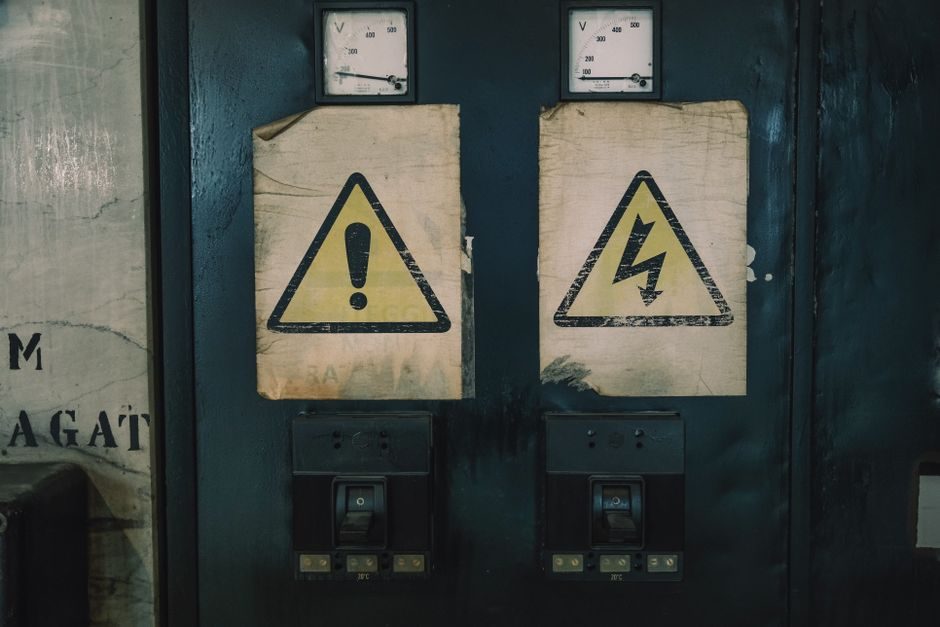
An isolating switch is rated by current, poles, and short-circuit withstand (e.g. HDT1 series modular isolators at 16-1600 A per [S4]), while a distribution cabinet is a complete enclosure integrating MCCB/ACB, busbar, surge protection and metering per the XGN66-12 platform footprint [S1]. Conflating the two is the single most common spec error on LV single-line diagrams.
The two products solve different problems: an isolator is a manually operated, off-load switching element that provides visible break distance and lockable safety isolation; a distribution cabinet is the metalwork + busbar + breaker + protection architecture that distributes power to multiple outgoing circuits. The decision rule is sequential — first design the cabinet's protection/branching scheme, then specify the isolator as the upstream or section disconnect.
Definition, Scope, and Functional Boundary
An isolating switch (also called a disconnector, load-break switch, or switch-disconnector) is a mechanical device that opens a circuit under no-load or specified load conditions, with a visible gap confirming isolation. LV models from the HDT1 family cover the modular DIN-rail format with ratings spanning 16 A to 1600 A, typically 3-pole or 4-pole with optional auxiliary contact, padlockable handle and fuse-link integration [S4]. HV three-column indoor disconnectors in the 12-40.5 kV class are quoted around US$290-320/piece on Made-in-China listings with manual grounding mode [S5].
A distribution cabinet, in contrast, is an integrated assembly rated by busbar current (e.g. 630 A, 1600 A, 4000 A), short-circuit withstand (Icw 25-65 kA/1s common, 80-100 kA for main switchgear), IP rating (IP30 to IP65), and form of internal separation (Form 1 to Form 4 per IEC 61439-2). The Saipwell XGN66-12 family states its footprint is "only 50% of the protection of ordinary switch cabinet," referencing compact breaker density rather than enclosure volume [S1]. This compactness comes from higher-density withdrawable or fixed-pattern compartments — a feature that no standalone isolator can replicate.
Selection Criteria: What Each Device Is For
An isolating switch is for: lockable visible isolation during maintenance, sectionalising of busbar zones, photovoltaic DC string isolation (e.g. Projoy DC isolator families) [S6], and as the main switch ahead of a single-load circuit. It is NOT for: overcurrent protection, branch circuit distribution, metering, or replacing an MCCB in a multi-outgoing panel.
A distribution cabinet is for: housing multiple outgoing circuits, integrating MCB/MCCB protection tiers, centralising metering, applying form-of-separation rules, and meeting switchroom footprint targets. It is NOT for: a single point-of-use isolation where no branch distribution is needed. For a deeper family-level walkthrough of the isolator side, see this spec-gate selection map on isolating switches and the paired piece on SPD vs switch-disconnector trade-offs.
Criterion-by-Criterion Comparison
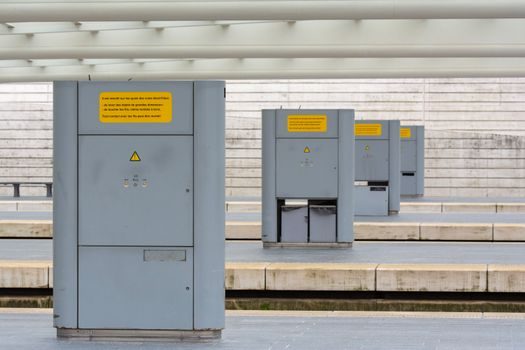
On functional scope, the isolator delivers one switching function (on/off, visible break) and the distribution cabinet delivers a full power-distribution node including protection, metering, surge protection and cable terminations [S1][S2]. On rated current, isolators scale to 1600 A in LV (HDT1 series) and 12-40.5 kV class in HV [S4][S5]; distribution cabinets scale by busbar rating, typically 630-4000 A with associated Icw short-circuit withstand. On standards, the isolator is governed by IEC 60947-3 (LV switch-disconnectors) and IEC 62271-102 (HV disconnectors); the distribution cabinet is governed by IEC 61439-1/-2 (LV assemblies) with switchgear variants under IEC 62271-200.
On cost and lead-time, a 1600 A HDT1 modular isolator is a single part with single-line wiring, while an equivalent rating inside a distribution cabinet is one of dozens of components plus busbar, enclosure, paint, plinth and certification. The cabinet typically dominates total cost by 5-10x. On integration, only the cabinet can host MCC compartments, motor control sections, and branch metering; the isolator cannot. For hazardous-area projects the enclosure side moves to explosion-proof distribution variants, while the isolator is replaced by ATEX/IECEx certified switch-disconnectors — the rule does not change: the isolator remains a component, the cabinet remains the assembly.
Who It Is For vs Who It Is Not For
Specifying an isolating switch is correct for: a PV string combiner requiring DC isolation to inverter inputs [S6], a single-motor feeder where a DOL starter already includes contactor+overload and only lockable isolation is missing, a bus-tie that must be openable for maintenance, and a generator changeover where visible break is mandatory. Specifying a distribution cabinet is correct for: a building's main LV room, a plant's MCC lineup, a data-centre PDU feed, a power distribution box feeding multiple floors, and any node where multiple outgoing circuits, selective coordination, and central metering are required.
Anti-patterns: do not specify a bare isolator as the only protection ahead of a sub-panel — the isolator has no overcurrent trip function, so a downstream short will not be cleared selectively. Do not specify a distribution cabinet to solve a single-circuit isolation problem — that is over-engineering and inflates cost and footprint. Do not use a distribution cabinet without a main incoming isolator/disconnector if local regulation requires a lockable main switch for the assembly.
Real Use Cases and Limitation Boundaries
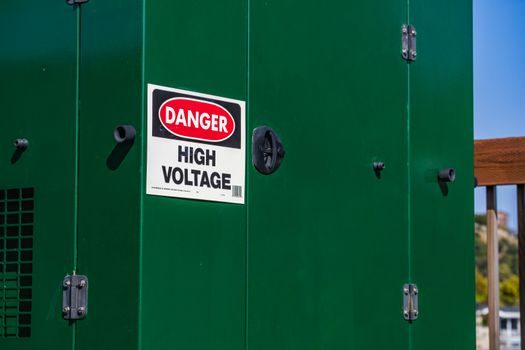
A rooftop PV combiner upstream of a 50 kW string inverter typically uses a DC isolator rated 600-1000 V DC, 32-63 A, with padlockable handle and arc-quenching chambers sized for DC (not AC) switching [S6]. This is the isolating switch domain. The downstream AC side of the same system lands in a distribution cabinet that hosts the inverter AC breaker, surge protection (commonly Type 1+2 SPD per LEEYEE catalog [S2]), energy meter and outgoing MCB tiers to sub-loads.
Limits: an isolator cannot break a short-circuit current on its own — it relies on an upstream breaker (or fuse-link in the HDT1 fuse-combination variant) to clear faults. A distribution cabinet cannot be installed without first defining its Icw, IP, form-of-separation and busbar current; if these are not declared, the assembly is non-compliant with IEC 61439-1 and cannot be CE/CCC marked. For harsh-environment installs, the cabinet moves to IP54-IP65 enclosures and may need stainless steel or GRP (fiberglass) housings — the isolator inside is still a single component and inherits only the IP of its own housing, not the cabinet's.
Sourcing, Standards, and Trackable Signals
Suppliers to monitor for current product data: Saipwell (XGN66-12 cabinet platform with GCS/GCK/MNS compatibility) [S1]; LEEYEE (Wenzhou, founded 2009, 8000 m² R&D centre, in-house 160 kA 8/20 µs and 30 kA 10/350 µs surge test capability for SPD/isolator verification) [S2]; Made-in-China.com HV isolating switch factory listings aggregating Zhejiang OEMs with drop-out fuses, lightning arresters and vacuum breakers in the same product mix [S3]; HUAJIA Electric (HDT1 modular isolator range, NT HRC fuse-link compatibility) [S4]; Projoy Electric (Suzhou, 2011, DC isolator specialist for PV) [S6].
Standards to keep on the desk for the next spec cycle: IEC 60947-3 for switch-disconnectors, IEC 62271-102 for HV disconnectors, IEC 61439-1/-2 for the LV assembly that the isolator is mounted into, and IEC 60079 for any hazardous-area isolator variants. A reliable procurement signal is whether the cabinet supplier publishes a heat-rise and Icw test report per IEC 61439-2 — a 2025-08 review of one catalog shows 50%-footprint claims but the underlying test data sheet is the item to demand [S1]. A second signal is the surge lab footprint: LEEYEE's combined 160 kA/30 kA/0-20 kV bench [S2] is the kind of in-house verification capability that separates a spec-grade isolator/SPD from a private-label relabel.
For related signal-routing hardware in adjacent cabinet builds, a practical cost reference is the Industrial Ethernet Switch Price & Cost Guide 2026, and the Remote I/O Module vs Industrial Ethernet Switch spec-driven selection piece lines up against the same control-cabinet side of the same enclosure.