Programmable DC power supplies specified for structural-fabrication sites, from welding bays and shot-blast rooms to paint-curing ovens, must clear four distinct evidence layers: electrical safety, EMC, environmental endurance, and process-specific calibration, and the audit fails when any layer is missing the standard's part number and edition [S4].
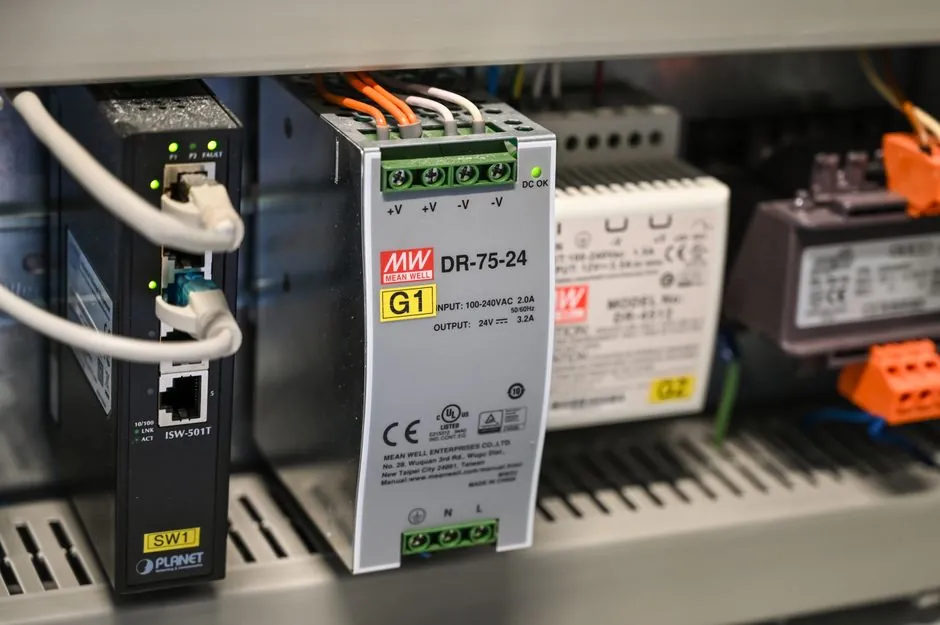
The power class drives the evidence depth: bench units in the 50 W to 1 kW band dominate ATE and burn-in racks, while slim 10 W to 100 W DIN-rail models feed PLCs, sensors, and HMIs on the same fabrication line, and both classes must show isolation, efficiency, and thermal derating in the supplier datasheet, not just on a brochure slide [S4].
Layer 1, Electrical Safety Evidence and CB or UL Scheme Acceptance
Safety evidence starts with IEC 61010-1 for measurement and laboratory equipment, and a CB Test Certificate accepted by most national schemes is the baseline for the EU, China, and ASEAN audits, while a power supply that ends up wired into an industrial control panel also needs UL 508 (US) and cUL (Canada) listing as the second-pair requirement [S4].
Reinforced insulation at 4000 V AC is the published benchmark for SELV compliance on 24 V DIN-rail families, and a 2500 V AC basic-insulation rating on the same rail is a red flag during a factory audit because SELV relies on reinforced isolation to keep the operator side safe under single-fault conditions [S4]. The supplier certificate must show the test-house name, report number, and standard edition; suppliers usually document over-voltage protection (OVP), over-current protection (OCP) trip curves, and any SCR crowbar or fold-back behaviour in a "Safety, EMC, and Environmental Compliance" appendix of the datasheet, and remote-sense terminals belong in the same evidence pack [S4].
Layer 2, EMC, Harmonics, and Surge Immunity Documentation
EMC evidence covers both emissions and immunity, with EN 61000-6-2 (industrial immunity) and EN 61000-6-4 (industrial emissions) being the common pair for a programmable DC power supply, and EN 61000-3-2 power-factor and harmonic-current compliance is mandatory for any unit drawing more than 75 W from the public mains, which is why active-PFC designs are the standard engineering answer rather than a marketing feature [S4].
The supplier's Declaration of Conformity must list every harmonised standard tested, the test-house accreditation number (A2LA or DAkkS, for example), and the report date within the last three years; a DoC that names "EN 61000 family" without a part number and edition is incomplete and gets rejected by a notified-body review, so procurement should refuse it on first pass [S4]. For units installed near variable-frequency drives or welding inverters, surge and burst immunity per IEC 61000-4-4 and IEC 61000-4-5 should be requested separately, because these are not always in a generic DoC and are the first items flagged on long cable runs that share busbars with thyristor-based equipment [S4].
Layer 3, Thermal Endurance Under IEC 60068-2-2 Dry Heat
Thermal endurance is where most certification packs fail, because datasheets quote a 0 to 50 °C operating range without showing the IEC 60068-2-2 dry-heat derating curve, so the supply must show continuous full-load operation at the worst-case ambient plus any manufacturer-stated derating, especially on a fabrication line where paint-oven controls and welding-rectifier rooms push the cabinet past 50 °C in summer [S4].
A practical test pattern is to confirm full-load burn-in at the maximum-rated ambient for at least 96 hours, then cross-check the reported case-temperature rise against the manufacturer's derating chart; if the supplier cannot produce a curve, the dc power supply is functionally uncertified for that environment, regardless of the rest of the evidence pack. For structural-fab work, the cabinet specifier should also tie this to the broader DIN-rail selection logic captured in the industrial DIN rail power supply selection reference, which is the same derating discipline applied at a smaller footprint.
Layer 4, Process-Specific Calibration and ISO/IEC 17025 Traceability
Calibration is the layer most often treated as a checkbox, and it is the layer that catches the audit when a fabricator ships a non-conforming beam, so voltage and current programming accuracy must be traceable to a national standard through an ISO/IEC 17025-accredited lab, and the calibration certificate must state the measurement uncertainty, the reference standards used, and the environmental conditions during the test [S4].
A practical quality benchmark for procurement: a quality bench linear supply delivers ≤1 mV RMS ripple, ≤50 µs recovery to within 0.1% after a 50% load step, and ≤0.02% + 5 mV programming accuracy at full scale, while a 1U switching supply at the 1.5 to 5 kW level typically specifies 0.05% + 10 mV programming accuracy, 1 to 10 mV RMS ripple, and 1 to 2 ms load-step recovery [S7]. When the supply feeds a programmable logic controller on the same fabrication line, the analog output of the supply and the PLC analog input should be cross-calibrated in the same loop so that setpoint error compounds do not exceed the welding or curing tolerance band, and a switching power supply topology is acceptable here provided the ripple and recovery numbers above are documented and met.
Structural-Fab Specific Use Cases and Power-Class Bands

Structural-fabrication shops typically split into three power bands, and each band pulls a different cert evidence pack: 200 W to 1500 W bench units for fixture power and prototype weld testing, 1.5 kW to 7.5 kW 1U rack supplies for ATE and inverter HIL testing, and 10 kW to 60 kW modular cabinets for production welding-rectifier simulation and battery-formation test rigs that mirror fab process current profiles [S5][S6]. Configurable modular families in 1U height with 1.5 kW to 5 kW per slot are a common fit for fab ATE racks because they scale to higher power without re-doing the safety and EMC evidence pack, and they are explicitly designed for industrial compliance [S2].
At the high-power end, industrial 15 kW modular units with 3-phase 400 V AC ±20% input, 0 to 1000 V / 0 to 500 A programmable output, and IP21 ingress protection are common for battery-formation and electric-vehicle research lines that share cabinet space with fab process power, and SiC-based topologies dominate the >10 kW class because the efficiency gain matters more than the BOM saving at that scale [S8]. A comparison table clarifies the cert-relevant difference between power classes on a fab floor:
Bench linear, 50 W to 1 kW: ≤1 mV RMS ripple, ≤0.02% + 5 mV programming accuracy, IEC 61010-1 baseline, EN 61000-6-2/6-4 EMC; best fit for fixture power, prototype weld testing, sensor excitation [S7]. 1U switching, 1.5 kW to 5 kW: 1 to 10 mV RMS ripple, 0.05% + 10 mV programming accuracy, same safety and EMC baseline, plus IEC 61000-4-4/4-5 surge; best fit for ATE racks, inverter HIL, multi-channel fab test [S2][S7]. Modular cabinet, 10 kW to 60 kW: 3-phase input, paralleled cabinets, IEC 61010-1 plus UL 508, EN 61000-3-2 mandatory above 75 W input, IP21 minimum; best fit for production welding-rectifier simulation, battery-formation rigs [S5][S8].
Common Failure Points During a Fab-Floor Audit
The audit fails first on missing standard edition dates, because a DoC that names IEC 61010-1 without the edition is treated as undated evidence and is rejected by notified bodies, and the same rule applies to EN 61000-6-2 and EN 61000-6-4 [S4]. The second failure mode is thermal derating, because the worst-case ambient on a fab floor in summer typically exceeds 45 °C near paint-curing ovens and welding bays, and a 0 to 50 °C datasheet spec with no curve is treated as not-validated for the installed environment [S4].
The third failure mode is surge immunity on long cable runs, because welding inverters and VFDs share busbars with the supply and inject IEC 61000-4-4 burst and IEC 61000-4-5 surge events that a generic EMC DoC does not cover, so the auditor flags it on the first pass and the supply has to be re-quoted or re-tested [S4]. The fourth failure mode is calibration traceability: certificates that do not list ISO/IEC 17025 accreditation, measurement uncertainty, and reference standards fail the layer-4 evidence check, and the fab specifier must insist on all three in the supplier's QA pack before signing the PO [S4].
Verifying Supplier Certificates Are Real and In Scope
Three checks close the loop on a supplier cert pack: first, the cert number must be searchable on the issuing body's online registry, because CB certificates, UL listings, and TÜV reports all have public lookup tools that confirm the report is active and matches the exact model code on the supplier's datasheet [S4]. Second, the harmonised standard part number and edition on the DoC must match the report, and the report date must be within the last three years, because a five-year-old report on a "current" supply is a known red flag in EU CE marking enforcement [S4].
Third, the test-house accreditation scope must cover the standard being claimed, which is checked against the A2LA or DAkkS scope of accreditation rather than just the lab's general ISO 9001 registration, because a lab accredited for one product category is not automatically accredited for power-supply safety or EMC testing [S4]. The same discipline of verifying third-party safety certification applies to adjacent equipment on the same fab floor, including the loop-impedance testers that maintenance uses to verify welding-rectifier grounding, which is covered in the loop impedance tester certification checklist for spare part sourcing reference, and the selection logic for floor grinders used in steel-construction prep in floor grinder specs for steel construction.
For procurement, the next node is a tracked signal: the IEC 61010-1 edition cited on supplier DoCs versus the edition the fab's notified body accepts, and any divergence flagged before the next PO is signed; second, the share of active DoCs that include IEC 61000-4-4 and IEC 61000-4-5 surge immunity numbers in the same pack, because that number is the leading indicator of which suppliers will pass a fab-floor audit on the first pass.