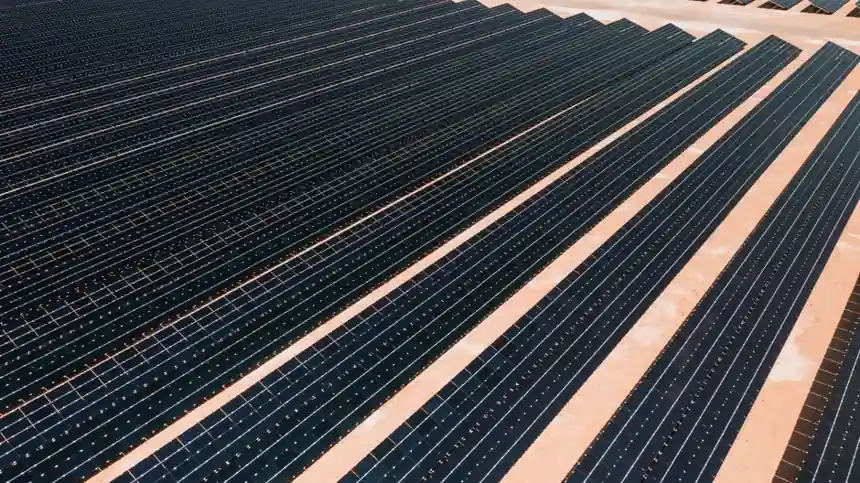
Photovoltaic procurement in 2026 rewards buyers who lock the engineering envelope first and the price second, because module wattage, inverter topology, and battery sizing interact directly with grid-code compliance. Global installed PV capacity reached 627 GW by end-2019 after 115 GW of new builds in that single year, with solar PV supplying roughly 2.8% of worldwide electricity and 24.6% of new-energy generation [S1]. That installed base is the pool today's procurement decisions either retrofit or extend.
A working spec stack for a utility-scale or C&I PV-plus-storage project has four binding choices: PV module technology (mono-PERC, TOPCon, HJT, or BC), inverter class (string vs. central, with or without VSG/grid-forming firmware), BESS chemistry and power-energy ratio (typically 0.5C to 1C), and the grid interconnection standard (IEEE 1547-2018 categories, IEC 61727, IEC 62116 for anti-islanding, plus regional grid codes). Each choice cascades into the next, so a buyer who picks a 1500 V central inverter before sizing storage will overpay for the DC-coupled architecture if the plant is later run as a PV-BES with VSG control.
Module and Inverter Pairing: Where the Spec Decisions Actually Bite
The 2019 capacity mix shows PV is no longer a niche generation class, with solar reaching 10.7% of total generation in Honduras, 8.6% in Italy, 8.3% in Greece, 8.2% in Germany, and 8.1% in Chile [S1].
For procurement, this means the inverter shortlist should filter on three concrete criteria: DC input voltage window (1000 V vs. 1500 V architecture), grid-forming firmware capability (VSG, droop, or virtual oscillator), and reactive power range at night (typically 0.95 lead/lag to 1.0 pf). Mono-crystalline modules at 21% to 23% efficiency and TOPCon at 23% to 25% efficiency are the current utility-scale defaults, with HJT and back-contact (BC) products entering procurement at premium pricing.
Virtual synchronous generator control has become the default grid-forming method for PV-battery systems because it lets an inverter emulate the swing equation of a real synchronous machine, suppressing frequency and power fluctuations without a microgrid central controller [S1].
Battery Storage Sizing: Power-to-Energy Ratio Drives CapEx
Battery energy storage system (BESS) sizing interacts with the PV array size through the DC/AC ratio and the desired duration of ride-through, so the procurement spec must state both the power rating (MW) and the energy capacity (MWh) separately. A common 0.5C configuration means a 100 MW / 200 MWh BESS, while a 1C configuration is 100 MW / 100 MWh, and the choice between them depends on whether the project is targeting energy shifting (favouring 0.25C to 0.5C) or frequency regulation (favouring 1C to 2C with shorter duration). [S1]
The research on PV-battery-diesel microgrids shows the BESS converter is the active element that holds frequency stable when a diesel genset steps in, with VSG virtual inertia and virtual damping designed using the rotor motion equation of a synchronous generator, primary frequency regulation, and voltage-reactive droop [S2]. For procurement, that translates into a hard requirement: the BESS power-conversion system (PCS) must expose inertia and damping parameters as settable fields, not locked firmware constants, so the plant controller can tune them against the diesel step-response characteristics.
For islanded or weak-grid builds, a PV-battery-diesel hybrid is the baseline architecture because the diesel genset handles the long-duration energy balance while the BESS handles the sub-second to multi-second inertia gap [S2]. The buyer should specify that the BESS state-of-charge (SOC) window for normal operation is roughly 10% to 90%, with a deeper discharge envelope (down to 5% SOC) only for emergency frequency support, to keep cycle life within the warranty envelope of typical LFP cells (commonly 6,000 to 10,000 cycles at 80% depth of discharge).
Control Strategy Selection: VSG, Droop, and Mode-Switching
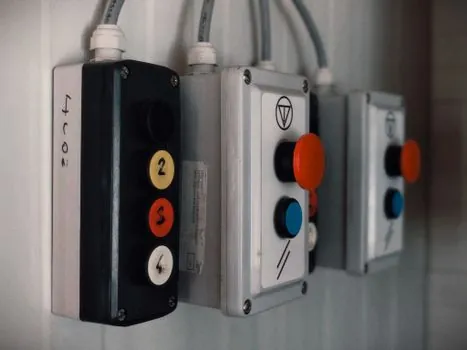
Three control families dominate PV-battery plant tenders: conventional current control with mode switching, droop control, and virtual synchronous generator (VSG) control. The mode-switching approach (off-grid voltage-source mode, grid-connected current-source mode) is simple but creates a short-term power-fail at the local load during unexpected grid faults, which is unacceptable for any plant with a process-critical downstream load [S1].
Droop control is the workhorse for peer-to-peer AC microgrids, but it does not inherently provide inertia, so on a low-inertia islanded microgrid the frequency still droops faster than the diesel genset can compensate [S2]. VSG control embeds the synchronous generator swing equation into the inverter firmware, which delivers both virtual inertia and virtual damping, and it does not require a microgrid central controller, so each VSG runs independently and the system tolerates communication-link failures that hierarchical control cannot [S1][S2].
For grid-tied PV-BES plants the engineering literature recommends a united VSG control strategy that adjusts the VSG active power output by shifting the primary frequency droop setpoint, so the same control law covers both grid-connected and off-grid operation without a hard mode switch [S1]. Procurement language should require the inverter vendor to demonstrate seamless off-grid transition in a factory acceptance test, not just paper-spec compliance, because mode-switching artefacts are the single most common field failure in PV-battery plants.
Access Planning and Voltage Regulation: The Distribution-Network Layer
Distribution-level PV procurement must include a planning step that most buyers skip, namely the scenario-based hosting-capacity study that compresses irradiance and load scenarios into a tractable set before solving the access-planning optimization. A 2018 study on IEEE 33-bus distribution networks used an improved clustering evaluation index to reduce the scenario set while preserving irradiance-load correlation, then solved a bilevel model where the upper layer optimizes PV access capacity and the lower layer runs the voltage-regulation strategy, with the Pareto front resolved by non-dominated sorting genetic algorithm II (NSGA-II) [S3].
The buyer-facing output of that methodology is a hosting-capacity curve per feeder, with a hard MW limit beyond which voltage rises above the ANSI C84.1 range B upper bound (126 V on a 120 V base) or the equivalent IEC 60038 low-voltage limit. Procurement teams writing a multi-site programme should pre-clear each candidate feeder with a hosting-capacity study before issuing the module-inverter RFP, because the cost of curtailing or storage-pairing a site after the panels are ordered is several multiples of the cost of pre-clearing.
Reactive-power coordination between the distribution company and the PV operator is the second non-obvious procurement input, because the bilevel model's lower layer is the voltage regulation strategy and the upper layer is the PV access capacity, and the two are coupled through reactive-power exchange [S3]. The RFP should require the inverter to operate across the full reactive-power range (typically 0.85 lead to 0.85 lag power factor at rated active power) and to support volt-var and volt-watt functions per IEEE 1547-2018, so the same hardware serves both the access-planning objective and the voltage-regulation objective without a field retrofit.
Hybrid Wind-PV-Storage: Active-Power Control Reference Architecture
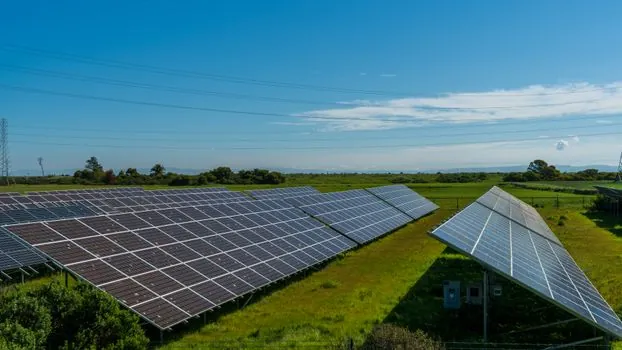
For hybrid wind-PV-storage plants at utility scale, the reference architecture is a coordinated active-power control strategy that binds wind and PV output to a smoothed target and decouples the BESS to handle state-of-charge recovery, validated on China's national wind-PV-storage-and-transmission demonstration project at Zhangjiakou, which is operated by State Grid Xinyuan Company and engineered by NARI Group [S4]. That reference architecture is now mature enough to copy directly into procurement specs without re-inventing the control law.
The key control features a buyer should hard-spec are: a smooth-control output filter on the wind+PV sum (typically 1 min to 10 min time constant), a target-tracking mode that follows the dispatcher's AGC setpoint, a frequency-regulation mode that uses the BESS for primary frequency response, and a coordinated mode that holds BESS SOC within a configurable band (commonly 30% to 70% for daily cycling, wider for emergency reserve) [S4]. The plant controller must hand off between independent and complementary control modes without a trip, and the SOC feedback loop must close at the plant level, not at each inverter, to prevent the wind, PV, and BESS units from fighting each other for the same headroom.
Procurement language for hybrid plants should reference the demonstrated Zhangjiakou architecture, because the same NARI-style plant controller is shipping in commercial form from several Chinese OEMs and the field-validated control parameters cut commissioning risk. For a more detailed walk-through of how a spec-first approach applies to adjacent capital-equipment buys, see the cupola furnace selection for energy equipment buyers guide, which uses the same lock-the-spec-then-price discipline for thermal equipment.
Procurement Risks, Failure Modes, and Verifiable Acceptance Tests
The four most common field failures in PV-battery plants, in order, are: (1) mode-switching transients when the grid faults and the plant unexpectedly islands, (2) BESS SOC drift when wind, PV, and storage fight for the same power headroom, (3) inverter reactive-power shortfall at night when the PV array is offline but the grid still needs VAR support, and (4) hosting-capacity violation on the distribution feeder causing voltage rise above the regulatory ceiling. Each of these is a specification gap, not a hardware defect, and each is caught by a factory or site acceptance test that the buyer must write into the contract before signing. [S1]
For a procurement programme that spans dozens of sites, standardising the FAT/SAT protocol across vendors is the single highest-leverage cost lever after module pricing.
For buyers cross-sourcing batteries alongside PV, the EV battery sourcing from China: spec map, vendor tiers, 2026 checklist guide covers the LFP cell vendor landscape and the same spec-first discipline, while the moisture analyzer certification checklist for emissions sampling systems piece is a useful reference for the instrument-certification layer of any plant that needs CEMS-grade monitoring on the DC bus.
What to Track After Award: Three Verifiable Signals

Three post-award signals tell a procurement team whether the spec is holding. Second, the BESS round-trip efficiency measured on site at the 0.5C rate should land between 88% and 92% for a modern LFP system; below 87% points to undersized PCS or a thermal-management gap. Third, the plant controller's mode-switching time during the grid-fault test should be under 200 ms for a VSG plant; anything over 500 ms indicates a hierarchical-control hangover that the spec failed to exclude. [S1]
Buyers running a 2026 PV-plus-storage procurement should treat module wattage, inverter topology, BESS sizing, and grid-code compliance as a single locked spec stack, not four separate RFPs, because the pressure transmitter and flow meter decisions on the downstream balance-of-plant ride on the same plant-controller architecture and the same FAT/SAT discipline.
Spec-level background on the components involved: linear guide.