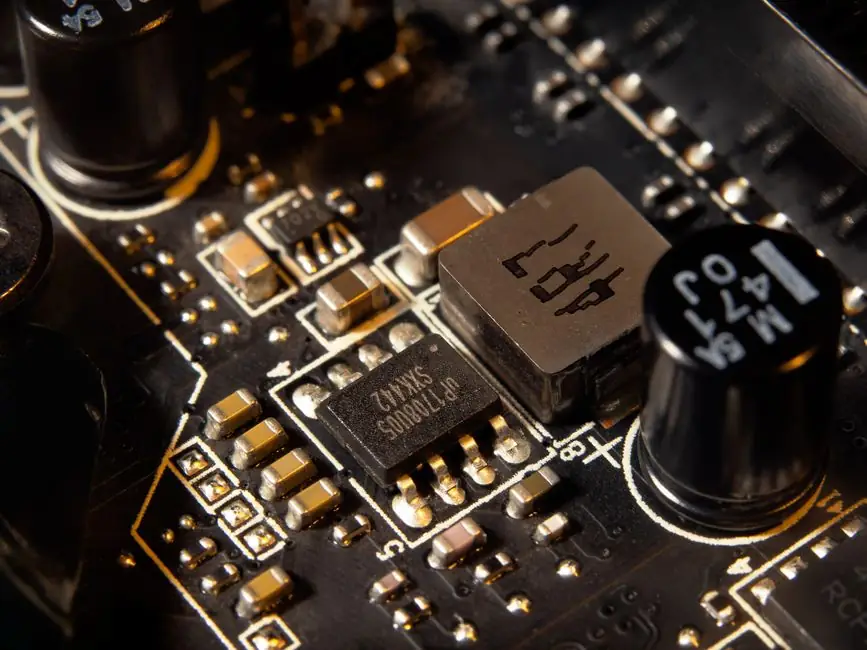
Reel-level traceability binds every pick on the placement machine to a feeder slot, reel lot, reference designator, board ID, timestamp, and vision offset, so a suspect lot resolves to specific serial numbers rather than an entire production lot [S2]. Board-level (lot-level) traceability ties a finished PCB to a common work order and material set, which is cheaper to implement but isolates a much wider population when a single component lot is in question [S5].
For industrial electronics bound by IEC 62443 and Machinery Directive 2006/42/EC, the lower bound is unit-level binding per board serial number, with at least 10 years of indexed retention against equipment lifetimes that commonly run 15 to 25 years [S2]. Buyers of safety-rated controls should treat reel-level binding as the default scope of enquiry, not as an upgrade option.
Definitions and the Three Practical Granularity Levels
PCB component traceability covers the ability to track and record the origin, history, location, and flow of every electronic component throughout raw material, manufacturing, assembly, and the final product [S1]. A practical taxonomy breaks that continuum into three binding depths used across the EMS industry today.
Level 1 (batch / lot-level) links a finished board to a work order, a common BOM revision, and the supplier lots that fed that work order; one batch may correspond to tens of thousands of boards, and the same material lot can flow across multiple work orders [S6][S5]. Level 2 (reel / tube / tray-level) assigns an internal identifier to each incoming package, then records the reel lot, feeder slot, and reference designator on every placement event [S6]. Level 3 (unit-level, also called board-level or per-board traceability) inscribes a unique serial number on each board at laser marking and uses that SN as the index key linking IQC lot, placement records, reflow profile, and inspection results into a single queryable record [S2][S5].
The 2D Data Matrix code is the dominant physical carrier for Level 3 because it survives a 260°C reflow profile and remains machine-readable on dense BGAs where 1D barcodes are not practical [S2]. The unit-level identifier is also the sole entry point for all post-delivery traceability requests, including field returns and regulator queries.
Where the Inspection Bindings Must Happen
Inspection data has to be written to the board SN at the moment of measurement, not archived in a separate quality system, otherwise the bidirectionality that makes reel-level traceability useful collapses during an audit [S2][S4]. Three nodes are the most frequently audited in industrial customer reviews, and each carries its own record schema.
At 3D SPI the system records paste volume per pad (mm³), area coverage (%), and offset (μm) together with any closed-loop feedback trigger events. At 3D AOI the disposition, defect images, and the re-inspection engineer ID are written to the board record. At X-ray the void percentage per joint is captured alongside the IPC-7095C threshold reference and the inspection program version, because a program version change is itself a process change that has to be traceable to specific serial numbers [S2].
At reflow, the board record holds actual peak temperature with ±2°C resolution, time above liquidus, and ramp rate, which is the primary manufacturing evidence in any solder joint reliability dispute [S2]. The data chain therefore runs IQC lot → placement pick → reflow profile → SPI/AOI/X-ray → laser-marked SN, with no aggregation at panel or batch level on any link.
Selection Criteria: Choosing Between Lot, Reel, and Unit-Level
Selection reduces to four decision criteria: regulatory exposure, recall cost asymmetry, equipment lifetime, and integration cost. The right answer is the lightest level that still survives a worst-case field investigation inside the regulator's expected response window. [S2]
Regulatory exposure: industrial equipment for IACS environments implicitly requires asset identification and change management under IEC 62443, and critical electrical subassemblies fall inside the technical file scope of Machinery Directive 2006/42/EC, so unit-level is a baseline legal obligation rather than a premium [S2]. Lot-level binding is sufficient for commercial assemblies without post-delivery traceability obligations, but it is not acceptable evidence in a regulated field failure review [S4].
Recall cost asymmetry: in the documented PLC backplane case, an EMS provider that could not produce reel-level binding data forced a 2,300-board preventive replacement across 18 months of deliveries, while component-level MES traceability would have resolved the affected population to 47 boards from a single shift, a six-figure cost delta at European field service rates [S2]. The asymmetry grows with fielded population and with regulator-required response time, so the higher the ratio of fielded units per shipped lot, the stronger the case for reel-level or finer binding.
Equipment lifetime: industrial electronics commonly run 15 to 25 years in service, with 10 years as the industry minimum data retention floor; safety-rated control systems typically require the full service life of the installed equipment [S2]. Storage cost at unit-level resolution over a 20-year horizon is the main counter-argument, and is the reason why buyers should specify retention windows per data class (IQC, process, inspection) rather than applying a single blanket period.
Data Density Comparison: Lot vs Reel vs Unit-Level
The table below lines the three binding depths against the four criteria that drive the level choice. The comparison is qualitative where the research gives a directional answer only, and numeric where the source supplies a concrete figure. [S1]
Regulatory defensibility: lot-level is generally inadequate under IEC 62443 / 2006/42/EC scope; reel-level is sufficient for batch-targeted containment; unit-level is the only level that supports per-SN recall inside a regulator response window [S2]. Recall scope resolution: lot-level can only narrow to a work order; reel-level narrows to a single reel lot within a work order; unit-level resolves to specific serial numbers, with the documented 2,300 → 47-board reduction as the reference case [S2]. MES implementation cost: lot-level requires BOM + work order binding, the cheapest path; reel-level requires per-pick binding at the placement machine, the dominant cost driver; unit-level adds laser marking, 2D code readers, and per-SN storage, which scales with shipped volume and retention years [S2][S4]. Data retention burden at a 20-year horizon: lot-level is the lightest; reel-level multiplies records by the number of picks per build; unit-level multiplies further by board count, which is why retention windows must be specified per data class [S2][S5].
Lot-level is therefore correct for commercial assemblies with no regulator exposure, reel-level is the working minimum for industrial buyers, and unit-level is the only level that maps a field-return SN to a complete, audit-defensible manufacturing record [S2][S5].
Real Use Cases From the Field
Automotive controllers: a thermal-stability defect in a voltage regulator chip on Production Line A, October 25, 2023, traced through MES from PCB serial number to SMT placement records to Tray Lot XC12345ABC supplied by Supplier Y in August 2023, which was used on 5,000 boards and potentially installed in 2,000 vehicles. Reel-level binding let the OEM isolate that tray lot in the warehouse and recall only the affected VIN range, instead of recalling all products from that period [S1]. This is the textbook containment case for Level 2 binding.
PLC backplanes: ESR drift in a capacitor population, where the absence of reel-level binding forced a 2,300-board preventive replacement, versus a 47-board targeted replacement had component-level MES records been available [S2]. The cost delta quantifies the value of Level 2 binding at industrial field service rates.
Commercial assemblies without regulator exposure: lot-level binding remains common, and is treated as adequate for consumer-grade products where the cost of a wider recall is lower than the implementation cost of per-pick logging [S4][S5]. The decision is explicitly program-by-program, not industry-wide.
Failure Modes and Buyer-Side Mistakes
The dominant buyer mistake is accepting a "full traceability" claim without asking what can actually be retrieved for one finished board and one material lot [S4]. A log that records supplier CoC at IQC but does not bind the reel lot to the placement event still resolves to a work order, not to a component, and that is the lot-level ceiling in disguise.
Common implementation gaps: per-pick records aggregated at panel or batch level rather than per-board; inspection results archived in a separate QMS keyed by date rather than by board SN; X-ray inspection program version changes not recorded against affected serial numbers, which makes the IPC-7095C void threshold unprovable later; and retention contracts shorter than the 15 to 25-year industrial service life [S2]. Each gap converts a reel-level system into a lot-level system in practice, even if the data is technically present.
Pre-quotation evidence to request: a sample board SN retrieved against a known supplier lot, a sample component lot retrieved against all SNs that consumed it, and inspection records bound to that SN with timestamp and program version [S4]. Without that round-trip, the system is not auditable.
Standards, Retention, and Inter-Article Cross-Reference

Two regulatory frameworks anchor the industrial electronics case for unit-level binding: IEC 62443 on asset identification and change management, and Machinery Directive 2006/42/EC on technical files for critical electrical subassemblies [S2]. The industry standard for traceability framework design is IPC-1782, which customers with more demanding requirements should reference explicitly in supplier specifications [S5]. IPC-7095C is the defect-classification reference used at X-ray inspection, and its threshold is part of the inspection record rather than a separate document [S2].
Data retention floor is 10 years across the industry, with 15 to 25 years as the typical industrial equipment service life, so retention contracts must be written against service life rather than the regulator minimum [S2]. Vision-system choices for the inspection nodes that feed the per-SN record (3D SPI, 3D AOI, X-ray) interact with the per-board binding requirement, and a relevant comparison of global and rolling shutter for in-line vision feeds directly into how cleanly the board ID is read at each inspection station.
For buyers balancing trace depth against MES integration cost, a selection matrix on enclosure and instrumentation form factors is a useful parallel: the same four-criterion logic (regulatory exposure, asymmetry of failure cost, lifetime, integration cost) applies to many industrial specification decisions, not just traceability scope. A structured risk-assessment workflow for new automation cells sits one layer upstream of traceability, defining which board populations a plant must be able to recall inside a regulator's response window.
Trackable signals to watch over the next reporting period: IPC-1782 revision updates and how MES vendors map them to reel-level data schemas; growing X-ray inspection program version audit findings against IEC 62443 reviews; and any disclosed reduction in average containment scope across the EMS industry as more placements move to per-pick logging [S2][S5].
Spec-level background on the components involved: control panel component, automatic level, and infrared level.